Discover how to future-proof your career in the age of AI. Learn which soft skills are irreplaceable and how to develop them for long-term professional success.
For decades, career advancement was largely predicated on technical proficiency. If you could code faster, calculate more accurately, or organize data more efficiently than your peers, you were indispensable. Today, we stand at the precipice of a fundamental shift in the professional landscape. Artificial Intelligence has not only entered the workforce; it has begun to master the technical hard skills that were once the gatekeepers of high-value employment.
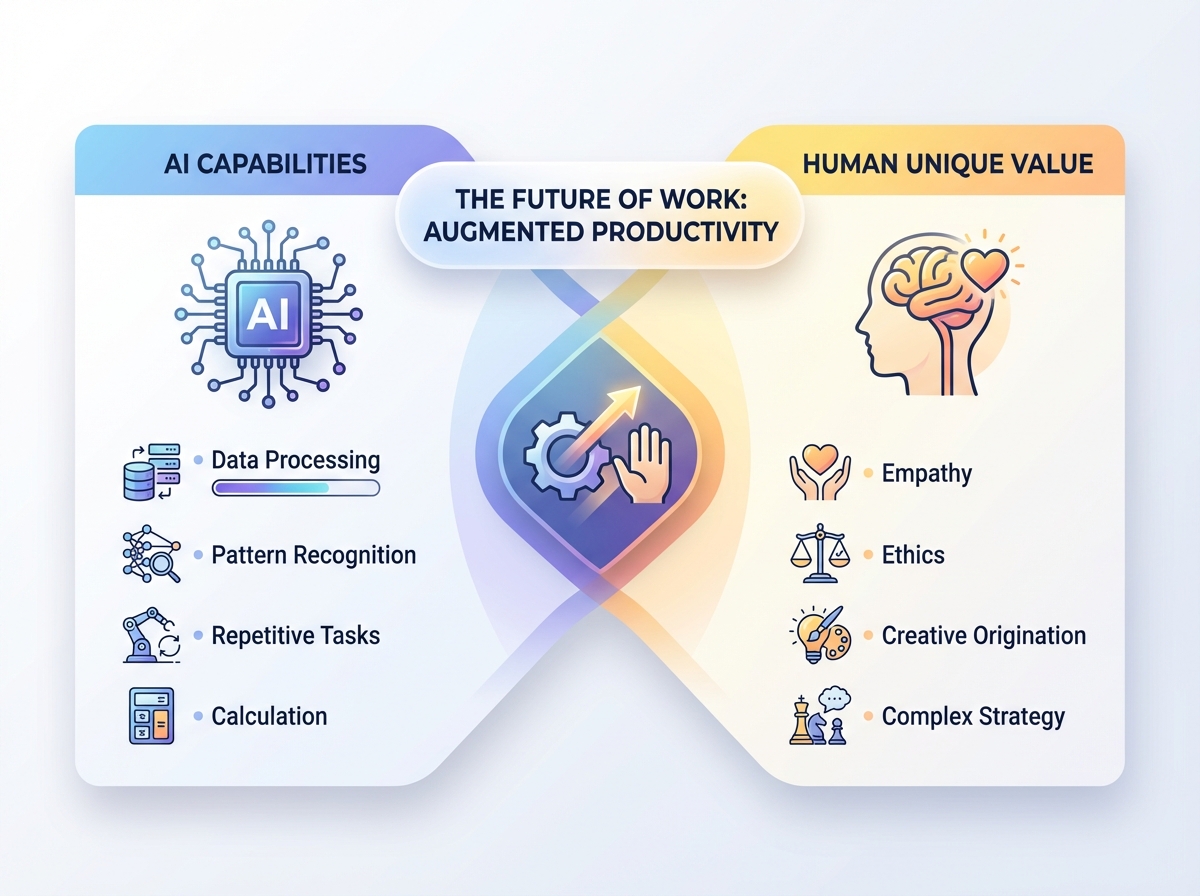
However, this is not a narrative of obsolescence. It is a narrative of evolution. As AI absorbs the cognitive load of repetitive, computational, and data-driven tasks, it clears the stage for the distinct capabilities that make us human. Future-proofing your career is no longer about competing with machines on their turf; it is about doubling down on the traits they cannot simulate.
To thrive in the coming decade, professionals must pivot from being "doers" of tasks to "orchestrators" of outcomes. This transition requires a deep investment in soft skills—interpersonal, cognitive, and emotional abilities that allow us to navigate ambiguity, inspire others, and make value-based decisions.
There is a concept in robotics and AI known as Moravec’s Paradox. It observes that high-level reasoning requires very little computation, but low-level sensorimotor skills require enormous computational resources. In a career context, this means that while AI can easily beat a grandmaster at chess or diagnose a rare disease based on data (high-level reasoning), it struggles immensely with the chaotic, unstructured nature of a human negotiation or the subtle emotional subtext of a team meeting.
This paradox is your competitive advantage. As algorithms commoditize technical execution, the value of "human" skills skyrockets. The scarcity principle applies here: as technical output becomes abundant and cheap, emotional and strategic input becomes rare and valuable.
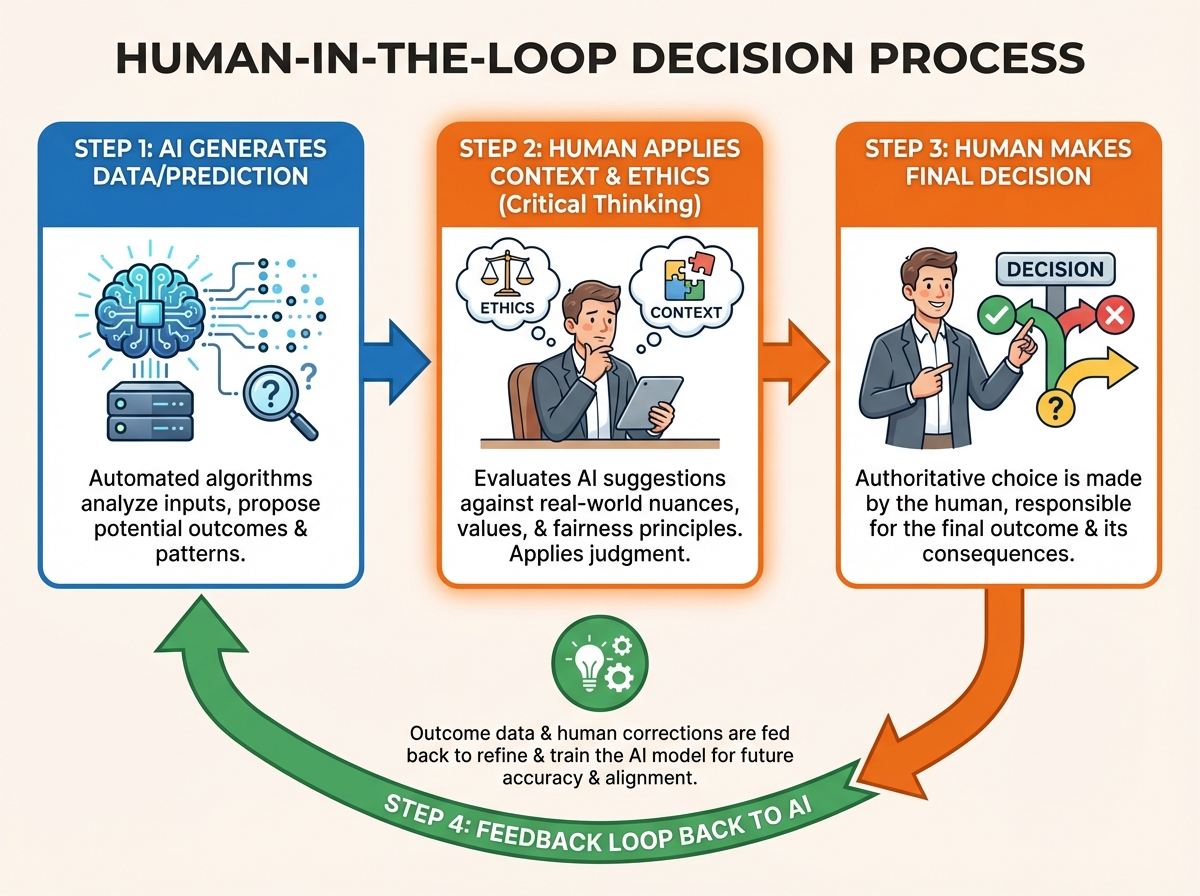
Even the most sophisticated AI models require a "human-in-the-loop." The AI provides the prediction; the human provides the judgment. Future-proofing your career means positioning yourself as that critical judgment layer. You become the editor, the ethical compass, and the creative director of the work produced by your digital counterparts.
> 💡 Master the Art of Strategic Oversight > > Shifting from execution to strategy requires new mental models. GPTnius AI Mentors, trained on proprietary research analyzing the frameworks of top strategic thinkers, can help you identify your blind spots and elevate your decision-making processes. > > Meet the AI mentors built from this research →
While AI can mimic language, it cannot mimic understanding. It can generate a sympathetic email, but it cannot feel empathy, read the tension in a room, or build genuine trust. Emotional Intelligence (EQ) is perhaps the most critical hedge against automation.
In a world where remote work and digital communication are ubiquitous, the ability to connect on a human level is premium. Leadership is not about managing workflows—software does that. Leadership is about managing energy, motivation, and burnout. An AI cannot look a burning-out employee in the eye and offer genuine compassion that alters their trajectory. It cannot sense the unspoken hesitation in a client’s voice that signals a deal is about to fall through.
Workplaces are complex social organisms. Success often depends on persuasion, coalition-building, and navigating unwritten rules. These dynamics are fluid and highly context-dependent, making them nearly impossible for current AI to navigate successfully. The ability to influence others without authority is a soft skill that yields hard results.
Generative AI is essentially a probability engine; it predicts the next likely word or pixel based on patterns in its training data. This makes it prone to "hallucinations"—plausible-sounding but factually incorrect information. This vulnerability underscores the vital need for human critical thinking.
In the AI era, you are no longer just a creator; you are a verifier. You must possess the critical thinking skills to interrogate the output of AI. Does this strategy actually make sense in our specific market context? Is this data biased? Is the tone appropriate for our brand voice? The ability to discern truth from probability is a skill that will define the credible professionals of the future.
AI is often siloed within the data it is fed. Humans, however, excel at cross-disciplinary thinking. We can draw a metaphor from biology to solve a problem in marketing, or apply a philosophy from architecture to software design. This "lateral thinking"—the ability to connect seemingly unrelated concepts to form a novel solution—remains a uniquely human stronghold.
If the only constant is change, then the most valuable skill is the ability to adapt. The tools you use today may be obsolete in six months. The workflow you perfected might be automated next year. Cognitive flexibility is the mental agility to unlearn old patterns and rapidly assimilate new ones.
Future-proofing requires you to become an expert at learning. This involves metacognition—thinking about how you think. It means understanding your own learning style and knowing how to rapidly upskill. Those who cling to "the way we've always done it" will be left behind, while those who view disruption as a catalyst for growth will lead.
AI struggles with ambiguity. It craves clear instructions and structured data. Real life, however, is messy. Projects have undefined scopes; markets behave irrationally. The ability to remain calm, focused, and productive in uncertain environments is a soft skill that provides stability to an organization. When the path isn't clear, humans must light the way.
AI operates on optimization functions. If you tell an AI to "maximize profit," it might suggest strategies that are legally gray or ethically compromised because it lacks a moral compass. It does not understand consequences beyond its programmed parameters.
Organizations will increasingly rely on humans to be the guardians of ethics. This involves asking questions that AI cannot: "Is this fair?" "Does this align with our company values?" "What is the societal impact of this decision?" As AI systems become more autonomous, the human responsibility to act as the ethical backstop becomes more profound. Professionals who can articulate and defend ethical frameworks will be essential in governance and strategy roles.
There is a distinction between generative capability and creative spark. AI iterates on existing data; it remixes what has already been done. True human creativity often comes from a place of intuition, personal experience, and emotional depth—sources that AI cannot access.
Peter Thiel’s concept of "Zero to One" refers to creating something entirely new, rather than just adding to what exists. While AI can help you go from 1 to n (scaling and iterating), humans are still the primary drivers of going from 0 to 1. Whether it is inventing a new product category or reimagining a business model, the spark of origination is human.
Understanding the importance of soft skills is the first step; actively training them is where the challenge lies. Unlike technical skills, you cannot simply read a manual to gain Emotional Intelligence or cognitive flexibility. These require practice, reflection, and feedback.
This is where GPTnius bridges the gap. GPTnius offers AI Mentors trained on proprietary research analyzing the published works, philosophies, and proven methodologies of thought leaders, including thinkers like Charlie Munger and James Clear. Our mentors do not impersonate anyone. They synthesize researched frameworks, such as mental models and habit systems, into personalized coaching conversations built around your specific goals.
Here is how you can use GPTnius to future-proof your career:
By leveraging these AI Mentors, you aren't just reading about soft skills; you are actively simulating and refining them in a safe, guided environment.
> 💡 Build Your Competitive Edge Today > > Don't wait for the industry to shift before you adapt. Use GPTnius AI Mentors to practice the critical soft skills—leadership, strategy, and adaptability—that will define the future of work. > > Meet the AI mentors built from this research →
The rise of AI is not a signal to surrender your career ambitions; it is a call to elevate them. By offloading the computational and repetitive tasks to machines, you are free to cultivate the deeply human skills that drive innovation, connection, and ethical progress. The future belongs to those who can partner with AI for efficiency while relying on their own humanity for impact. Start building those bridges today.
The most critical soft skills include Emotional Intelligence (EQ), critical thinking, adaptability (cognitive flexibility), ethical judgment, and complex problem-solving. These represent areas where human nuance surpasses current AI capabilities.
Yes. Platforms like GPTnius use AI Mentors to simulate conversations, role-play negotiation scenarios, and provide feedback based on proven methodologies, allowing you to practice and refine interpersonal skills in a safe environment.
While AI may simulate empathy or conversation, it lacks genuine understanding and shared human experience. Jobs requiring deep trust, complex negotiation, leadership, and ethical oversight are highly resistant to automation.