Stop pulling all-nighters. Discover the science of acing exams without cramming using AI-driven strategies, active recall, and personalized learning frameworks.
We have all been there: It is 3:00 AM, the desk is littered with empty energy drink cans, and you are frantically highlighting paragraphs you don't remember reading ten minutes ago. This is the ritual of cramming—a desperate attempt to shovel information into your brain hours before a test. While it might help you regurgitate facts the next morning, the science is clear: cramming leads to rapid forgetting and high anxiety.
But there is a better way. By combining proven cognitive science frameworks with the capabilities of Artificial Intelligence, you can transform your study habits from chaotic to strategic. Acing exams without cramming isn't about working harder; it is about leveraging systems that align with how your brain actually encodes memory.
This article outlines a comprehensive, AI-powered study plan designed to maximize retention, minimize stress, and ensure student success.
To build a better study plan, we must first understand the biological limitations of the human brain. Learning is not a passive process of absorption; it is an active process of encoding and consolidation.
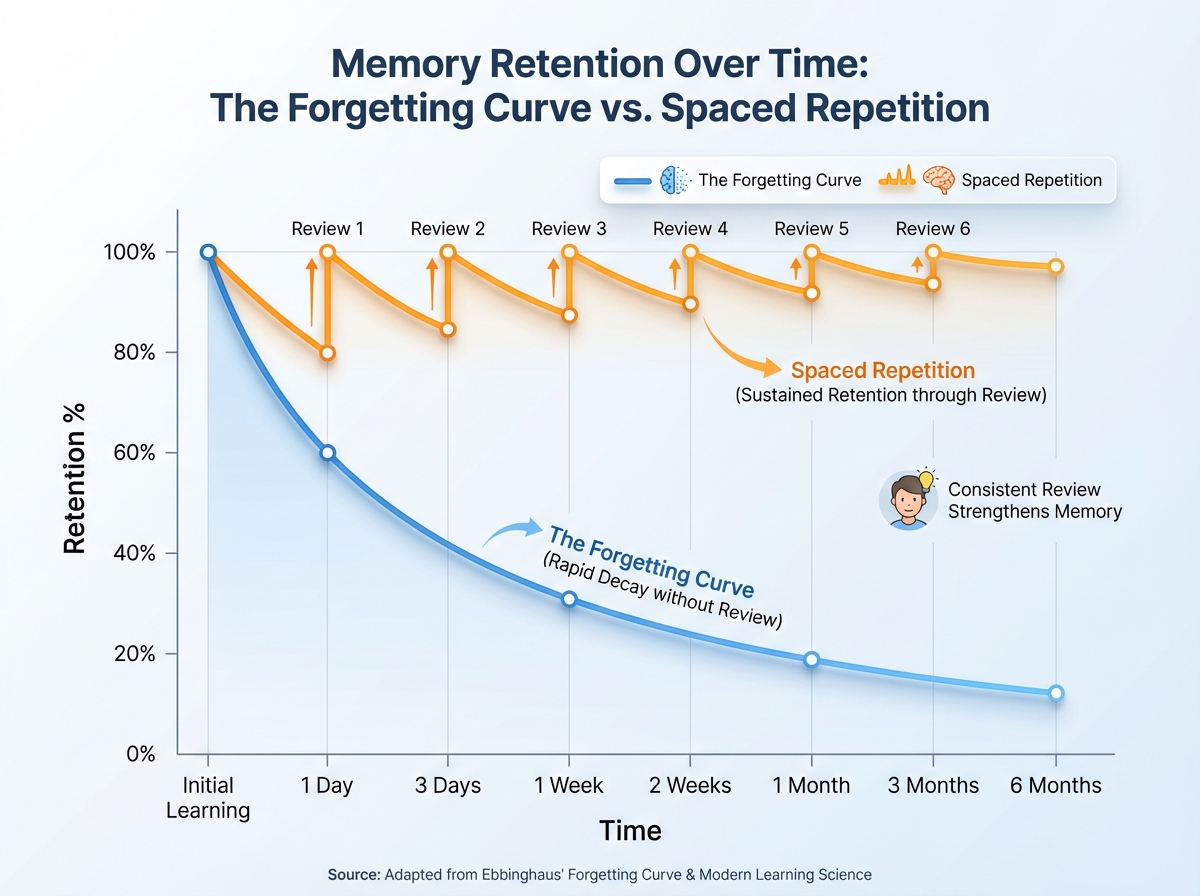
In the late 19th century, psychologist Hermann Ebbinghaus discovered the "Forgetting Curve." His research showed that humans forget approximately 50% of new information within an hour and up to 70% within 24 hours if no effort is made to retain it. Cramming relies on short-term memory, which is volatile and limited in capacity. Without reinforcement over time, that knowledge evaporates.
Your working memory has a finite capacity. When you cram, you overload this system, leading to cognitive fatigue. This makes it nearly impossible to form the deep neural connections required for complex understanding. Effective learning requires spacing out information so the brain has time to consolidate it during rest and sleep.
> 💡 Master Your Mental Models > > Struggling to structure your study time effectively? Our AI Mentors, trained on research into mental models and productivity systems, can help you build a schedule that respects your cognitive limits. > > Meet the AI mentors built from this research →
The antidote to cramming is planning. However, creating a study schedule is often overwhelming. This is where AI becomes your logistical architect.
Instead of staring at a massive textbook, use AI to break it down. You can feed your syllabus or course outline into an AI tool and ask it to categorize topics by high-yield and low-yield concepts. This is an application of the Pareto Principle (the 80/20 rule), suggesting that 80% of your exam results will come from 20% of the core concepts.
Actionable Prompt: "Here is my syllabus for [Subject]. Based on standard academic curricula, identify the top 20% of core concepts that are most likely to appear on the final exam. Outline a study hierarchy starting with these foundational topics."
Work backward from your exam date. If your exam is in four weeks, you need a schedule that incorporates review buffers. AI tools can generate detailed day-by-day itineraries that account for your specific constraints.
Actionable Prompt: "I have an exam on [Date]. I can study for 2 hours on weekdays and 4 hours on weekends. Create a study schedule that covers [List of Topics], utilizing the spaced repetition method. Include rest days and review blocks."
Passive review (re-reading notes) is the illusion of competence. You recognize the text, so you think you know it. To truly learn, you must retrieve information from your brain without assistance. This is called Active Recall.
Spaced Repetition involves reviewing material at increasing intervals: 1 day, 3 days, 1 week, 2 weeks, etc. This resets the Forgetting Curve just as the memory begins to fade, strengthening the neural pathway.
Creating flashcards takes time. AI can generate them instantly, allowing you to spend your energy on the actual studying.
Strategy: Paste a section of your notes into an AI tool and ask: "Generate 10 challenging active recall questions based on this text. Do not provide multiple choice answers; require me to explain the answer. Provide the correct answer in a hidden toggle or separate section."
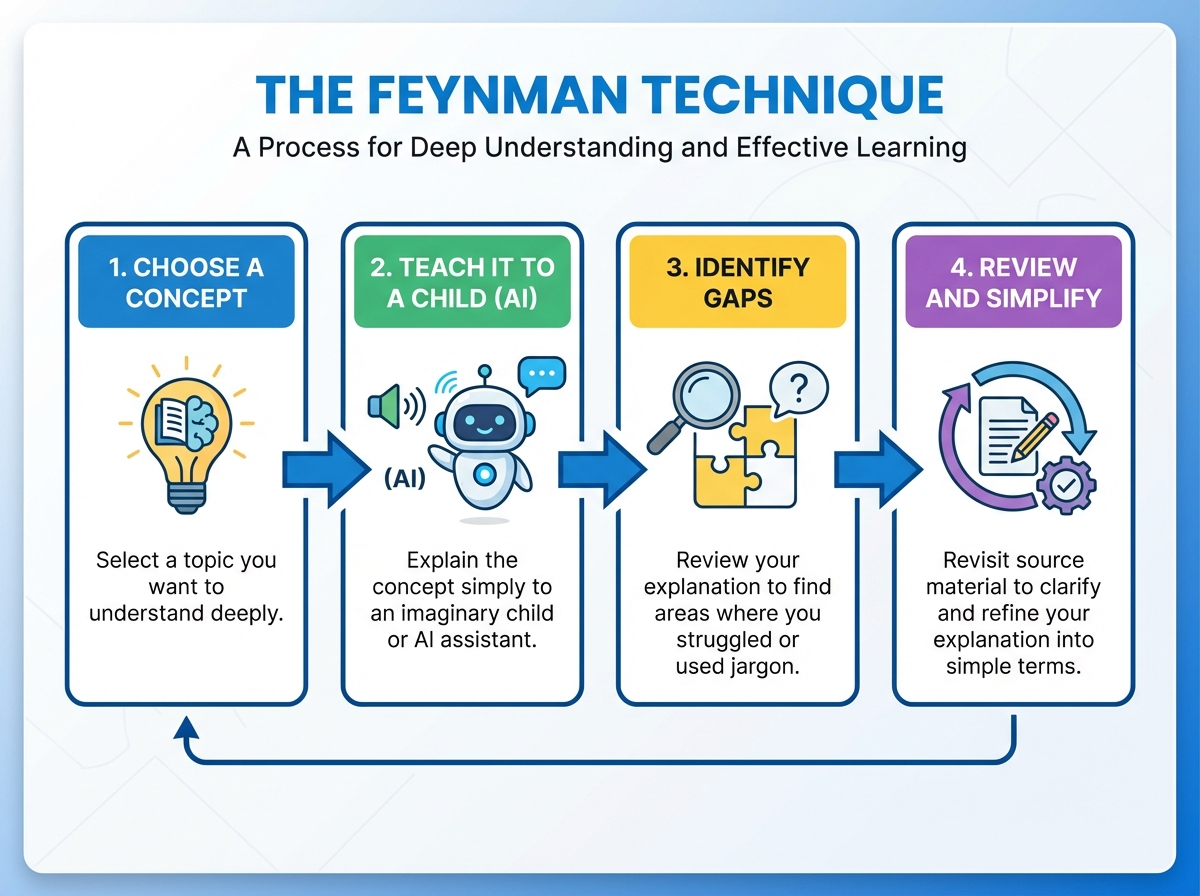
The Feynman Technique, named after physicist Richard Feynman, asserts that you do not understand a concept until you can explain it in simple terms to a novice. If you get stuck, you have identified a gap in your knowledge.
Traditionally, you would need a patient friend to listen to your explanations. Now, you can use an AI Mentor to play that role.
The Simulation: Tell the AI: "I am going to explain [Complex Concept] to you as if you are a 12-year-old student. Stop me if I use jargon I haven't defined, or if my logic doesn't follow. Ask me clarifying questions to test my understanding."
This forces you to simplify and clarify your thoughts. The AI's feedback loop identifies exactly where your grasp of the topic is shaky, allowing you to target your review precisely.
Acing exams without cramming also means taking care of the machine doing the learning: your brain.
Sleep is not a waste of time; it is when memory consolidation happens. During REM sleep, your brain processes the day's information and moves it from short-term to long-term storage. A study plan that cuts into sleep is counterproductive.
To maintain focus without burning out, use the Pomodoro Technique: 25 minutes of intense focus followed by a 5-minute break. After four cycles, take a longer break. This prevents cognitive load saturation.
While general AI tools can generate text, GPTnius offers AI Mentors trained on proprietary research analyzing the published works, philosophies, and proven methodologies of thought leaders, including thinkers like James Clear and Charlie Munger. Our mentors do not impersonate anyone. They synthesize researched frameworks, such as habit formation systems and mental models, into personalized coaching conversations built around your specific goals.
These mentors don't just give you answers; they help you build the systems required for academic success.
Here is how GPTnius facilitates your exam preparation:
> 💡 Build Your Ultimate Study System > > Stop guessing and start strategizing. Let our AI Mentors, trained on the world's best productivity and learning frameworks, guide you toward exam mastery. > > Meet the AI mentors built from this research →
Yes, absolutely. Research shows that spaced repetition and active recall are significantly more effective for long-term retention and exam performance than cramming. By starting early and using a strategic plan, you can achieve higher grades with less stress.
AI can act as a personal tutor by generating study schedules, creating active recall flashcards, summarizing complex texts, and simulating the Feynman Technique by testing your ability to explain concepts simply.
The combination of Active Recall (testing yourself) and Spaced Repetition (reviewing at increasing intervals) is widely considered the gold standard in cognitive science for retaining information.