Master the Zettelkasten Method to boost retention and creativity. Learn how to build a 'Second Brain' using AI notes for exam success and personal development.
In the digital age, students and lifelong learners face a paradox: we have access to infinite information, yet we often struggle to retain it. We read books, attend lectures, and highlight articles, only to find that weeks later, the specific insights have evaporated. This is known as the "Collector's Fallacy"—the mistaken belief that "collecting" information (saving a link, buying a book) is the same as acquiring knowledge.
To bridge the gap between consumption and creation, we need a system that mimics the way our brains actually work: through association and connection. Enter the Zettelkasten Method (German for "slip-box").
Originally popularized by the prolific sociologist Niklas Luhmann—who published 70 books and 400 articles using this system—the Zettelkasten is not just a filing cabinet. It is a dialogue partner, a creativity machine, and, when combined with modern artificial intelligence, the ultimate "Second Brain" for student success and personal development.
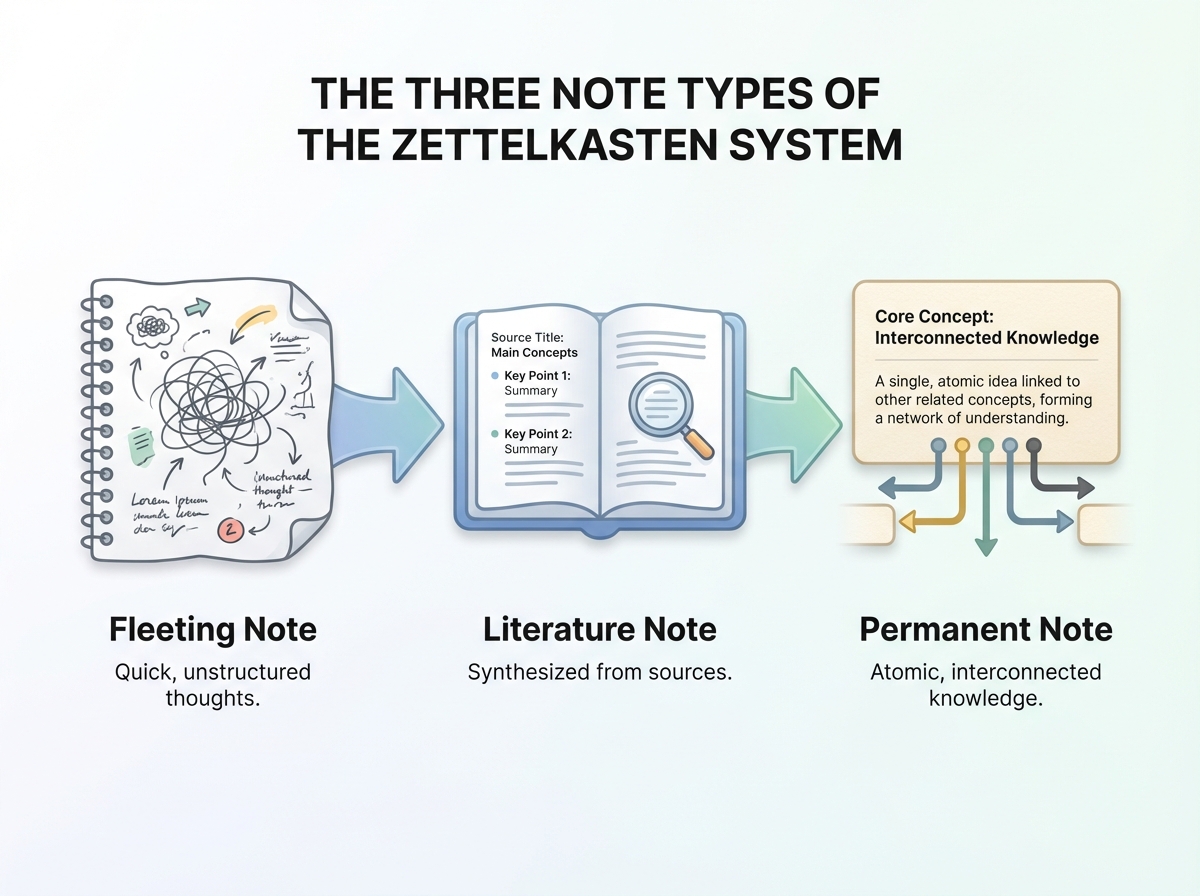
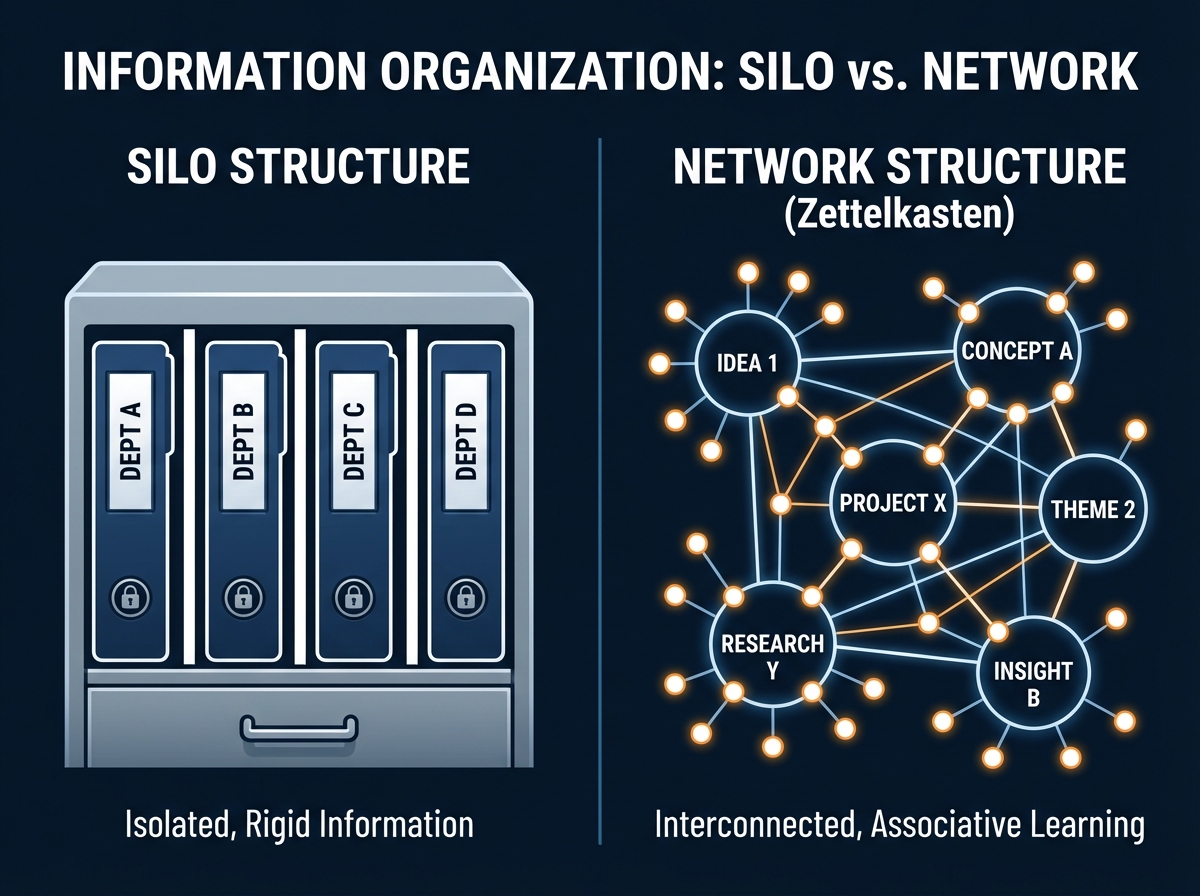
At its core, the Zettelkasten Method rejects the traditional, rigid hierarchy of folders and sub-folders. Instead, it relies on atomic notes linked together by context, much like neurons in a brain. To implement this effectively, you must understand the three distinct types of notes.
These are temporary reminders. They are the scribbles in the margin of a textbook, the voice memo recorded while walking, or the quick bullet point during a lecture. They are messy and unprocessed. Their only purpose is to capture an idea before it escapes.
The Rule: Process these within 24-48 hours, or discard them.
When you consume content (a book, a podcast, a research paper), you create Literature Notes. These are summaries of what the author said, written in your own words, with the bibliographic source attached.
The AI Advantage: Instead of passively copying quotes, you can use AI to help synthesize complex academic language into simpler terms, ensuring you truly understand the source material before writing it down.
This is the heart of the Zettelkasten. A Permanent Note is a single, atomic idea written in full sentences so that it is understandable without context. It is not just a summary of what you read; it is an elaboration of what you think about what you read.
These notes are then added to your "slip-box" and, crucially, linked to other related notes. Over time, these clusters of notes form critical mass around specific topics, essentially writing your essays or exam answers for you.
> 💡 Stop Hoarding, Start Connecting > > Struggling to turn your messy class notes into a cohesive study system? The "Architect" AI Mentor, trained on proprietary research analyzing James Clear’s habit systems and mental models, can guide you in structuring your daily note-taking habits for maximum retention. > > Meet the AI mentors built from this research →
Why does this method work so well for student success and exams? It leverages two powerful psychological principles: Elaboration and Retrieval Practice.
Traditional studying often involves rote memorization or re-reading, which are passive activities with low retention rates. The Zettelkasten forces you to translate information into your own words (Elaboration). You cannot create a valid Permanent Note without fully processing the concept.
Furthermore, the system relies on Associative Indexing. Our brains do not store memories in alphabetical order; they store them through associations. You remember "apple" when you see "red" or "pie." By manually linking notes (e.g., connecting a note on Supply and Demand to a note on The 2008 Housing Crisis), you create a neural pathway in your external brain. When you pull on one thread of information during an exam, the entire web of knowledge comes with it.
While Luhmann used wooden cabinets and index cards, today's students have a significant advantage: Artificial Intelligence. AI doesn't just digitize the Zettelkasten; it supercharges it. Here is how AI transforms the method from a chore into a superpower.
In a physical box, you might lose a note if you file it under the "wrong" category. AI-powered note-taking tools utilize vector embeddings and semantic search. This means the system understands the meaning of your note, not just the keywords.
If you write a note about "neuroplasticity," an AI-enabled system can instantly surface a note you wrote three months ago about "growth mindset," even if they share no common keywords. This reveals connections you might have missed, fostering the kind of lateral thinking required for high-level academic writing.
One of the hardest parts of the Zettelkasten method is writing the Permanent Note. You may stare at a blank screen wondering, "Does this matter?"
AI can act as a Socratic tutor. You can feed your Literature Notes into an LLM and ask:
This dialogue ensures your Permanent Notes are robust, multi-dimensional, and deeply understood.
Ready to build your Second Brain? Here is a practical workflow to integrate this method into your study routine.
Choose a capture tool that is frictionless. It could be a simple notes app or a voice recorder. The goal is speed. Do not worry about formatting here. If you are reading a PDF, use AI tools to highlight and extract key arguments automatically.
Set aside 30 minutes daily for "Gardening." This is where you convert Fleeting Notes into Permanent Notes.
Before you file the note, search your existing database. Ask yourself:
Link the new note to at least two existing notes. If you are using AI tools, review the "suggested connections" sidebar to find surprising links between different subjects.
Even with AI assistance, students often fall into specific traps when adopting the Zettelkasten method.
It is tempting to use AI to auto-summarize entire books and dump them into your database. Do not do this. If you do not read and process the information yourself, it is not knowledge; it is just data. The value of the Zettelkasten lies in the effort of linking and rewriting, not the storage volume.
Do not spend weeks researching the "perfect" app. Whether you use Obsidian, Notion, Roam Research, or simple index cards, the tool matters less than the methodology. Start simple. Complexity should only be added when the system demands it.
Building a Zettelkasten requires discipline and a shift in how you view learning. It is not just about memorizing; it is about thinking clearly. This is where GPTnius becomes an invaluable partner in your personal development journey.
GPTnius offers AI Mentors trained on proprietary research analyzing the published works and methodologies of world-renowned thought leaders. For example, our "Architect" mentor draws from research on frameworks like Charlie Munger’s mental models and James Clear’s habit formation systems.
Here is how a GPTnius AI Mentor can help you build your Second Brain:
> 💡 Turn Your Notes into Strategic Assets > > Don't let your hard work gather digital dust. Engage with GPTnius AI Mentors to synthesize your notes into actionable strategies and deep wisdom, using frameworks derived from the world's best thinkers. > > Meet the AI mentors built from this research →
The Zettelkasten Method is more than a note-taking strategy; it is a commitment to lifelong learning. By moving away from rigid folders and embracing a network of connected ideas, you mirror the organic structure of your own brain. When you augment this process with AI—using it to summarize, audit, and surface connections—you build a powerful engine for student success.
Remember, the goal is not to have the most notes. The goal is to have the best ideas. Start building your slip-box today, and watch your ability to think, write, and create reach new heights.
Standard note-taking usually organizes information hierarchically (by topic or date) which isolates ideas. The Zettelkasten Method organizes information associatively, linking atomic notes together like a web, which mimics how the brain connects memories and encourages creative insights.
You should not use AI to write the notes entirely, as the learning happens during the rewriting process. However, you can use AI to summarize long texts, suggest connections between notes, or quiz you on the material to ensure your notes are accurate.
Yes, it is excellent for exams. It utilizes 'active recall' and 'elaboration,' two of the most effective study techniques. By linking concepts together, you create a deeper understanding that makes retrieving information during an exam much easier.