Discover how AI flips Bloom's Taxonomy, allowing you to bypass rote memorization and jump straight to creation. A guide to accelerated learning in the AI age.
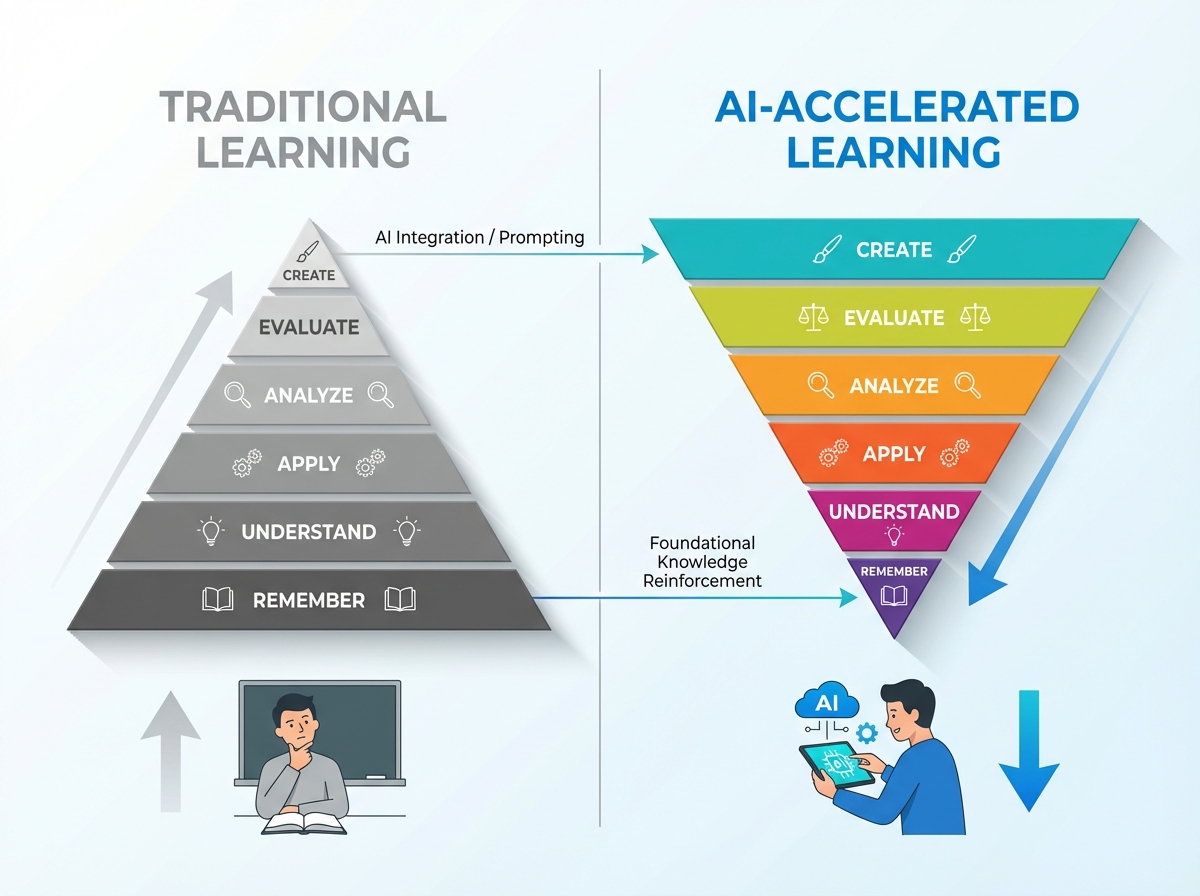
For decades, the educational landscape has been dominated by a rigid hierarchy known as Bloom’s Taxonomy. Introduced in 1956 and revised in 2001, this framework categorized educational goals into six major levels, usually depicted as a pyramid. At the wide base sat Remembering and Understanding. Only after mastering these foundational layers were students supposedly ready to move up to Applying, Analyzing, Evaluating, and finally, at the very peak, Creating.
This structure implies a linear, time-consuming journey. It suggests that you must spend months memorizing vocabulary before you can speak a language, or years studying syntax before you build an application. While logical in a pre-digital era, this bottom-up approach is fundamentally at odds with how human motivation works—and completely obsolete in the age of Artificial Intelligence.
Today, we are witnessing Bloom’s Taxonomy Reimagined. AI has not just accelerated learning; it has inverted the pyramid. By offloading the lower-order cognitive tasks (remembering facts, understanding basic syntax) to AI, learners can now begin their journey at the Creation stage. This shift unlocks a powerful new methodology for accelerated learning and personal development, allowing you to build, innovate, and solve problems from Day One.
To understand the magnitude of this shift, we must first look at the constraints of the traditional model. In standard education, the cognitive load required to reach the "Creation" phase is immense. If you wanted to write a symphony, you first had to learn music theory, notation, and instrumentation. By the time you reached the creative phase, months or years had passed, often leading to burnout or loss of interest.
The AI-Inverted Model flips this script. Here is the new hierarchy of accelerated learning:
This inversion creates a "high-velocity feedback loop." Instead of learning in a vacuum, you learn in the context of solving a specific problem. Psychology tells us that context-dependent memory is far stickier than rote memorization. When you learn a fact because you need it to fix a project you care about, retention skyrockets.
> 💡 Accelerate Your Growth by Starting at the Top > > Stop getting stuck in the 'learning trap' of endless theory. GPTnius AI Mentors, trained on proprietary research into the world's best mental models, can help you jump straight into strategic application and creation. > > Meet the AI mentors built from this research →
In the reimagined taxonomy, AI acts as a scaffold that supports you at the highest level of cognitive function before you have fully mastered the basics. This is distinct from "cheating"; it is about managing cognitive load to focus on strategy rather than syntax.
Whether you are learning to code, write legal briefs, or design marketing strategies, the blank page is the enemy of speed. AI removes the blank page.
This approach leverages the "Zone of Proximal Development" (Vygotsky). AI pushes you slightly beyond what you can do alone, allowing you to operate at a professional level while you are still learning the ropes. The motivation derived from seeing immediate results releases dopamine, which in turn fuels the persistence required for deep learning.
If AI handles the heavy lifting of creation and rote memory, what is left for the human learner? The answer lies in the middle of the taxonomy: Evaluation and Analysis.
This is where the "Reimagined" aspect becomes critical. In an AI world, the value of a human is not in knowing the answer, but in knowing how to judge the answer. Your role shifts from generator to curator.
To learn effectively with AI, you must cultivate "Taste." If an AI writes a piece of code, does it follow security best practices? If it writes a marketing email, is the tone empathetic or robotic?
In the traditional model, you memorized facts just in case you might need them (Just-in-Case learning). In the AI era, you learn facts only when the creation process demands it (Just-in-Time learning).
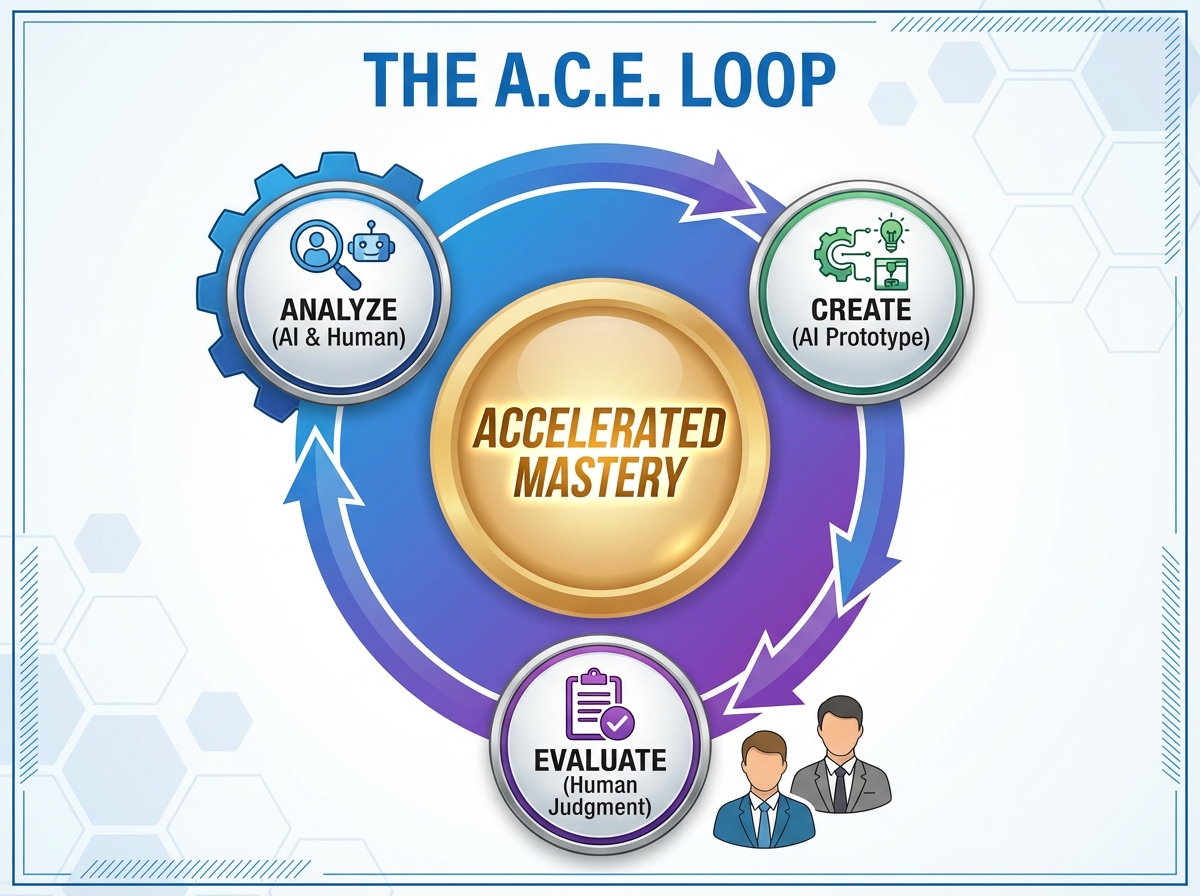
This is the final step of our inverted pyramid. Once you have Created a prototype and Evaluated its flaws, you descend to the level of Understanding to fix it.
For example, if you generate a financial model and the AI hallucinates a formula, you are forced to dive into the documentation (Understanding) to correct it. You are now learning the formula not because a teacher told you to, but because your creation is broken. This creates a neural hook—an emotional and practical connection to the information—that makes it nearly impossible to forget.
Not entirely. We still need a mental database of concepts to function. However, the nature of what we memorize must change. We no longer need to memorize:
Instead, we must memorize:
To apply Bloom’s Taxonomy Reimagined in your personal development plan, follow this 4-step loop for any new skill you wish to acquire:
Applying this inverted learning model requires more than just a generic chatbot; it requires a mentor that can guide your evaluation and analysis. This is where GPTnius excels.
GPTnius offers AI Mentors trained on proprietary research analyzing the published works, philosophies, and proven methodologies of thought leaders, including thinkers like Charlie Munger and James Clear. Our mentors do not impersonate anyone. They synthesize researched frameworks, such as mental models and habit systems, into personalized coaching conversations built around your specific goals.
If you are trying to apply the "Evaluation" phase of the new Bloom's Taxonomy to a business decision, a mentor helps you challenge your assumptions, analyze the second-order effects of your decisions, and refine your mental models.
By engaging in guided discussions with these specialized mentors, you ensure that you aren't just "using AI" to do the work for you, but using it to sharpen your own critical thinking and strategic capabilities.
> 💡 Master the Art of Strategic Thinking > > Don't just learn faster—learn smarter. Use GPTnius AI Mentors to analyze your ideas through the lens of proven frameworks and elevate your decision-making skills today. > > Meet the AI mentors built from this research →
The era of linear, rote learning is over. By reimagining Bloom's Taxonomy, we unlock a faster, more engaging path to mastery. The goal is no longer to store information in our brains like a hard drive, but to process information like a processor. By starting with Creation and using AI as a partner in Evaluation and Analysis, we can acquire skills at a pace previously thought impossible. The tools are ready; the pyramid has been flipped. The only remaining question is: What will you create today?
Traditional Bloom's Taxonomy is a linear pyramid starting with remembering and ending with creation. The reimagined AI version inverts this, using AI to handle memory and basic understanding, allowing learners to start with creation and evaluation immediately.
No, if used correctly. By using AI to prototype (create), learners are forced to evaluate and analyze the output. This shifts the focus from rote memorization to high-level critical thinking and pattern recognition.
Use AI as a Socratic debate partner. Ask it to challenge your assumptions, provide counter-arguments to your ideas, or analyze the logic behind a specific decision. This forces you to defend and refine your thinking.