Master the art of rapid skill acquisition with Meta-Learning Strategies 2025. Discover how to combine cognitive science and AI to learn hard things fast.
The ability to learn faster is no longer a luxury; in the rapidly shifting landscape of 2025, it is a survival mechanism. The half-life of a learned professional skill has dropped to just five years, meaning much of what you know today will be obsolete by 2030. To stay ahead, you cannot simply learn more; you must learn better.
This is the domain of Meta-Learning—literally, "learning how to learn."
Traditionally, learning was viewed as a linear path: attend a lecture, read a book, take a test. Today, the most effective learners operate like architects. They survey the landscape, deconstruct the necessary skills, and build a customized scaffolding to bridge the gap between ignorance and competence. With the advent of advanced AI tools, this process has been supercharged. We now have the capacity to simulate the mentorship dynamics of history's greatest thinkers, allowing us to absorb complex information at unprecedented speeds.
This guide covers the essential Meta-Learning Strategies for 2025, blending timeless cognitive science with cutting-edge AI applications to help you master hard things fast.
Before diving into specific tactics, we must understand the strategy. Rapid skill acquisition is not about speed-reading; it is about structural efficiency. It relies on identifying the high-leverage concepts that yield the greatest results.
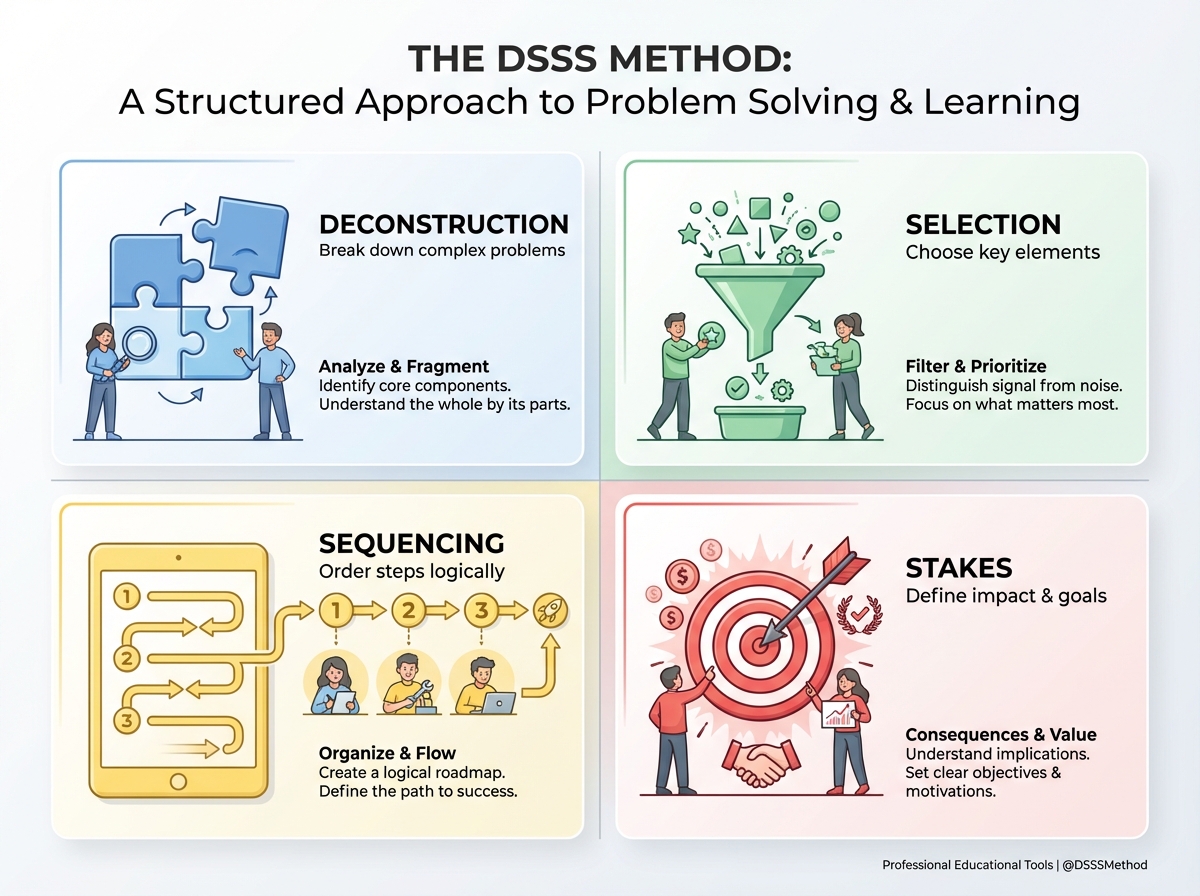
Most people fail to learn hard things because they are intimidated by the size of the task. Learning "Mandarin" or "Quantum Computing" feels impossible. The first step of meta-learning is deconstruction—breaking a complex skill down into its smallest manageable components.
In 2025, we don't just guess at these components. We use data to identify them. If you want to learn a language, you don't start with obscure grammar rules; you identify the 1,000 words that make up 85% of daily conversation. If you are learning coding, you focus on the syntax patterns used in the most common libraries.
Once a skill is deconstructed, you must apply the Pareto Principle: 20% of the sub-skills will provide 80% of the desired outcomes. The goal of accelerated learning is not perfection; it is functional competence. By ruthlessly eliminating the non-essential 80% of the material, you free up cognitive resources to master the core 20% deeply.
The order in which you learn matters. Many standard curriculums are designed for academic thoroughness, not rapid acquisition. In a meta-learning context, you should sequence learning to maximize early wins. This prevents the "valley of despair"—that moment when the initial enthusiasm fades, and the difficulty spikes.
> 💡 Structure Your Learning Path with Expert Logic > > Struggling to break down a complex topic? GPTnius AI Mentors, trained on proprietary research analyzing the frameworks of the world's best systems thinkers, can help you deconstruct any skill into a step-by-step roadmap. > > Meet the AI mentors built from this research →
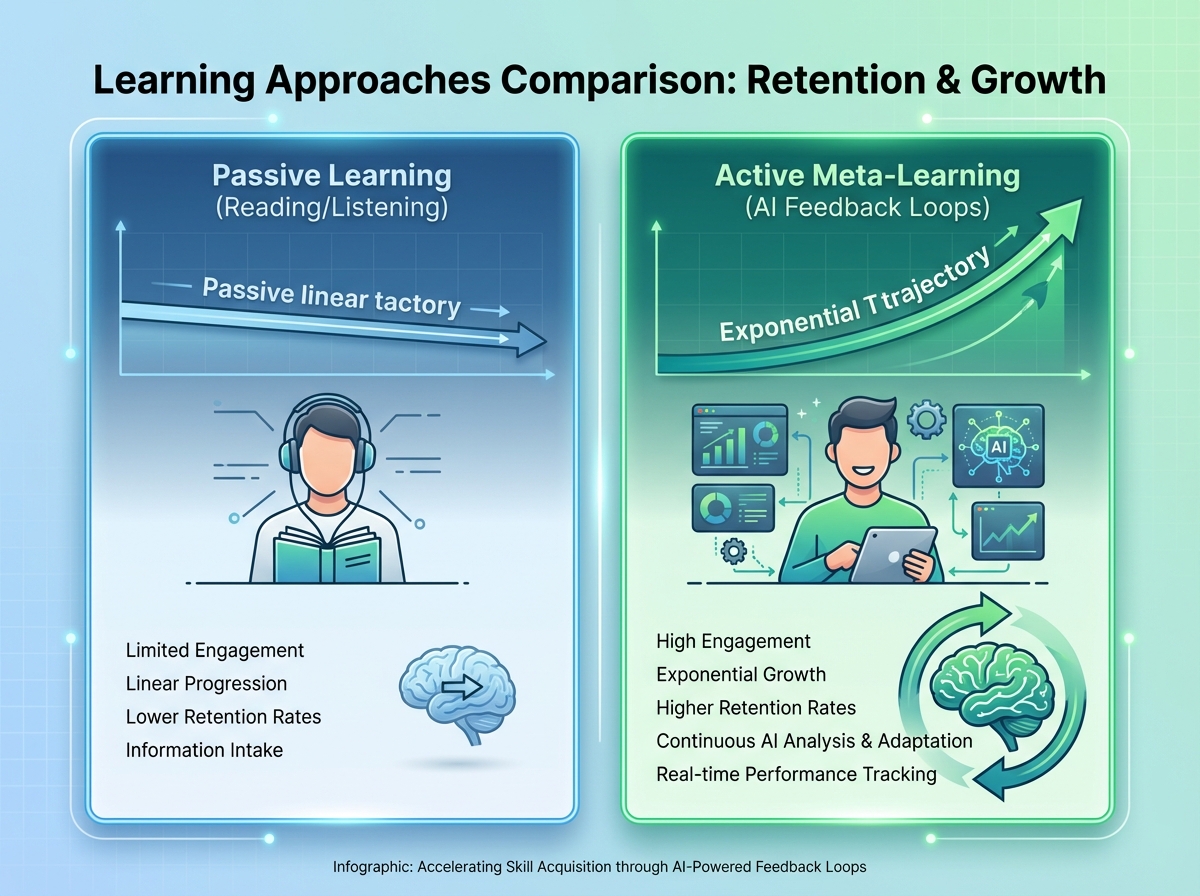
While the philosophy of meta-learning remains constant, the tools have changed. In 2025, we are moving away from passive consumption toward Algorithmic Active Recall.
Rereading notes is one of the least effective ways to learn, yet it remains the most common. It creates the "illusion of competence"—you recognize the text, so you think you know the concept. You don't.
True learning happens during retrieval. You must force your brain to pull information out, not just stuff it in. This is where AI becomes a game-changer. Instead of static flashcards, AI-driven conversations can quiz you on concepts dynamically, forcing you to explain ideas in your own words. This utilizes the Generation Effect, which states that information is better remembered if it is generated from one's own mind rather than simply read.
Spaced repetition is the technique of reviewing material at increasing intervals—just as you are about to forget it. In 2025, SRS has evolved beyond simple vocabulary apps. We now apply SRS to conceptual frameworks.
Imagine trying to learn a mental model like "Inversion." An AI mentor can present you with a business problem today and ask you to solve it using Inversion. Three days later, it presents a personal finance dilemma requiring the same model. Ten days later, an engineering problem. This interleaving of contexts solidifies the mental model far better than massed practice (cramming).
The Feynman Technique is a legendary method for ensuring understanding: explain a concept in simple terms, as if teaching it to a sixth-grader. If you get stuck, you have identified a gap in your knowledge.
In the past, this required a patient friend or a rubber duck. Today, AI serves as the ultimate Socratic partner.
This loop provides immediate feedback, correcting misconceptions before they calcify in your long-term memory.
We often treat learning as a purely intellectual pursuit, ignoring the emotional component. However, the limbic system (emotional brain) acts as a gatekeeper to the neocortex (thinking brain). If you are frustrated, bored, or anxious, the gate closes.
"Hard things" are hard because they impose a high cognitive load. When your working memory is overwhelmed, learning stops. Meta-learning strategies in 2025 emphasize Micro-Learning—short, intense bursts of focus (25-45 minutes) followed by genuine rest.
This aligns with the Ultradian Rhythms of the human body. Pushing past 90 minutes of intense focus usually results in diminishing returns.
Without stakes, focus drifts. One effective strategy is to create artificial stakes. Commit to a public project, a presentation, or a tangible output. When the brain knows the information will be used immediately, it tags that data as "survival critical," increasing retention rates significantly.
Theory is useless without application. While you can attempt to build these meta-learning structures yourself, the process is time-consuming. GPTnius offers a streamlined solution through AI Mentors that have been trained on proprietary research analyzing the published works, philosophies, and proven methodologies of thought leaders.
Here is how GPTnius accelerates your meta-learning journey:
By engaging in guided discussions with these AI Mentors, you aren't just chatting with a bot; you are simulating a coaching conversation with a mentor grounded in the world's most effective thinking strategies.
> 💡 Accelerate Your Learning Curve Today > > Don't waste time trying to figure out how to learn. Let GPTnius AI Mentors guide you through the research-backed frameworks of the world's top thinkers to master any subject faster. > > Meet the AI mentors built from this research →
Meta-learning is the process of 'learning how to learn.' In 2025, this involves using AI tools and cognitive science principles to deconstruct complex skills, optimize study schedules via algorithms, and utilize active recall to reduce the time required for mastery.
AI accelerates learning by acting as a personalized tutor. It can generate analogies, quiz you to facilitate active recall, identify gaps in your logic (like the Feynman Technique), and create customized learning roadmaps based on the Pareto Principle (80/20 rule).
Yes. The Pareto Principle suggests that 20% of the sub-skills contribute to 80% of the functional results. In technical fields like coding or languages, focusing on the most frequently used syntax or vocabulary first allows for rapid functional competence.