Discover how David Goggins' 40% Rule can help you overcome mental barriers. Learn practical steps to push past your limits in work, life, and fitness.
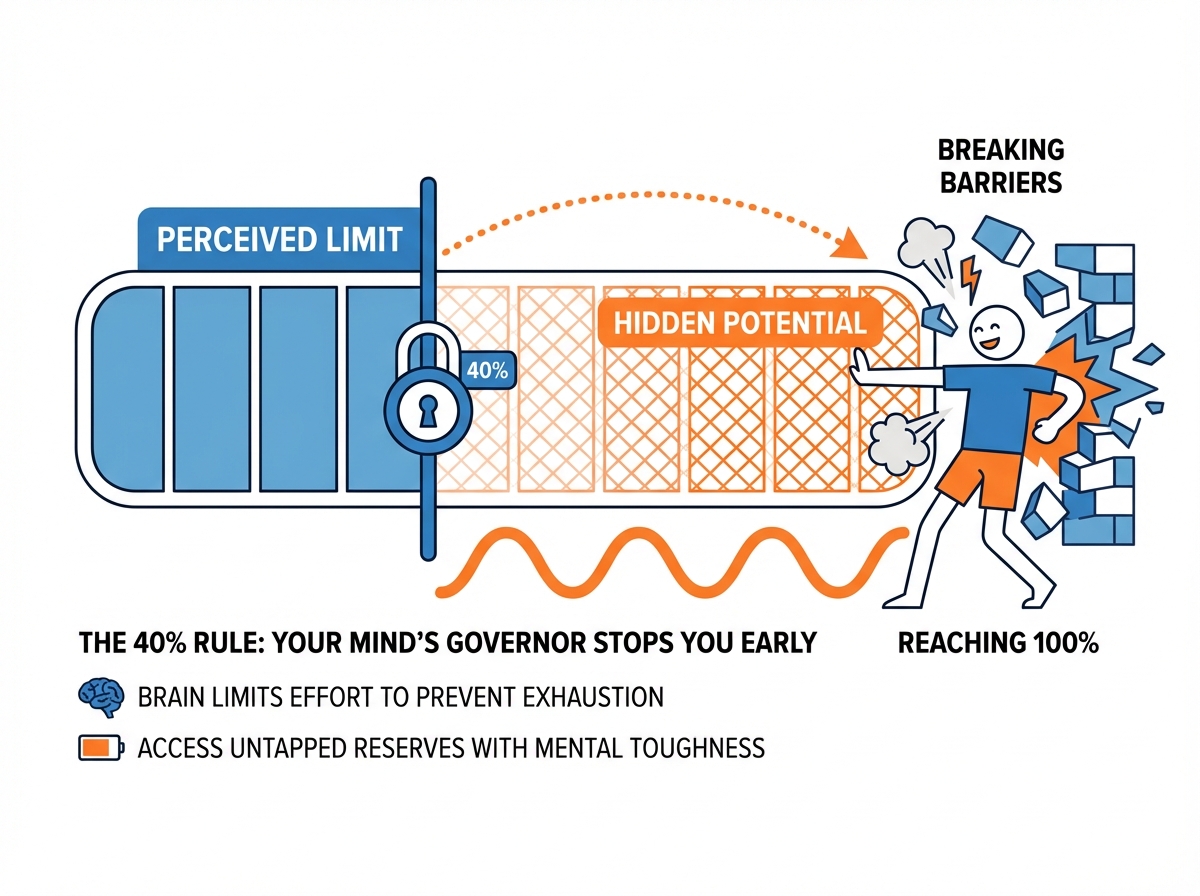
The 40% Rule is a concept popularized by Navy SEAL and ultra-endurance athlete David Goggins. It states that when your mind tells you that you are completely exhausted and cannot go one step further, you have actually only tapped into about 40% of your body's capability. The remaining 60% is hidden behind a mental barrier—a "governor"—designed to protect you from suffering. By learning to override this governor, you can achieve results in business, fitness, and personal growth that previously seemed impossible.
---
We have all felt it. That moment during a late-night work session, a difficult run, or a complex problem-solving task where your brain screams, "Enough." You feel drained, your focus fractures, and the temptation to quit becomes overwhelming. You believe you have hit your absolute limit.
According to the 40% Rule, that feeling is a lie.
This concept, a cornerstone of mental toughness frameworks often associated with David Goggins, suggests that what we perceive as our maximum capacity is actually a safety mechanism. This article explores the science behind the rule, how to safely apply it to everyday challenges, and how to restructure your mindset to access your hidden reserves.
To understand the 40% rule, you have to understand the brain's primary function: survival. Your brain is not wired for greatness; it is wired for preservation. It seeks comfort, energy conservation, and safety.
Imagine a high-performance sports car. The engine is capable of reaching 200 miles per hour. However, the manufacturer installs a device called a governor. This electronic limiter cuts the fuel supply when the car hits 110 mph to prevent the engine from overheating or the driver from losing control. The car can go faster, but the software won't let it.
Your brain is that governor. When you experience discomfort—whether it is physical pain during a workout or mental fatigue during a project—your brain sends stress signals (cortisol and adrenaline) urging you to stop. It creates a false ceiling to ensure you keep a massive reserve of energy for emergency survival.
Most people live their entire lives within this 40% buffer zone. We mistake the first sign of discomfort for our maximum limit. The 40% Rule is the realization that this signal is merely a warning light, not a stop sign. It is the point where the real work begins.
> 💡 Master Your Mental Governor > > Your brain naturally seeks the path of least resistance, often signaling you to quit long before your true capacity is reached. GPTnius AI Mentors, trained on research into elite mental toughness frameworks and cognitive restructuring, can help you distinguish between actual failure and mental fatigue. > > Meet the AI mentors built from this research →
While the 40% Rule originated in the grueling context of Navy SEAL training and ultra-marathons, its most powerful applications often occur in the boardroom, the classroom, and daily life. Here is how to translate this extreme philosophy into practical success.
In a professional setting, the "wall" usually manifests as burnout, procrastination, or the refusal to tackle deep work. You might stare at a spreadsheet or a blank page and feel you cannot write another word.
Applying the Rule:
Relationships require patience, empathy, and difficult conversations. Often, we withdraw emotionally when things get uncomfortable. We say, "I don't have the energy for this argument right now."
Applying the Rule:
Learning a new language or skill is mentally exhausting. The brain consumes 20% of the body's energy, and intense focus burns glucose rapidly.
Applying the Rule:
Knowing the rule exists is different from living it. Here is a tactical approach to pushing past your limits safely.
Just as lifting weights creates calluses on your hands, doing things you hate creates calluses on your mind. You cannot develop mental toughness in a comfortable environment.
This is another concept often linked to Goggins' philosophy. When you hit the wall, you need a source of fuel.
Do not try to jump from 40% to 100% overnight. That leads to injury or total burnout.
While the 40% Rule is empowering, it requires discernment. There is a difference between mental fatigue and actual damage.
Reading about mental toughness is passive; applying it requires a strategy. GPTnius offers AI Mentors that have been trained on proprietary research analyzing the published works, philosophies, and proven methodologies of thought leaders in resilience and performance psychology.
For example, you can engage with an AI Mentor designed to synthesize research on mental fortitude frameworks similar to those used by David Goggins, combined with James Clear’s habit formation strategies. Here is how these mentors assist you:
By turning abstract principles into a personalized dialogue, GPTnius helps you systematically dismantle your self-imposed limitations.
> 💡 Unlock Your Full Potential Today > > Don't let your mental governor dictate your limits. Partner with a GPTnius AI Mentor to apply the 40% Rule to your specific goals, track your progress, and break through the barriers holding you back. > > Meet the AI mentors built from this research →
While the specific '40%' figure is anecdotal, the underlying concept is supported by the Central Governor Theory in sports science. This theory suggests the brain induces fatigue to protect the body from damage long before physiological failure actually occurs.
The key is distinguishing between 'good pain' (discomfort, burning muscles, mental desire to quit) and 'bad pain' (sharp, shooting pain, dizziness, or structural failure). The 40% rule applies to the former; never push through acute injury.
Absolutely. In a professional context, the 40% rule helps overcome procrastination, fear of failure, and the mental fatigue that sets in during deep work. It is about building the discipline to focus when you would rather be distracted.