Discover how Marcus Aurelius' Meditations applies to modern challenges. Learn actionable Stoic practices to manage stress, build resilience, and find clarity.
Stoicism isn't just ancient history; it is a practical toolkit for navigating the chaos of the digital age. This article explores key insights from Marcus Aurelius' Meditations, offering actionable frameworks like the Dichotomy of Control and Negative Visualization to help you build resilience and focus. Learn how AI mentorship can help you apply these philosophical principles to your daily life.
---
In an era defined by relentless notifications, algorithmic outrage, and the pressure to be constantly "on," the private journal of a Roman Emperor who died nearly 2,000 years ago has become an unlikely bestseller. Marcus Aurelius, the last of the "Five Good Emperors," wrote Meditations not for an audience, but for himself—as a means to maintain his sanity and moral compass while leading the most powerful empire on earth through plague, war, and political betrayal.
Today, Meditations is more than a historical artifact; it is a survival guide for the 21st century. The resurgence of Stoic philosophy in modern life speaks to a collective craving for stability in an unstable world. We may not command legions or govern Rome, but we battle our own wars against distraction, anxiety, and the fear of missing out.
This guide explores how to strip away the toga and apply the core tenets of Marcus Aurelius' Meditations to your Slack channels, your commute, and your long-term goals. It moves beyond theory to offer practical Stoic practices that turn ancient wisdom into modern muscle memory.
It is easy to dismiss philosophy as an academic pursuit reserved for dusty lecture halls. However, Stoicism was designed for action. It was built for the marketplace, the battlefield, and the forum. Marcus Aurelius wrote his notes while on campaign, often in the damp, cold tents of the Germanic front. He dealt with a plague that wiped out millions, a brother who co-ruled with incompetence, and the immense weight of absolute power.
When we read Meditations, we aren't reading a sermon; we are reading a man coaching himself to be better. He writes things like, "When you wake up in the morning, tell yourself: The people I deal with today will be meddling, ungrateful, arrogant, dishonest, jealous, and surly." This isn't pessimism; it's preparation.
The challenges have changed form, but not substance. The "meddling and ungrateful" people of Rome are now the trolls in comment sections or difficult stakeholders in a project meeting. The plague is a global pandemic or a computer virus. The anxiety of fate is now the anxiety of the economy.
Ancient wisdom today serves as an anchor. It reminds us that human nature hasn't changed. If Marcus could find stillness while ruling an empire on the brink of collapse, we can find stillness while navigating a chaotic inbox. The philosophy offers a framework for emotional regulation, clear thinking, and ethical leadership that is desperately needed in our hyper-connected, reactive society.
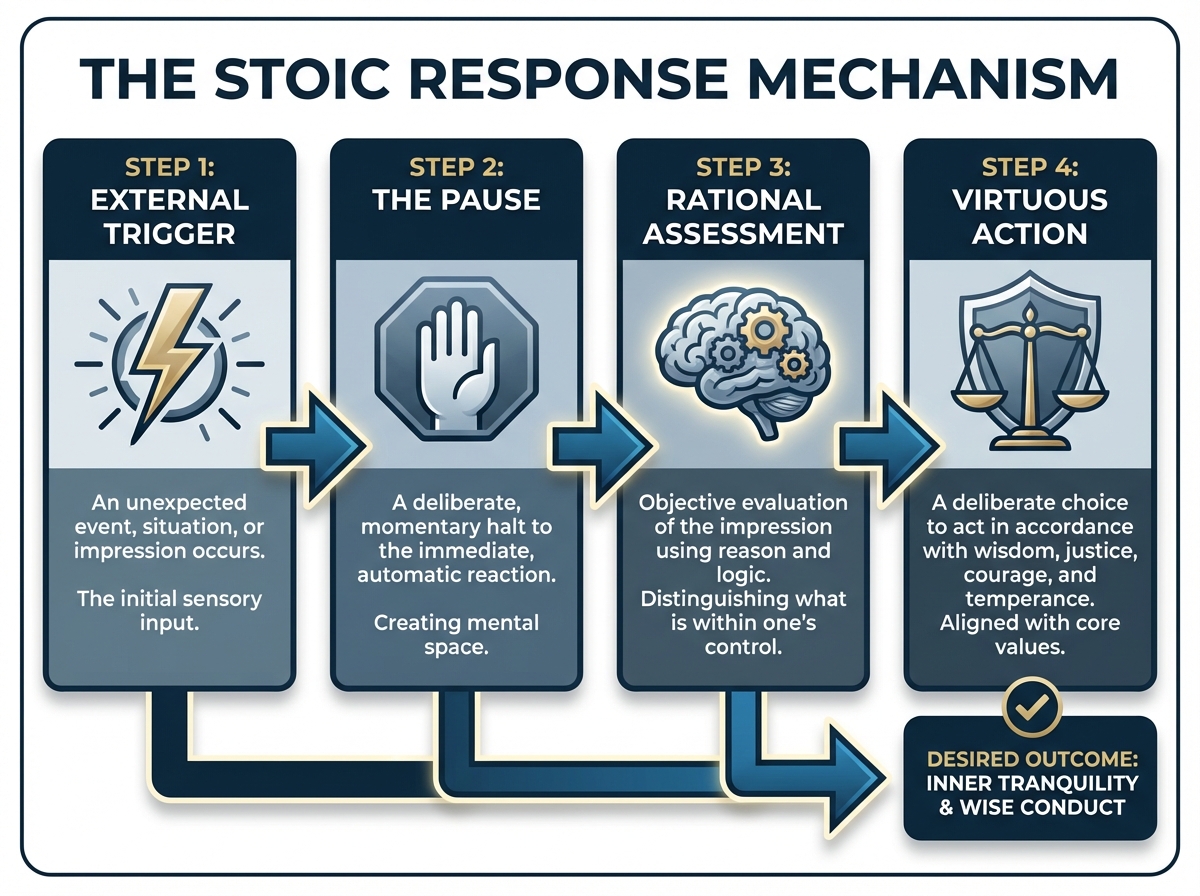
To apply Stoicism in daily life, we must first understand the mental models that underpin the philosophy. These aren't abstract rules; they are operating systems for the human mind.
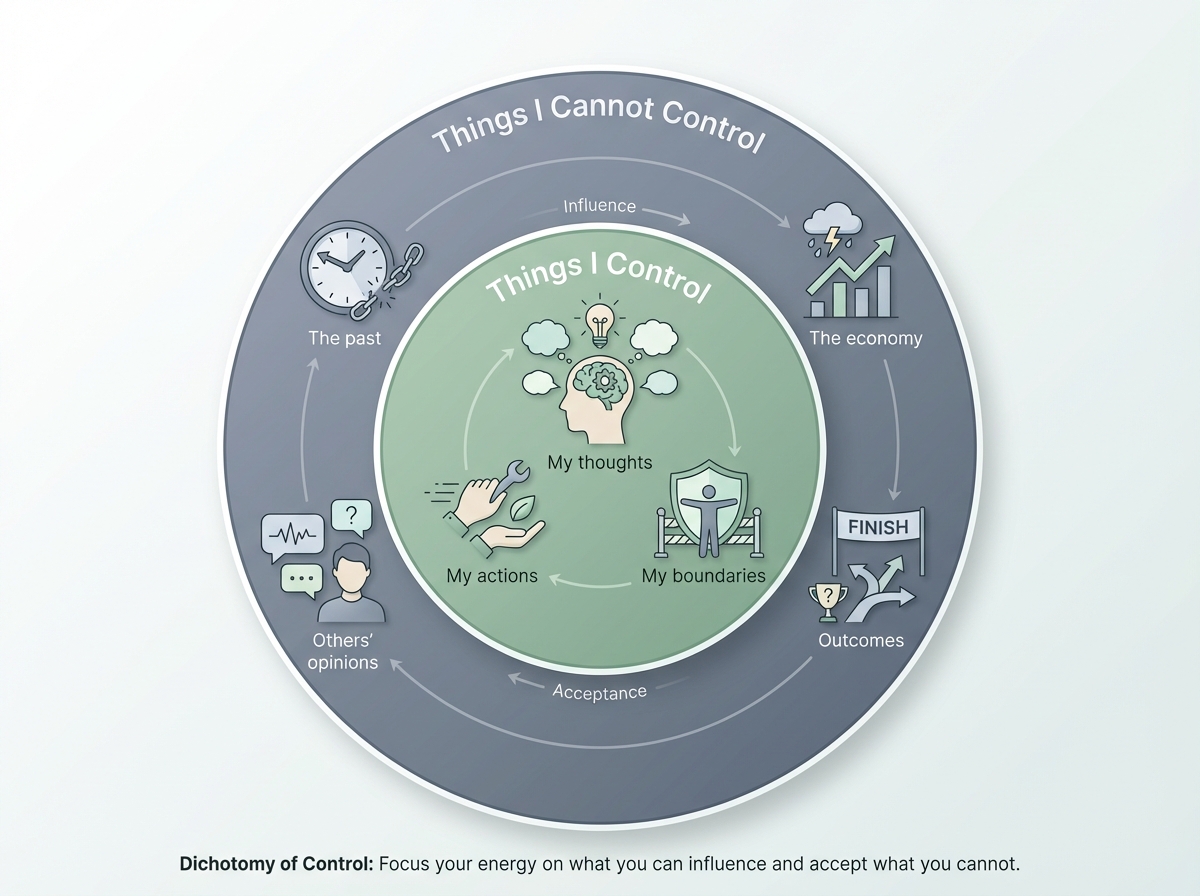
The most fundamental Stoic principle is the Dichotomy of Control. Epictetus, a slave-turned-teacher who influenced Marcus deeply, put it simply: "Some things are up to us, and some things are not up to us."
In the 21st century, this distinction is often blurred. We stress over:
The Stoic realizes that pouring energy into the first category is a waste of life. You cannot control the algorithm that hid your post, but you can control the quality of the content you create. You cannot control if your flight is delayed, but you can control whether you spend that time reading or raging at the gate agent.
Nietzsche coined the term Amor Fati, but the concept is thoroughly Stoic. It means not just bearing what happens to you, but actually loving it. It is the mindset that treats every obstacle as fuel.
Did you lose your job? It is an opportunity to pivot your career or start the business you always dreamed of. Did the project fail? It is data that ensures the next attempt succeeds. In modern terms, this is the ultimate "growth mindset." It transforms victimhood into agency. Instead of asking "Why is this happening to me?" the Stoic asks, "How can I use this?"
> 💡 Master Your Mindset with The Architect > > Struggling to separate what you can control from what you can't? The GPTnius "Architect" mentor uses frameworks analyzed from Stoic masters to help you build a personalized mental model for resilience. > > Meet the AI mentors built from this research →
Philosophy is useless without application. Here are three specific Stoic practices you can integrate into your routine immediately.
Marcus Aurelius often practiced "The View from Above." He would imagine looking down on the earth from the cosmos, seeing armies as ants and borders as imaginary lines. This exercise induces a state of awe and, more importantly, perspective.
How to do it today: Before you check your phone in the morning, close your eyes. Visualize your home, then your city, then your country, and finally the planet. Visualize the millions of people waking up, rushing, arguing, and loving.
This zooms you out from your immediate stressors. Suddenly, the passive-aggressive email you received late last night feels insignificant in the grand scheme of things. It grounds you before the digital noise rushes in.
Anxiety often stems from the fear of the unknown. Stoics countered this with Premeditatio Malorum—the premeditation of evils. Instead of hoping for the best, they vividly imagined the worst.
How to do it today: Before a big presentation, ask yourself: "What is the worst that could happen?"
Then, visualize how you would cope. If the projector fails, you will speak from your notes with more eye contact. If the client hates it, you will ask for specific feedback and iterate. By exposing yourself to the fear in a controlled environment, you rob the actual event of its power to paralyze you. You replace anxiety with a contingency plan.
Marcus Aurelius had a habit of stripping things of their "legend." He described expensive vintage wine as merely "fermented grape juice" and his purple imperial robes as "sheep wool dyed with shellfish blood."
How to do it today: When you feel a craving for the latest tech gadget or feel inadequate because of a luxury influencer's post, use objective description.
Stripping away the marketing and the emotional narrative helps you see reality clearly and reduces the pull of consumerism and validation.
Applying Stoicism in daily life is particularly effective for the unique pathologies of the modern world.
Marcus wrote, "Discard your thirst for books, so that you won't die in bitterness." He wasn't anti-intellectual; he was anti-distraction. He warned against consuming information without digesting it or applying it.
Today, we doom-scroll. We consume endless podcasts and articles (like this one) without changing our behavior. The Stoic remedy is to limit consumption and increase integration. Read less, but read deeper. Do not just collect quotes; test them.
The modern workplace is a breeding ground for stress, largely because we tie our identity to our output. Stoicism teaches us to detach our self-worth from our external achievements.
Work diligently because it is in your nature to be productive and helpful (social duty), not because you crave the applause of your boss. When you focus on the process (which you control) rather than the promotion (which you don't), you become a more effective worker because you are not crippled by the fear of failure.
Reading about Stoicism is easy; living it is difficult. The gap between understanding a concept like the "Dichotomy of Control" and actually applying it when your project is canceled is immense. This is where mentorship bridges the gap.
GPTnius offers AI Mentors that have been trained on proprietary research analyzing the published works, philosophies, and proven methodologies of thought leaders, including the principles found in Stoicism.
For example, our "Architect" mentor draws from research on mental models and resilience frameworks. It does not just recite quotes; it synthesizes these researched frameworks to provide personalized coaching conversations tailored to your specific situation.
Here is how an AI Mentor helps you practice:
By engaging in guided discussions, you move from passive reading to active application, turning ancient wisdom today into a consistent personal operating system.
> 💡 Turn Philosophy into Practice > > Don't just read about Marcus Aurelius—apply his frameworks to your daily challenges with a personalized AI guide. The GPTnius AI Mentors help you integrate Stoic resilience into your career and life. > > Meet the AI mentors built from this research →
Marcus Aurelius did not have a smartphone, but he had the same human mind that you do—prone to fear, distraction, and anger. His Meditations endure because they offer a way out of the noise and into a fortress of inner peace.
By practicing the Dichotomy of Control, engaging in negative visualization, and viewing the world objectively, you can navigate the 21st century with the composure of a philosopher-king. The goal isn't to suppress emotion, but to cultivate a mind that is unshakeable, regardless of what the external world throws your way.
No, this is a common misconception. Stoicism is not about suppressing emotions but about managing your reactions to them. It teaches how to avoid being enslaved by negative emotions like anger or fear, allowing for clearer, more rational decision-making.
You can practice Stoicism at work by focusing entirely on your own effort and behavior (which you control) rather than office politics or outcomes (which you don't). Use challenges as opportunities to practice patience and resilience.
While there are many translations, the Gregory Hays translation is widely regarded as one of the most accessible and modern interpretations for contemporary readers.