Master the Inner Citadel meaning in Stoicism. Learn practical exercises to build mental fortitude and resilience using Marcus Aurelius' timeless techniques.
The 'Inner Citadel' is a metaphor used to describe the core of the Stoic mind—specifically the ruling faculty or hegemonikon—that remains untouched by external events. By distinguishing between what happens to you and how you judge it, you can construct a mental fortress of tranquility. This article provides a comprehensive guide on how to build your Inner Citadel through specific Stoic exercises, helping you maintain composure and clarity in a chaotic world.
---
If you were the most powerful man in the world, leading an empire through a deadly plague, constant border wars, and internal betrayal, how would you keep your sanity? For Marcus Aurelius, the Roman Emperor and Stoic philosopher, the answer lay in cultivating an Inner Citadel.
While Marcus Aurelius never used the exact phrase "Inner Citadel" (a term coined later by French scholar Pierre Hadot to describe Marcus’s psychological fortress), the concept is the central pillar of his Meditations. It is the idea that within every human being, there is a sanctuary—a ruling center—that external events cannot penetrate unless we allow them to.
In an era defined by digital noise, economic uncertainty, and rapid change, the need for this mental fortification is greater than ever. Building an Inner Citadel is not about retreating from the world or suppressing emotions; it is about creating a space of absolute freedom where you can process reality objectively and choose your response with wisdom.
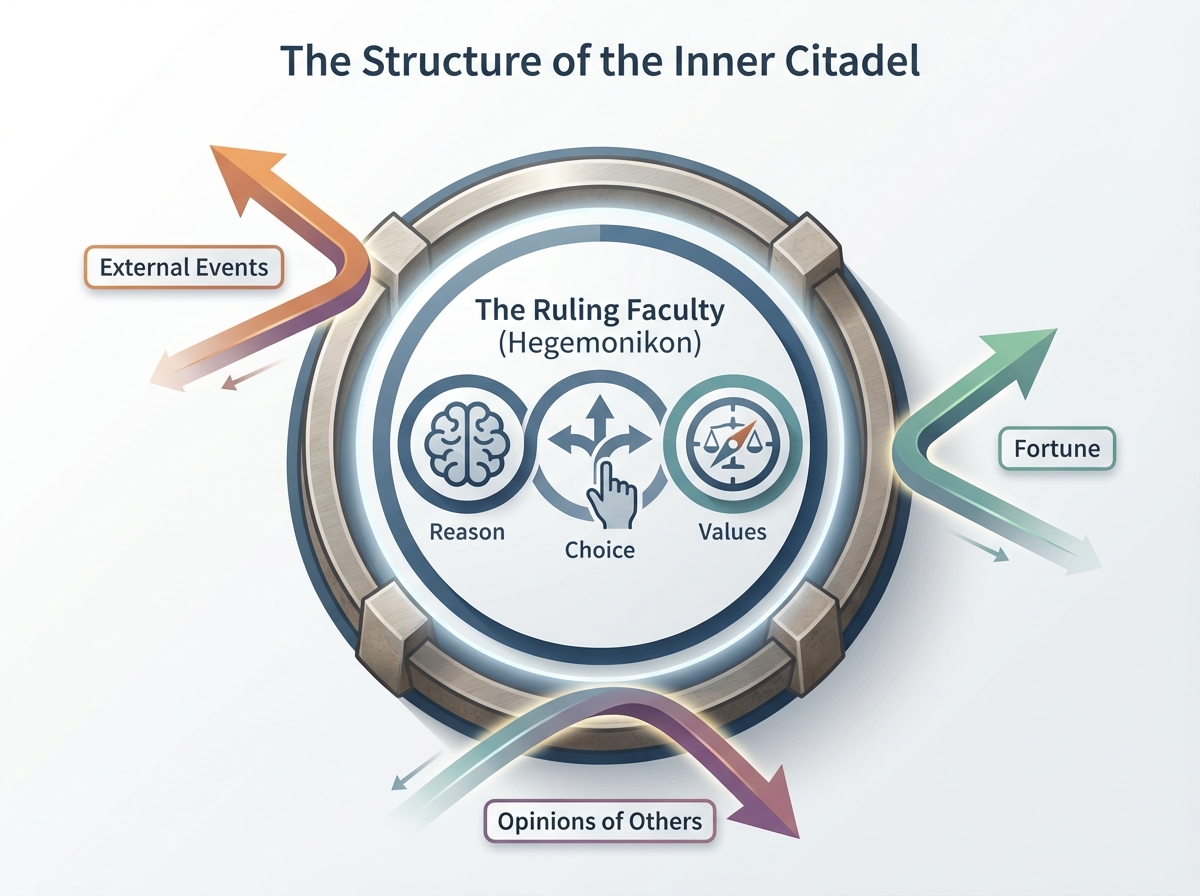
To build the fortress, you must first understand the blueprint. In Stoicism, the Inner Citadel refers to the hegemonikon, or the "ruling faculty" of the mind. It is the part of you that perceives, judges, and decides.
Marcus Aurelius wrote repeatedly about the ability of the mind to remain inviolable. He noted that while the body can be imprisoned, sickened, or attacked, the mind remains free. The Inner Citadel is built on a fundamental Stoic truth: We are not disturbed by things, but by the views we take of them.
The foundation of the Inner Citadel is the Dichotomy of Control. This principle divides existence into two categories:
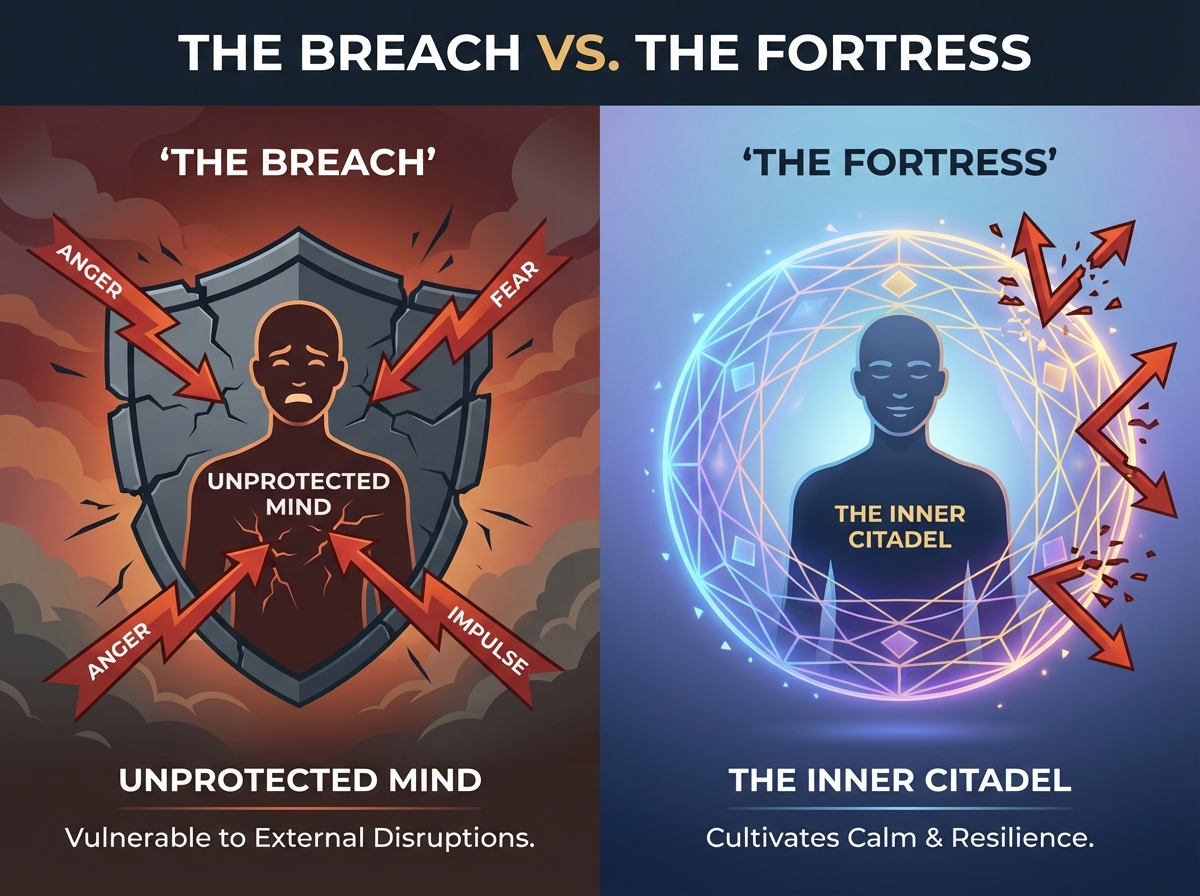
The walls of your Inner Citadel are defined by this boundary. If you try to control what is outside the walls (the economy, traffic, other people's opinions), you breach your own defenses. If you focus entirely on governing what is inside the walls (your reasoned choice), you become invincible.
Every event that happens to you is an impression (phantasia). Before this impression enters your Inner Citadel, it must be checked by the guard. The un-trained mind lets every impression in, accepting immediate emotional reactions as truth. The Stoic mind stops the impression at the gate and asks: "Is this objectively bad, or is it just a neutral event that I am judging as bad?"
> 💡 Master Your Mental Defenses > > struggling to distinguish between external events and your internal reactions? Our AI Mentors, trained on research analyzing Marcus Aurelius's philosophical frameworks, can help you role-play these scenarios to strengthen your judgment. > > Meet the AI mentors built from this research →
Pierre Hadot, in his analysis of Marcus Aurelius, identified three specific disciplines that constitute the practice of the Inner Citadel. Mastering these is essential for anyone asking how to build an Inner Citadel.
This discipline protects the mind from false judgments. It requires you to see things exactly as they are, stripping away the emotional language we usually attach to them.
By removing the value judgment ("disaster"), you remove the suffering. The event remains, but the emotional turmoil cannot breach the citadel.
The Inner Citadel is not a place of isolation. It is a fortress from which you launch positive action. Marcus Aurelius constantly reminded himself that humans are made for cooperation. The discipline of action dictates that we must act for the common good.
Even if the world is hostile, the resident of the Inner Citadel acts with justice and kindness, not because the world deserves it, but because it is the nature of a rational being to do so.
This is perhaps the hardest wall to build. It involves accepting the events that are outside of our control—specifically, accepting fate (Amor Fati). When the walls of the citadel are strong, you do not wish for reality to be different; you accept the present moment as the raw material for your character.
Philosophy is useless if it remains theoretical. To construct unshakeable mental fortitude, you must train. Here are five actionable Inner Citadel exercises you can begin today.
Marcus Aurelius often practiced describing things in their most basic, biological terms to strip them of their seductive or frightening power.
How to do it: When you are overwhelmed by a desire (e.g., for an expensive gadget) or a fear (e.g., a difficult email), write down a description of the object using only physical facts.
This exercise lowers the emotional stakes, allowing your rational mind to regain control.
Sometimes our Inner Citadel feels weak because our perspective is too narrow. We get bogged down in petty annoyances.
How to do it: Close your eyes and imagine floating up from your chair. See your house, then your city, then your country, and finally the Earth as a tiny blue dot in the cosmos. From this vantage point, look down at your current problem. In the grand scheme of the universe, is this traffic jam or this rude comment truly worth disturbing your peace?
Journaling was Marcus Aurelius’ primary tool for spiritual survival.
How to do it: Create a two-column journal.
You cannot be ambushed if you are expecting the attack. The Inner Citadel is reinforced by anticipating difficulties.
How to do it: Each morning, take two minutes to visualize what could go wrong. Imagine the train is late. Imagine your coffee spills. Imagine a client is angry. By mentally rehearsing these scenarios, you desensitize yourself to the shock. When they happen, your fortress is ready. As Marcus wrote: "The boor, the ungrateful, the arrogant... I have met them all today."
This is a real-time exercise for when stress hits.
How to do it: When a stimulus occurs (someone yells, a glass breaks), force a mandatory 5-second pause before responding. In that silence, visualize yourself stepping back behind the thick stone walls of your Inner Citadel. Remind yourself: "I do not have to have an opinion about this." Then, respond.
Building the Inner Citadel is not a one-time renovation; it is a lifetime of maintenance. Just as a physical fortress requires constant repair against the elements, your mental fortress requires daily practice.
Many beginners in Stoicism make the mistake of reading the texts but failing to do the drills. They understand the Inner Citadel meaning intellectually but crumble when faced with real-world adversity.
To maintain your walls:
Reading about the Inner Citadel is the first step, but applying it requires consistent feedback and guidance. This is where GPTnius bridges the gap between theory and practice.
GPTnius offers AI Mentors trained on proprietary research analyzing the published works, philosophies, and proven methodologies of thought leaders, including the Stoic philosophers. Our mentors do not impersonate anyone. They synthesize researched frameworks, such as the dichotomy of control and daily Stoic exercises, into personalized coaching conversations built around your specific goals.
Here is how GPTnius helps you build your fortress:
By engaging in guided discussions, you move from passive reading to active training, turning the concept of the Inner Citadel into a tangible mental asset.
> 💡 Build Your Fortress With Expert Guidance > > Don't let life's chaos breach your defenses. Use GPTnius to practice Stoic exercises and receive personalized strategic advice based on proven philosophical frameworks. > > Meet the AI mentors built from this research →
The Inner Citadel is not a retreat from reality; it is the only way to engage with reality effectively. By building a fortress of the mind—grounded in the distinction between what we control and what we do not—we claim our birthright of freedom. As Marcus Aurelius proved, you can stand in the center of a storm and remain completely dry, provided your Inner Citadel is strong. Start laying the bricks today.
The Inner Citadel is a metaphor describing the ruling faculty of the mind (hegemonikon) that remains free and untouched by external events. It represents a mental fortress where one can retreat to find peace and rational judgment regardless of outside circumstances.
No, Marcus Aurelius did not use the exact phrase 'Inner Citadel.' The term was coined by French philosopher Pierre Hadot in his analysis of Marcus Aurelius's 'Meditations' to describe the Emperor's psychological techniques for resilience.
You can practice the Inner Citadel by engaging in Stoic exercises such as the 'View from Above,' distinguishing between what you can and cannot control (Dichotomy of Control), and stripping events of value judgments to see them objectively.