Unlock deep learning with Socratic Questioning. Discover how AI mentors use ancient philosophy to coach critical thinking, uncover blind spots, and refine decision-making.
In an era defined by instant answers and algorithmic feeds, the art of the question is becoming a lost discipline. We are conditioned to seek immediate resolution—to query a search engine or a chatbot and receive a definitive fact. However, wisdom is rarely found in a single answer; it is forged through the rigor of inquiry.
Socratic Questioning, a method dating back over 2,400 years to the Greek philosopher Socrates, is experiencing a digital renaissance. It is the practice of disciplined, systematic questioning that explores complex ideas, gets to the truth of things, opens up issues and problems, uncovers assumptions, analyzes concepts, distinguishes what we know from what we don't know, and follows logical implications of thought.
Surprisingly, the most effective vehicle for this ancient human practice today is Artificial Intelligence. When properly utilized, AI shifts from being a mere retrieval system to a sophisticated cognitive sparring partner. This article explores how AI-driven mentorship is democratizing access to high-level critical thinking coaching.
Before we can leverage AI to apply it, we must understand the mechanism of Socratic Questioning. It is not simply asking "Why?" repeatedly like a curious toddler. It is a structured dialogue designed to facilitate critical thinking.
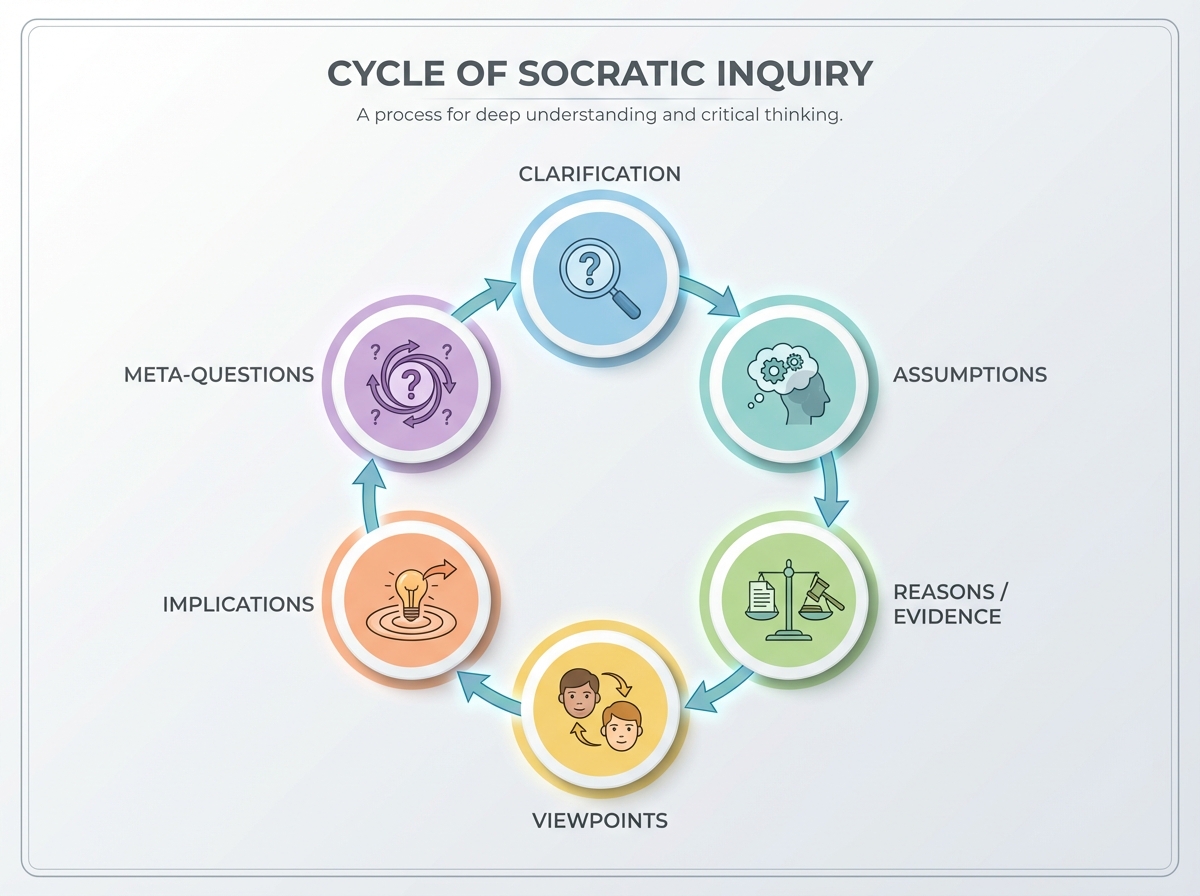
Educational psychologists and cognitive scientists generally categorize Socratic questions into six distinct types:
When a mentor—human or AI—cycles through these categories, they force the learner to construct their own understanding rather than passively receiving information.
> 💡 Master Your Mental Models > > Struggling to spot the flaws in your own logic? GPTnius AI Mentors, trained on research into the world's best decision-making frameworks, can guide you through a rigorous Socratic audit of your goals. > > Meet the AI mentors built from this research →
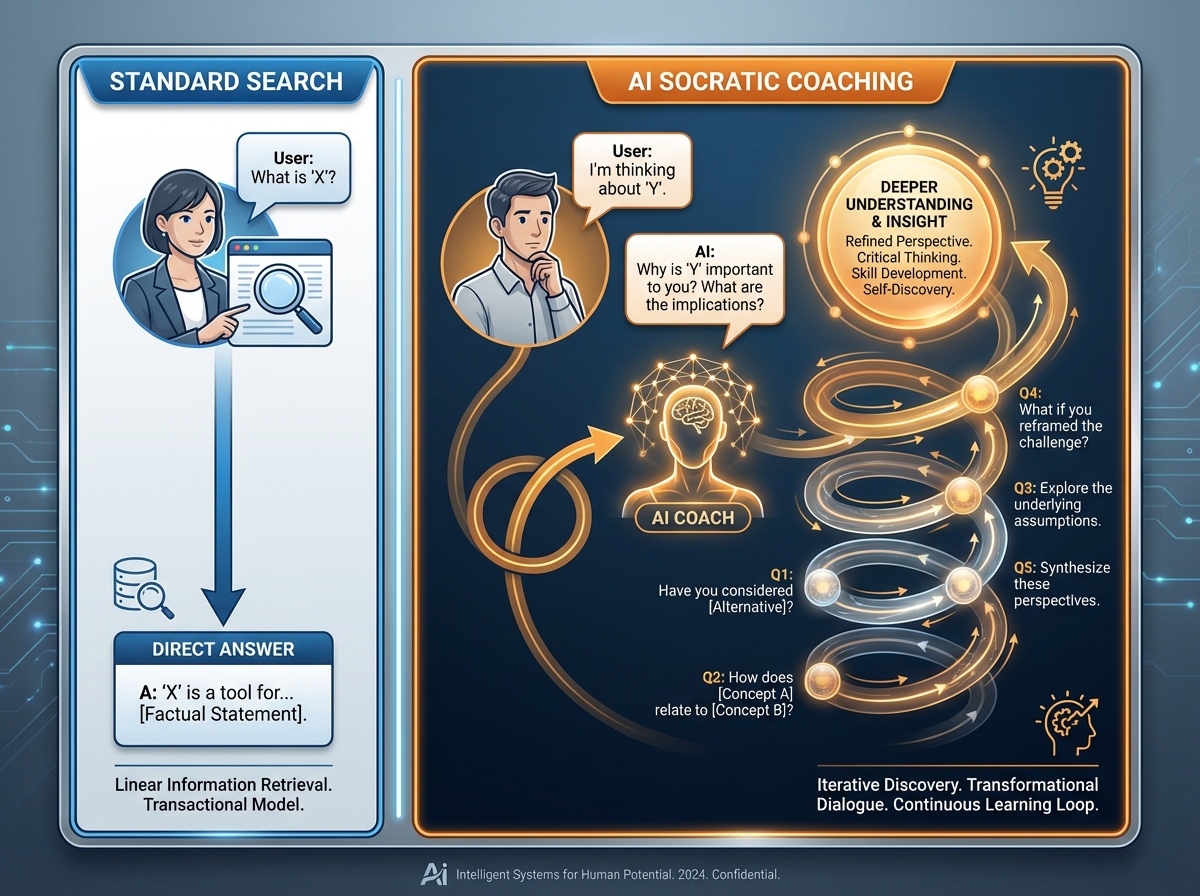
Most users approach AI with a "Prompt Engineering" mindset: How do I write the perfect command to get the perfect output? This treats the AI as a servant or a tool.
To develop critical thinking, we must flip the dynamic. This is often called Reverse Prompting or Reflective AI Interaction. Instead of asking the AI for an answer, you ask the AI to interview you.
Human mentors are invaluable, but they come with inherent biases and social dynamics. You might hesitate to admit a flaw in your logic to a boss or a peer for fear of judgment. AI removes the social friction of the Socratic method.
How do you actually initiate this type of deep work? You cannot simply say "Question me." You must set the stage. Here are three frameworks for using AI to sharpen your thinking.
Use this when you are about to make a high-stakes decision (e.g., a career pivot, a strategic investment, or a difficult conversation).
The Prompt Strategy: "I am considering [Decision X]. I want you to act as a Socratic Coach. Do not give me advice. Instead, ask me probing questions about my assumptions, my evidence, and the potential consequences. Ask one question at a time and wait for my response before moving to the next."
The Outcome: The AI will likely uncover that your decision is based on "gut feeling" rather than evidence, forcing you to go back and do the research.
Based on the root-cause analysis method developed by Sakichi Toyoda, this approach drills down into problems.
The Prompt Strategy: "I am facing [Problem Y]. Help me find the root cause using the '5 Whys' framework. Ask me why this problem occurred, and based on my answer, ask 'why' again until we reach the fundamental systemic issue."
The Outcome: You move from surface-level symptoms (e.g., "I missed the deadline") to root causes (e.g., "I have not established a system for prioritizing deep work over urgent emails").
We often suffer from tunnel vision. This method forces cognitive flexibility.
The Prompt Strategy: "I hold the belief that [Belief Z]. I want you to challenge this view by asking questions from the perspective of [Opposing Persona - e.g., a risk-averse CFO, a radical innovator, a skeptical customer]."
The Outcome: You inoculate your arguments against future criticism by pre-emptively addressing the strongest counter-arguments.
The value of Socratic Questioning lies in the Generation Effect. Cognitive psychology research shows that information is better remembered and understood if it is generated from one's own mind rather than simply read.
When an AI asks, "What evidence do you have to support that claim?" and you have to stop, search your memory, realize the gap, and formulate a new hypothesis, you are building neural pathways that passive reading cannot create.
This process often induces a state of Cognitive Dissonance—the mental discomfort experienced when holding two conflicting beliefs. While uncomfortable, this is the fertile ground where growth happens. An AI mentor can hold you in that state of dissonance long enough for you to resolve it logically, without the urge to "save face" that occurs in human conversation.
While generic chatbots can perform basic questioning, they often lack the pedagogical structure required for true mentorship. They tend to revert to giving advice rather than sustaining the inquiry.
GPTnius solves this by offering AI Mentors that have been trained on proprietary research analyzing the published works, philosophies, and proven methodologies of thought leaders.
Our mentors do not impersonate anyone. They synthesize researched frameworks, such as Socratic questioning and the mental models popularized by thinkers like Charlie Munger, into personalized coaching conversations built around your specific goals.
GPTnius allows you to:
Note: GPTnius AI Mentors are not endorsed by, affiliated with, or impersonating any real individuals. They are sophisticated syntheses of research on public methodologies.
> 💡 Elevate Your Thinking Today > > Stop settling for surface-level answers. Engage with GPTnius AI Mentors to experience coaching conversations grounded in research-backed frameworks and Socratic methodology. > > Meet the AI mentors built from this research →
The future of learning is not just about having access to all human knowledge; it is about having the critical thinking skills to navigate it. Socratic Questioning is the compass we need for this journey.
By leveraging AI not just as an oracle of answers, but as a coach of questions, we can sharpen our intellect, reduce our biases, and make better decisions. The technology is here. The question is: are you ready to be questioned?
It is the use of Artificial Intelligence to facilitate a dialogue where the AI asks probing, open-ended questions to help the user uncover assumptions, analyze logic, and reach their own conclusions, rather than the AI simply providing answers.
Yes. By acting as a non-judgmental sparring partner, AI can force users to articulate their reasoning, identify gaps in their logic, and consider alternative viewpoints, which promotes the 'Generation Effect' essential for deep learning.
GPTnius AI Mentors are specifically trained on proprietary research analyzing the frameworks and methodologies of renowned thought leaders. They are structured to provide coaching and strategic guidance, whereas generic chatbots are optimized primarily for general conversation and information retrieval.