Discover why passive reading fails and how AI chatbots revolutionize active recall. Learn research-backed strategies to boost retention and accelerate learning.
We have all been there. You finish a chapter in a business book or complete a module in an online course. You highlight the key sentences, nod your head in agreement, and perhaps re-read the summary. You feel smart. You feel prepared. You feel like you have learned.
Two weeks later, you struggle to recall a single actionable insight.
This phenomenon is what psychologists call the "Illusion of Competence." It occurs when you confuse recognizing information with being able to recall it. Passive reading—the act of consuming information without testing your understanding—is the default learning mode for most adults. Unfortunately, it is also one of the least effective ways to retain knowledge.
In the era of accelerated learning, the gold standard is Active Recall. Historically, this required tedious manual effort, such as creating physical flashcards or finding a study partner. However, the rise of AI chatbots and advanced language models has fundamentally shifted the landscape. AI is not just a tool for generating text; it is the ultimate engine for active retrieval.
This article explores the neuroscience behind why reading fails, why retrieval works, and how you can utilize AI to hack your memory retention.
To understand why active recall wins, we must first understand how memory works. The brain is not a hard drive that stores files perfectly upon a single click. It is a biological network that prioritizes efficiency. If a neural pathway is not used, the brain prunes it to save energy.
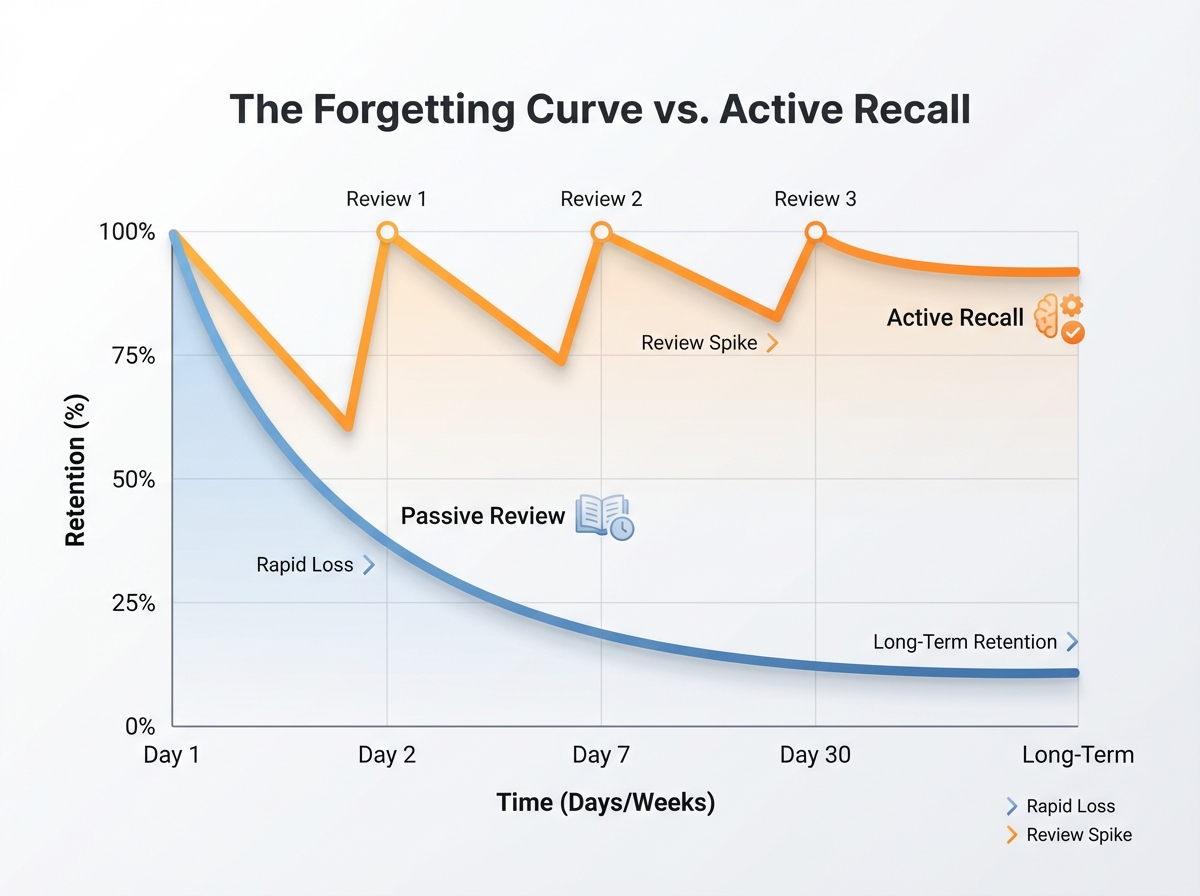
Hermann Ebbinghaus, a German psychologist, famously plotted the "Forgetting Curve." His research demonstrated that humans forget approximately 50% of new information within an hour and up to 70% within 24 hours if no effort is made to retain it.
Passive reading involves re-reading text, highlighting, or listening to lectures without interruption. It feels easy because it requires low cognitive load. When you re-read a sentence, your brain recognizes the pattern and says, "I know this." This fluency is deceptive. You are recognizing the text on the page, not retrieving the concept from your mind.
Active recall is the act of retrieving information from memory without looking at the source material. When you force yourself to answer a question, you are chemically strengthening the synaptic connections associated with that memory. It creates a level of "desirable difficulty."
Think of it like a muscle. Passive reading is like watching someone else lift weights. Active recall is lifting the weight yourself. The struggle is the learning.
> 💡 Stop The Cycle of Forgetting > > Don't let valuable insights slip away. Turn passive consumption into active mastery by engaging with an AI Mentor that challenges your understanding. > > Meet the AI mentors built from this research →
Before AI, active recall was logistically difficult. You had to stop, write a question, cover the answer, and quiz yourself later. Or, you needed a human tutor to interrogate you.
AI chatbots have democratized the Socratic Method—a form of cooperative argumentative dialogue that stimulates critical thinking. Here is why AI wins over traditional study methods:
Flashcards are binary: you either know the flip side or you don't. They are excellent for vocabulary but poor for complex concepts like strategic frameworks or mental models. An AI chatbot can ask dynamic, nuance-based questions. It can ask, "How would this concept apply to a scenario involving a struggling startup?" rather than just "Define this concept."
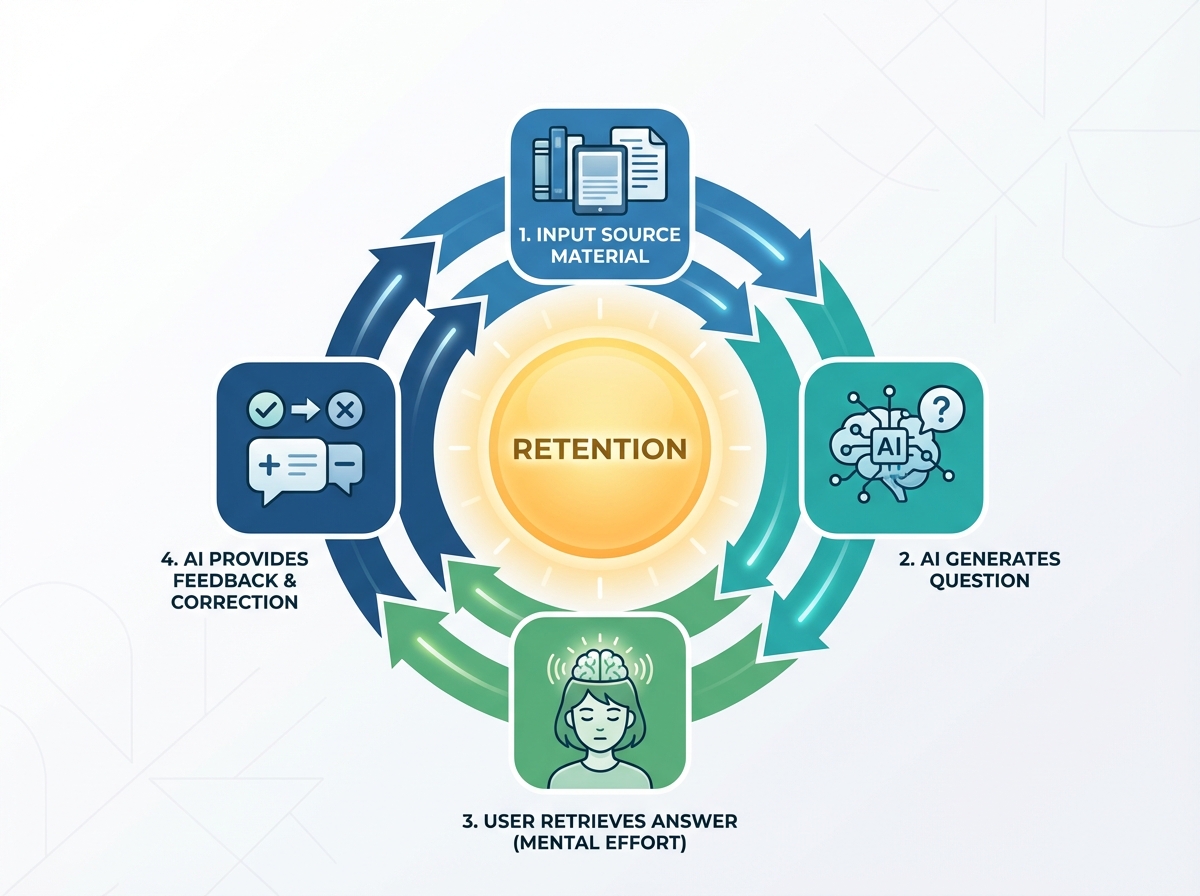
In traditional active recall, if you get an answer wrong, you might not know why unless you dig back through the textbook. AI provides instant feedback. It can pinpoint exactly where your logic failed, correct your misconceptions, and ask a follow-up question to ensure you understand the correction.
The Feynman Technique involves explaining a concept in simple terms to identify gaps in your understanding. You can now treat an AI as a student. You explain the concept to the AI, and ask it to identify any gaps, logical fallacies, or jargon that obscures meaning. This forces high-level retrieval and synthesis.
To move from theory to practice, you need specific workflows. Here is how to integrate AI into your learning loop.
Before you read a book or article, paste the table of contents or headers into an AI tool. Ask it to generate five difficult questions based on those topics. Try to answer them before you read. This primes your brain (a phenomenon known as the "generation effect") and makes the subsequent reading far more "sticky" because your brain is hunting for answers.
Most people study in blocks (AAA, BBB, CCC). Research shows that "interleaving" (ABC, BCA, CAB) improves retention. You can instruct an AI to act as a quizmaster that jumps between different topics you have learned over the past month, forcing your brain to constantly switch contexts and retrieve different types of information.
Memorizing a definition is one thing; applying it is another. Ask the AI to generate a roleplay scenario where you must apply the principle you just learned.
This forces you to actively recall the arguments and logic, not just the definition.
While generic chatbots can perform basic quizzing, they often lack the pedagogical structure required for deep mentorship. This is where GPTnius distinguishes itself.
GPTnius offers AI Mentors that have been trained on proprietary research analyzing the published works, philosophies, and proven methodologies of thought leaders. For example, when you engage with a mentor like "The Architect," you are not just chatting with a bot; you are interacting with a system designed to synthesize frameworks like mental models and habit systems into personalized coaching conversations.
Here is how GPTnius specifically enhances active recall:
By engaging in these high-friction, high-value conversations, you move beyond passive reading into the realm of accelerated capability.
> 💡 Master Your Mind with GPTnius > > Experience the power of research-backed AI coaching. Apply mental models and proven frameworks to your life through active, guided conversations. > > Meet the AI mentors built from this research →
The era of passive information consumption is over. In a world drowning in data, the ability to retain and apply knowledge is a competitive advantage. By shifting from passive reading to active recall, and leveraging the interactive power of AI, you can drastically reduce the time it takes to master new skills.
Do not settle for the illusion of competence. Embrace the difficulty of retrieval, utilize the Socratic capabilities of AI, and turn your brain into a powerhouse of retention.
Passive reading involves consuming information (reading, listening) without testing yourself, often leading to poor retention. Active recall involves retrieving information from memory without aid, which strengthens neural connections and improves long-term memory.
AI chatbots can act as infinite, patient tutors that use the Socratic method. They can generate quizzes, simulate roleplay scenarios for applying knowledge, and provide immediate feedback on your explanations, which is more effective than static flashcards.
Yes, active recall is effective for almost all subjects, from learning languages and medical terminology to understanding complex business frameworks and coding syntax. It moves knowledge from short-term to long-term memory.