Discover why generic coaching fails and how Adaptive Mentorship uses context and psychology to accelerate personal development. Learn how AI is revolutionizing personalized learning.
Traditional "one-size-fits-all" coaching often fails because it ignores individual context and the dynamic nature of learning. Adaptive Mentorship solves this by adjusting guidance in real-time based on your progress, psychology, and specific challenges. This article explores the science behind adaptive learning and how AI-driven tools are democratizing access to hyper-personalized mentorship.
---
In the world of personal development and professional growth, we are often sold a singular, seductive lie: that there is a specific, immutable recipe for success. Whether it is a morning routine used by a tech billionaire, a productivity framework from a bestselling author, or a fitness regimen from an elite athlete, the implication is always the same. If you follow the steps, you will get the result.
Yet, millions of people follow these steps every day and fail to see the promised transformation. The problem isn’t the advice itself—often, the principles are sound. The problem is the rigidity of the delivery.
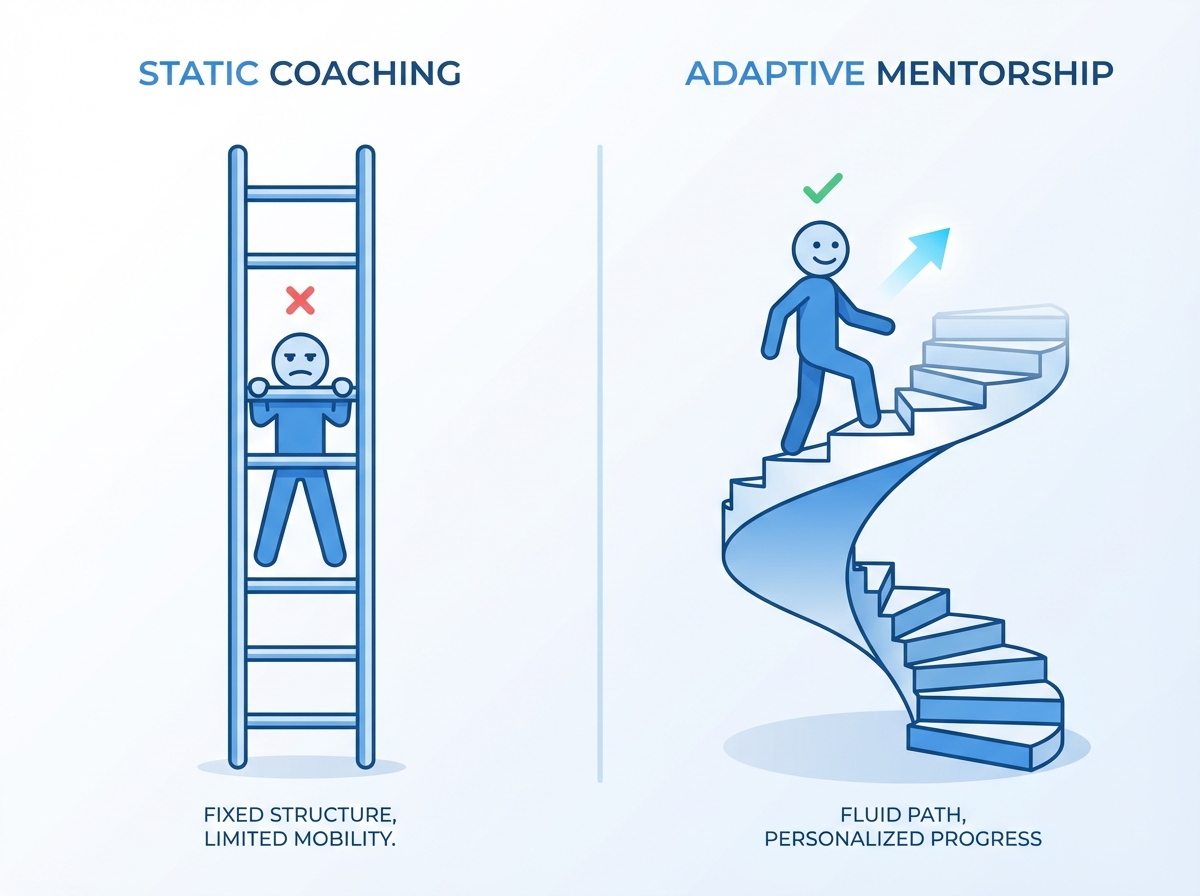
This is the failure of static coaching. It assumes that the learner is a constant variable. It ignores the fluctuating reality of human psychology, energy levels, prior knowledge, and environmental constraints.
Enter Adaptive Mentorship. This is not merely about "personalization" (which might just mean adding your name to an email); it is about a dynamic, responsive system of guidance that evolves as you evolve. It is the difference between a printed map and a GPS that reroutes you when you miss a turn.
To understand why we need adaptive solutions, we must first diagnose the fatal flaws of the "one-size-fits-all" model.
Standardized advice lacks context awareness. A strategy for "deep work" that requires four uninterrupted hours is brilliant for a tenured professor but useless—and discouraging—for a single parent or a manager in a high-velocity startup. When advice ignores context, implementation becomes impossible, leading to shame and abandonment of the goal.
Most static coaching programs assume learning is linear: Step 1, Step 2, Step 3. However, human growth is non-linear. You might master Step 1 instantly but struggle for weeks with Step 2. A static program will either bore you by forcing you to dwell on what you know or discourage you by rushing past what you don't.
Novices need structure; experts need freedom. This is known as the Expertise Reversal Effect. Giving a novice an open-ended problem creates cognitive overload, causing them to freeze. Conversely, forcing an expert to follow a rigid checklist reduces their performance. Static coaching cannot distinguish between the two.
> 💡 Stop Paying for Advice That Doesn't Fit > > Generic strategies rarely survive contact with real-world chaos. You need a mentor that understands your specific constraints and adapts the plan when life gets in the way. > > Meet the AI mentors built from this research →
Adaptive Mentorship isn't just a buzzword; it is rooted in educational psychology and cognitive science. It relies on three core mechanisms to ensure effectiveness.
Proposed by psychologist Lev Vygotsky, the ZPD is the sweet spot between what a learner can do unaided and what they cannot do at all. It is the zone where learning occurs, but only with guidance.
Adaptive Mentorship constantly assesses where your ZPD is located. If you are struggling, it adds scaffolding (more specific instructions, smaller steps). If you are succeeding, it removes scaffolding (focusing on high-level strategy and autonomy).
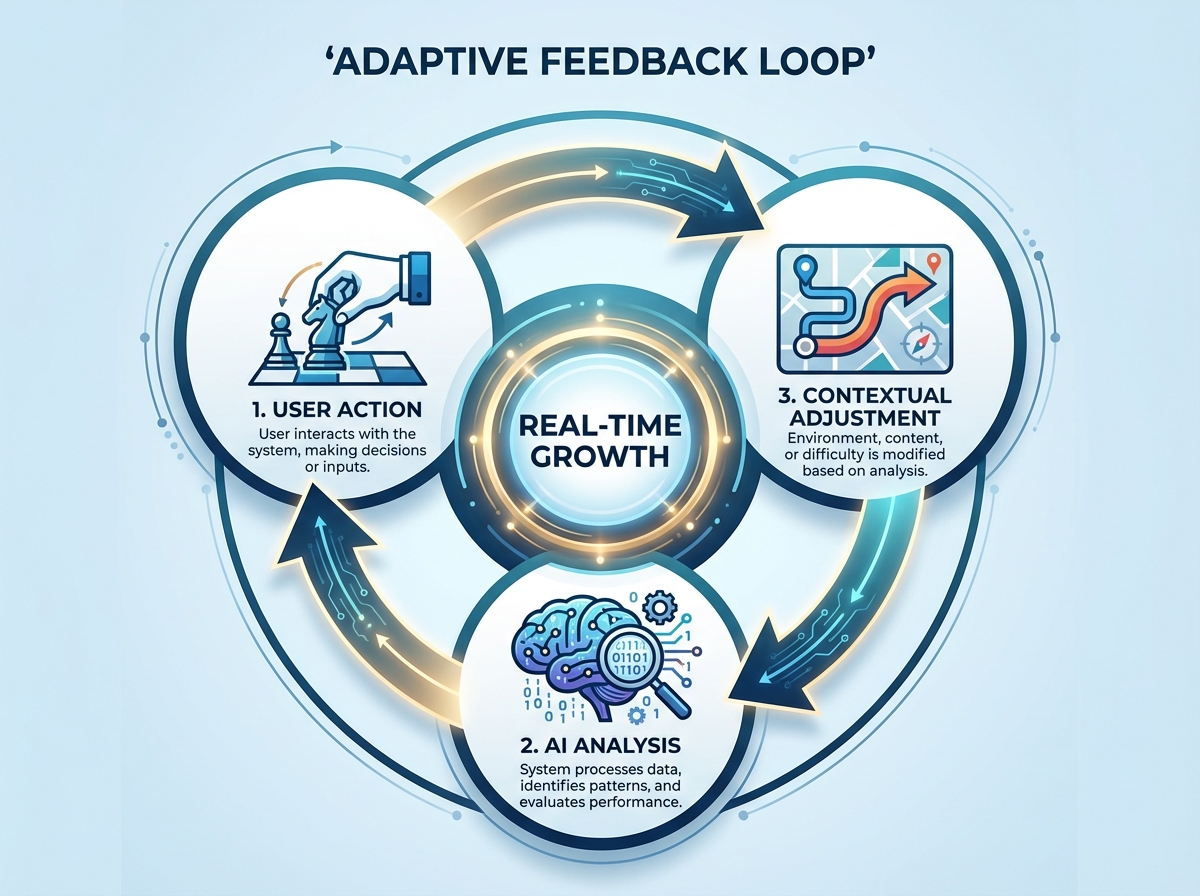
In systems theory, the tighter the feedback loop, the faster the system corrects errors. In traditional mentorship, you might meet a mentor once a month. That is a 30-day lag between action and correction.
Adaptive systems, particularly those powered by AI Learning, aim for real-time feedback. By correcting a misconception the moment it arises, the learner avoids solidifying bad habits. This rapid iteration creates a compounding effect on growth.
Historically, true adaptive mentorship was a luxury. It required a human coach to monitor you 24/7, analyze your psychology, remember your history, and adjust their teaching style instantly. This was unscalable and prohibitively expensive.
Artificial Intelligence has changed the equation. AI allows for Scalable Adaptive Mentorship.
Unlike a human mentor who might forget the specific challenge you mentioned three weeks ago, AI retains a perfect record of your learning path. It can connect the dots between your current struggle and a goal you set months prior, providing continuity that static courses cannot match.
Different concepts require different explanations. Sometimes you need a compassionate listener (counseling style); other times you need a drill sergeant (directive style).
AI can analyze thousands of interaction points to identify patterns you don't see yourself. It might notice that you consistently stall on Tuesdays, or that you struggle specifically with strategic planning but excel at execution. This data-driven insight allows for hyper-targeted interventions.
Even without a dedicated coach, you can apply the principles of Adaptive Mentorship to your own personal development journey.
Stop consuming "just in case" information. Shift to "just in time" learning. Only seek advice relevant to the specific problem you are facing right now. If you are building a product, don't read a book on corporate scaling; read a guide on product-market fit.
Don't wait for a quarterly review to assess your progress. Create daily or weekly check-ins. Ask yourself:
Be honest about your competence level in different domains.
GPTnius was built on the premise that access to high-quality, adaptive mentorship should be universal.
GPTnius offers AI Mentors trained on proprietary research analyzing the published works, philosophies, and proven methodologies of thought leaders, including thinkers like James Clear and Charlie Munger. Our mentors do not impersonate anyone. They synthesize researched frameworks, such as habit systems and mental models, into personalized coaching conversations built around your specific goals.
Here is how GPTnius applies Adaptive Mentorship:
By combining proprietary research with the infinite patience and availability of AI, GPTnius provides a coaching experience that evolves as you grow.
> 💡 Experience the Power of Adaptive AI Mentorship > > Stop settling for generic advice. Engage with AI Mentors trained on the world's best frameworks and get guidance that adapts to your life, your goals, and your pace. > > Meet the AI mentors built from this research →
The era of the static syllabus is ending. In a world that changes rapidly, the ability to learn and adapt is the ultimate competitive advantage. Adaptive Mentorship offers a path out of the noise of generic advice and into a focused, personalized growth trajectory. By leveraging the principles of the Zone of Proximal Development and utilizing AI tools that offer context-aware guidance, you can stop spinning your wheels and start making measurable progress.
Adaptive Mentorship is a coaching approach that dynamically adjusts guidance, feedback, and support based on the learner's current competence, emotional state, and specific context, rather than following a rigid, linear curriculum.
AI enables scalable adaptive mentorship by providing 24/7 availability, remembering infinite context about the user's history, and instantly switching coaching styles (e.g., from supportive to directive) based on the user's immediate needs.
The ZPD is a concept from psychology representing the gap between what a learner can do alone and what they can do with guidance. Adaptive mentorship targets this zone to maximize learning efficiency without causing boredom or anxiety.