Unlock the power of grit. Explore Angela Duckworth's psychology of passion and perseverance, distinct from resilience, to drive long-term success.
In a culture obsessed with natural talent and overnight success, it is easy to feel discouraged when we see high achievers performing effortlessly. We assume they were born with a gift we lack. However, psychologist Angela Duckworth’s groundbreaking research suggests that the secret to outstanding achievement isn't just talent but a special blend of passion and persistence she calls "grit."
Whether you are an entrepreneur building a business, an athlete training for a marathon, or a professional seeking career advancement, understanding the psychology of grit is essential. It changes the narrative from "I'm not smart enough" to "I haven't worked at this long enough." This comprehensive guide explores what grit is, how it differs from resilience, and how you can develop it to reach your full potential.
At its core, the grit definition in psychology is the passion and perseverance for very long-term goals. It is about having stamina. Grit is sticking with your future, day in and day out, not just for the week, not just for the month, but for years, and working really hard to make that future a reality.
Angela Duckworth, a professor of psychology at the University of Pennsylvania, popularized this concept in her seminal book, Grit: The Power of Passion and Perseverance. Through her research at West Point Military Academy, the National Spelling Bee, and various corporate environments, she discovered a consistent pattern: the most successful individuals were not necessarily the ones with the highest IQs or the most natural talent. They were the ones who possessed grit.
To truly understand grit and success, we must break it down into its two components:
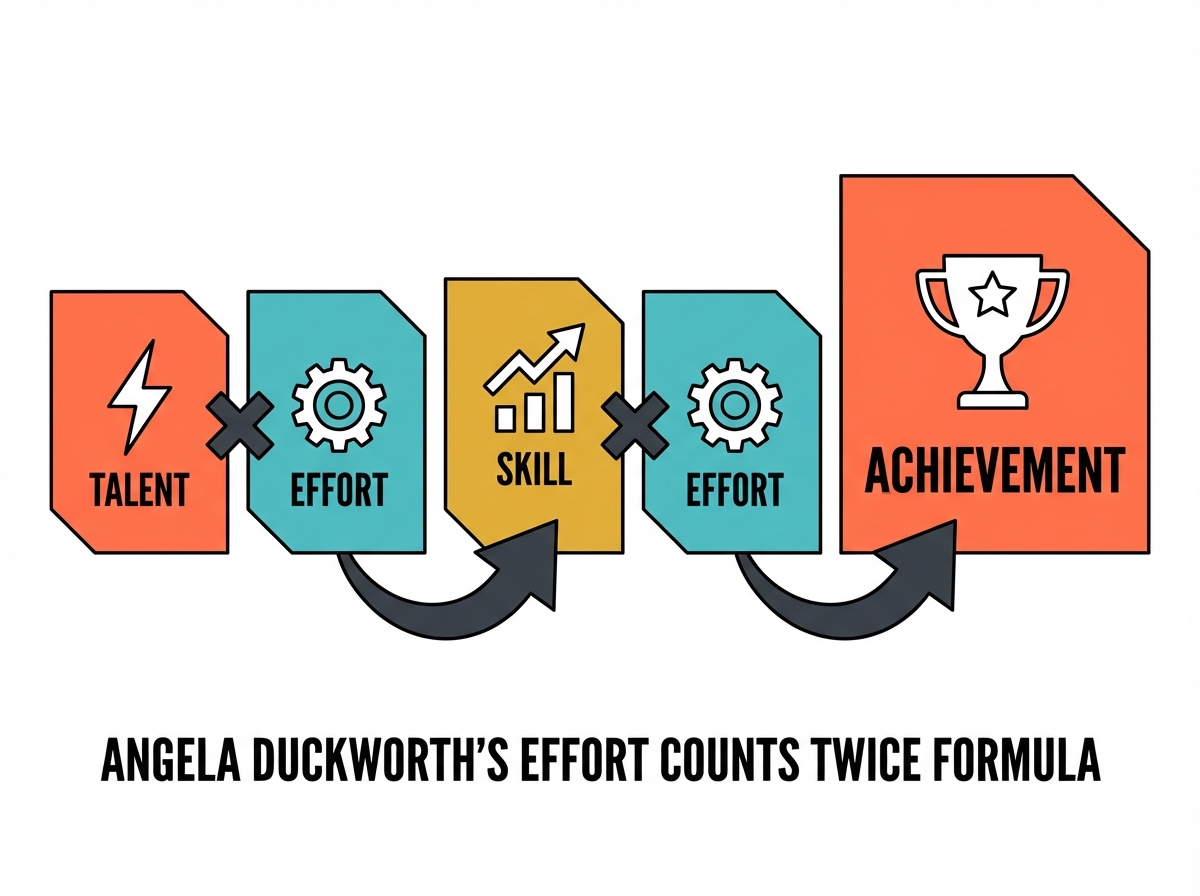
One of the most compelling aspects of Duckworth’s research is her formula for achievement. She argues that while talent matters, effort counts twice. She visualizes this through two simple equations:
Here is how it works: Talent is how fast your skills improve when you invest effort. Skill is what you have after you have put in the hours. However, skill alone doesn't equal achievement. You have to take that skill and apply more effort to produce a tangible result.
Without effort, your talent is nothing more than unmet potential. Without effort, your skill is nothing more than what you could have done but didn't. This framework is empowering because while we cannot control our innate talent, we have absolute control over our effort.
> 💡 Build Habits That Compound Into Success > > Understanding that effort counts twice is the first step; building the daily systems to sustain that effort is the second. GPTnius AI Mentors, trained on research into habit formation and productivity frameworks, can help you design a routine that turns sporadic effort into consistent skill-building. > > Meet the AI mentors built from this research →
While often used interchangeably, there is a nuance between grit vs. resilience.
Resilience is the ability to recover quickly from difficulties. It is about bouncing back after a setback, trauma, or failure. It is a reactive state—something bad happens, and you withstand it.
Grit, on the other hand, is proactive. It involves resilience, but it adds the component of a long-term goal. A resilient person might survive a tough layoff and find a new job. A gritty person will survive the layoff, find a new job, and continue pursuing their decade-long dream of becoming an industry leader despite the interruption.
Think of resilience as the ability to stay afloat in a storm, while grit is the act of swimming toward a specific shore, mile after mile, regardless of the weather.
The good news is that grit is not a fixed trait. You can grow your grit from the inside out. Duckworth identifies four specific psychological assets that mature gritty people tend to have in common. You can cultivate these to learn how to develop grit.
Passion begins with intrinsically enjoying what you do. You cannot grit your way through a life you hate. While you won't love every part of your job every day, you need an overarching interest in the field.
Action Step: Explore different pursuits. Don't pressure yourself to "find your passion" overnight. Instead, foster your interests by asking questions, experimenting, and deepening your knowledge in areas that spark your curiosity.
Gritty people do not just practice; they engage in deliberate practice. This involves setting a stretch goal, focusing 100% on the technique, receiving immediate feedback, and refining the approach. It is about trying to do things you cannot do yet.
Action Step: Identify one specific skill you want to improve. Set a time each day to practice it without distraction. Focus on your weaknesses rather than celebrating your strengths.
Interest is about what you enjoy; purpose is about how your work contributes to the well-being of others. Grit is easier to sustain when you feel your work matters. The most gritty individuals see their work as a calling rather than just a job.
Action Step: Reflect on how your current goals contribute to a larger cause. Who benefits from your hard work? Connecting your daily grind to a higher purpose can fuel you when your interest temporarily wanes.
This isn't the hope that "tomorrow will be better." It is the expectation that your own efforts can improve your future. This is closely tied to Carol Dweck’s concept of a Growth Mindset—the belief that our abilities can be developed.
Action Step: Monitor your self-talk. When you fail, do you say, "I'm not good at this," or do you say, "I haven't mastered this yet"? Reframing failure as a learning opportunity is critical for maintaining grit.
To measure these traits, Duckworth developed the Angela Duckworth Grit Scale. It asks individuals to rate themselves on statements like:
Taking the scale can be a sobering reality check. It forces us to confront whether we are truly persistent or just enthusiastic starters who rarely finish. High scores on this scale correlate strongly with success in rigorous environments, from military training to competitive sales.
One practical way to instill grit in yourself (or your children) is what Duckworth calls the "Hard Thing Rule." It has three parts:
Reading about grit is the easy part; applying it when you are tired, discouraged, or distracted is where the real challenge lies. This is where GPTnius can bridge the gap between theory and practice.
GPTnius offers AI Mentors that have been trained on proprietary research analyzing the published works, philosophies, and proven methodologies of thought leaders. For example, the "The Architect" mentor draws from research on mental models and habit formation systems to help you structure your path to success.
Here is how a GPTnius AI Mentor helps you build grit:
By engaging in coaching conversations synthesized from proven principles, you are not just learning about grit—you are actively practicing it with a dedicated partner.
> 💡 Turn Grit into Your Competitive Advantage > > Don't let your potential go unrealized due to a lack of structure. Engage with an AI Mentor trained on the methodologies of top thought leaders to cultivate the passion and perseverance necessary for elite achievement. > > Meet the AI mentors built from this research →
Grit is not a magic pill, but it is a verifiable predictor of success. By understanding that effort counts twice, distinguishing between resilience and long-term stamina, and actively cultivating interest, practice, purpose, and hope, you can dramatically increase your odds of achieving your goals. Talent may get you noticed, but grit is what gets you to the finish line.
While related, self-control is about resisting momentary temptations (like eating a donut), whereas grit is about maintaining a goal over years despite failure and adversity.
Yes, 'stupid grit' involves persisting with a goal that no longer makes sense or is actively harmful. True grit involves re-evaluating if the low-level goals still serve the top-level vision.
Research suggests it is both. While there is a genetic component to temperament, grit can be significantly developed through environmental factors, mindset shifts, and deliberate practice.