Stop relying on willpower. Learn how identity-based habits reshape your self-image and belief systems to create permanent behavioral change.
We have all been there. It is January 1st, or perhaps a Monday morning after a regretful weekend. You set a goal: "I want to lose 20 pounds," or "I want to write a book," or "I want to double my income."
You start with a burst of motivation. You go to the gym five days in a row. You write 1,000 words. You make ten cold calls. But within a few weeks, the motivation fades. The gym bag stays in the closet. The manuscript gathers digital dust. The old behaviors return.
Why does this happen? It is rarely a lack of desire or effort. The problem lies in the direction of change. Most people try to change their habits by focusing on what they want to achieve (outcomes). However, the most effective way to change your habits is to focus on who you want to become (identity).
This concept, often referred to as identity-based habits, suggests that true behavior change is identity change. You might start a habit because of motivation, but the only reason you stick with one is that it becomes part of your identity.
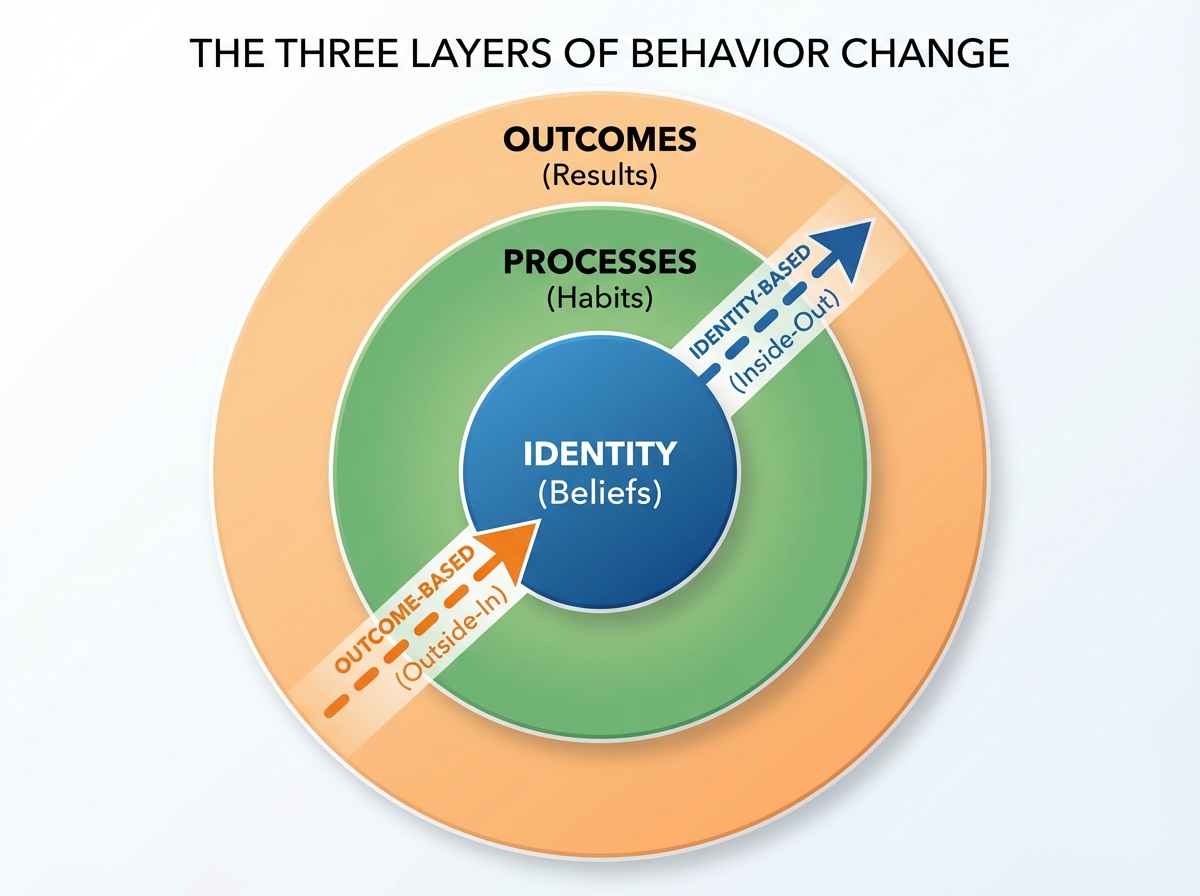
To understand why identity-based habits are superior to outcome-based habits, we must look at the structure of behavior change. Imagine an onion with three layers.
This layer is concerned with changing your results: losing weight, publishing a book, winning a championship. Most of the goals you set are associated with this level of change.
This layer is concerned with changing your habits and systems: implementing a new workout routine, decluttering your desk for better workflow, developing a meditation practice. Most of the habits you build are associated with this level.
This layer is concerned with changing your beliefs: your worldview, your self-image, your judgments about yourself and others. Most of the beliefs, assumptions, and biases you hold are associated with this level.
Many people begin the process of changing their habits by focusing on the outcome. This is an "outside-in" approach. They say, "I want to be skinny (outcome), so I will stick to this diet (process)."
However, if your belief system (identity) remains that of a person who loves junk food and hates exercise, you are fighting an uphill battle. You are trying to force a new behavior on top of an old identity. Eventually, the old identity sabotages the new behavior.
Identity-based habits take an "inside-out" approach. You start by focusing on who you want to become. You say, "I am the type of person who respects their body." When you identify that way, eating healthy isn't a chore; it's simply acting in alignment with who you are.
> 💡 Align Your Actions With Your True Self > > Struggling to define the identity you want to build? Our AI Mentors, trained on research analyzing the frameworks of top behavioral psychologists, can help you uncover the beliefs holding you back and design a roadmap for who you want to become. > > Meet the AI mentors built from this research →
Your identity is not set in stone. It is a flexible set of beliefs that evolves over time. The word "identity" is derived from the Latin words essentitas, which means being, and identidem, which means repeatedly. Your identity is literally your "repeated beingness."
This creates a powerful feedback loop between your habits and your identity:
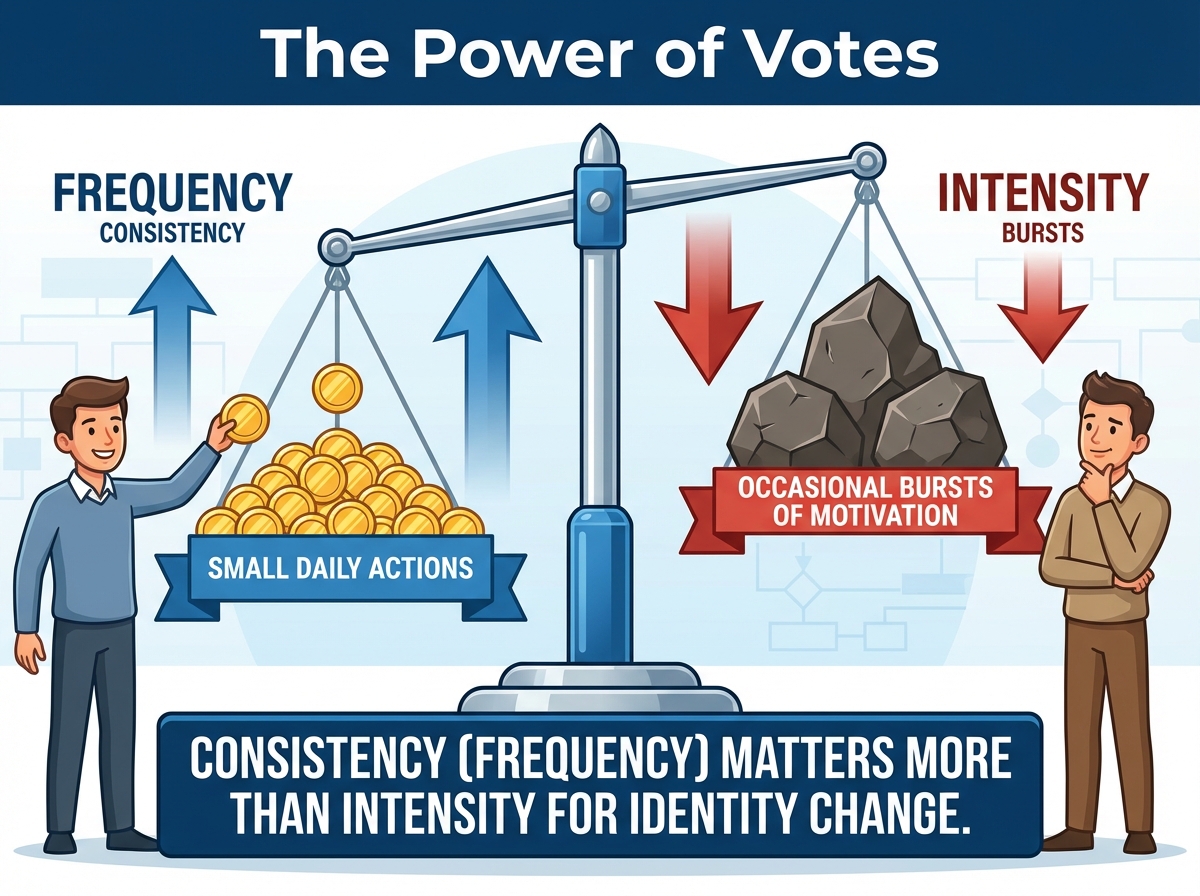
Think of your self-image as a democracy. You do not need a unanimous vote to win an election; you just need a majority. It doesn't matter if you cast a few votes for "bad" habits or a lazy lifestyle. If the majority of your votes are for a healthy, productive lifestyle, that is the identity you will adopt.
Each habit is not just about getting a result; it is about teaching yourself to trust yourself. You are proving to yourself that you can rely on your own word.
Changing your identity sounds intimidating, but it is actually a practical two-step process.
This is where you set your compass. If you don't know who you want to become, you cannot change. This doesn't mean you need to know exactly what you want to achieve in life, but you need to know the values and principles you want to embody.
Ask yourself:
Example: Instead of "I want to write a book," the identity is "I am a writer." Instead of "I want to run a marathon," the identity is "I am a runner."
Once you have the identity, you need evidence. You cannot just chant affirmations in the mirror and expect your life to change. You need proof.
This is where small wins are critical. If you want to be a writer, writing for 2 minutes a day creates evidence. Writing for 3 hours might be too hard to sustain initially, leading to failure, which casts a vote for "I am not a writer."
Start small. Cast a vote. Do it again tomorrow. The goal is not intensity; the goal is consistency to build the belief system.
When you first start practicing identity-based habits, you will likely experience cognitive dissonance. This is the mental discomfort experienced by a person who holds two or more contradictory beliefs, ideas, or values.
For example, if you have viewed yourself as "disorganized" for 20 years, and you suddenly start organizing your day, your brain will rebel. It will say, "This isn't you. You're the messy one. This feels fake."
This is often called "Imposter Syndrome," but in the context of habit building, it is simply growing pains. Here is how to handle it:
To make this concrete, let's look at how shifting from outcome-based to identity-based thinking changes the approach.
Two people are resisting a cigarette. When offered a smoke:
Understanding the theory of identity-based habits is one thing; applying it to your complex, daily life is another. This is where GPTnius bridges the gap between knowledge and action.
GPTnius offers AI Mentors trained on proprietary research analyzing the published works, philosophies, and proven methodologies of thought leaders, including thinkers like James Clear. Our mentors do not impersonate anyone. They synthesize researched frameworks, such as identity-based habit systems, into personalized coaching conversations built around your specific goals.
Here is how a GPTnius AI Mentor helps you build identity-based habits:
You don't have to rebuild your identity alone. You can have a strategist in your corner 24/7.
> 💡 Build the Habits That Build You > > Ready to stop setting goals and start changing your life? Connect with a GPTnius AI Mentor to design the identity-based habits that will make your success inevitable. > > Meet the AI mentors built from this research →
Becoming the person you want to be is not about a radical overnight transformation. It is a gradual evolution. It requires a shift in focus from what you want to have to who you want to be.
By utilizing identity-based habits, you stop fighting against yourself. You align your actions with your beliefs. You cast votes for your future self, one small win at a time. Eventually, you don't have to "try" to perform the habit anymore. You simply act, because that is who you are.
Identity-based habits are behaviors focused on who you wish to become rather than what you want to achieve. Instead of setting a goal to run a marathon (outcome), you cultivate the habit of being a runner (identity), which naturally leads to the outcome.
Identity change is not a fixed timeline but a continuous process. It happens gradually as you accumulate 'votes' for your new identity through consistent small actions. The more evidence you provide yourself, the faster your self-image shifts.
Outcome-based habits often fail because they try to change behavior from the outside in. If you change your actions without changing the underlying beliefs (identity) that drive them, the old identity will eventually sabotage the new behavior.