Master the art of habit building with insights from Atomic Habits. Learn the 1% rule, habit stacking, and behavior change science to transform your life.
Real change comes from the compound effect of hundreds of small decisions—doing two push-ups, writing one paragraph, or waking up five minutes early. This guide explores the framework of Atomic Habits, breaking down the science of the 1% rule, the difference between goals and systems, and the Four Laws of Behavior Change to help you build good habits and break bad ones permanently.
---
We often convince ourselves that massive success requires massive action. Whether it is losing weight, building a business, writing a book, or winning a championship, we put pressure on ourselves to make some earth-shattering improvement that everyone will talk about.
Meanwhile, improving by 1 percent isn’t particularly notable—sometimes it isn’t even noticeable—but it can be far more meaningful, especially in the long run. The difference a tiny improvement can make over time is astounding. Here’s how the math works out: if you can get 1 percent better each day for one year, you’ll end up thirty-seven times better by the time you’re done. Conversely, if you get 1 percent worse each day for one year, you’ll decline nearly down to zero.
What starts as a small win or a minor setback accumulates into something much more. This is the core philosophy behind Atomic Habits: tiny changes that lead to remarkable results.
Habits are the compound interest of self-improvement. The same way that money multiplies through compound interest, the effects of your habits multiply as you repeat them. They seem to make little difference on any given day and yet the impact they deliver over the months and years can be enormous.
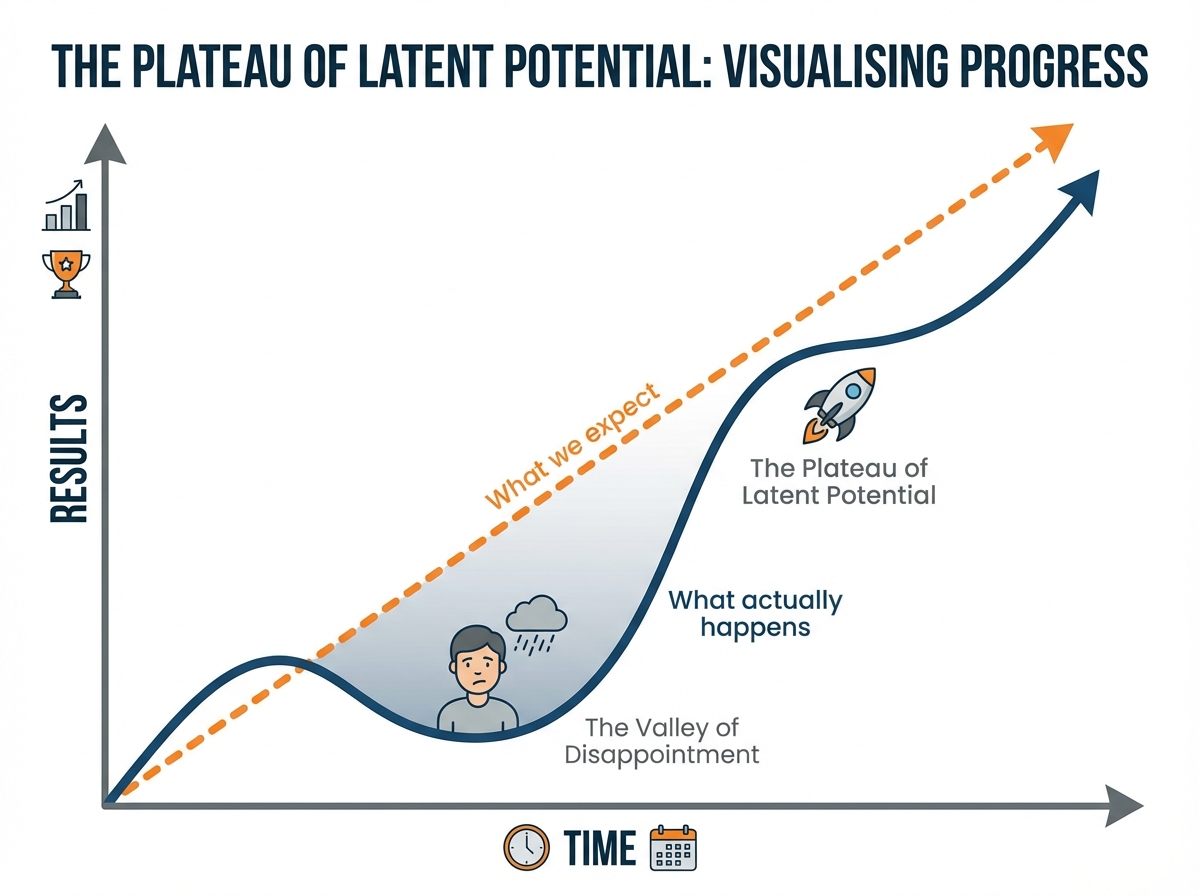
However, this creates a psychological trap known as the "Plateau of Latent Potential." When you finally start a new routine, you expect linear progress. But reality is often curvilinear. In the early stages, there is often a "Valley of Disappointment" where you feel like you're doing the work but not seeing the results. You expect to be halfway to your goal, but you're only a fraction of the way there.
This is a hallmark of any compounding process: the most powerful outcomes are delayed. It is not until you cross this plateau that the results of your efforts become visible. Mastery requires patience.
> 💡 Don't Navigate the Valley of Disappointment Alone > > Staying consistent when results aren't visible is the hardest part of habit building. Our AI Mentors, trained on proprietary research analyzing the methodologies of top behavioral experts, can help you track those 1% wins and maintain perspective during the plateau. > > Meet the AI mentors built from this research →
Prevailing wisdom claims the best way to achieve what we want in life—getting into better shape, building a successful business, relaxing more and worrying less—is to set specific, actionable goals.
However, goals have a few problems:
If you want better results, then forget about setting goals. Focus on your system instead. Goals are about the results you want to achieve. Systems are about the processes that lead to those results.
The deepest layer of behavior change is identity. Most people begin the process of changing their habits by focusing on what they want to achieve (outcome-based habits). The alternative is to build identity-based habits. With this approach, we start by focusing on who we wish to become.
Imagine two people resisting a cigarette. When offered a smoke, the first person says, "No thanks. I'm trying to quit." It sounds reasonable, but this person still believes they are a smoker who is trying to be something else.
The second person declines by saying, "No thanks. I'm not a smoker." It’s a small difference, but this statement signals a shift in identity. Smoking was part of their former life, not their current one. They no longer identify with being someone who smokes.
True behavior change is identity change. You might start a habit because of motivation, but the only reason you’ll stick with one is that it becomes part of your identity.
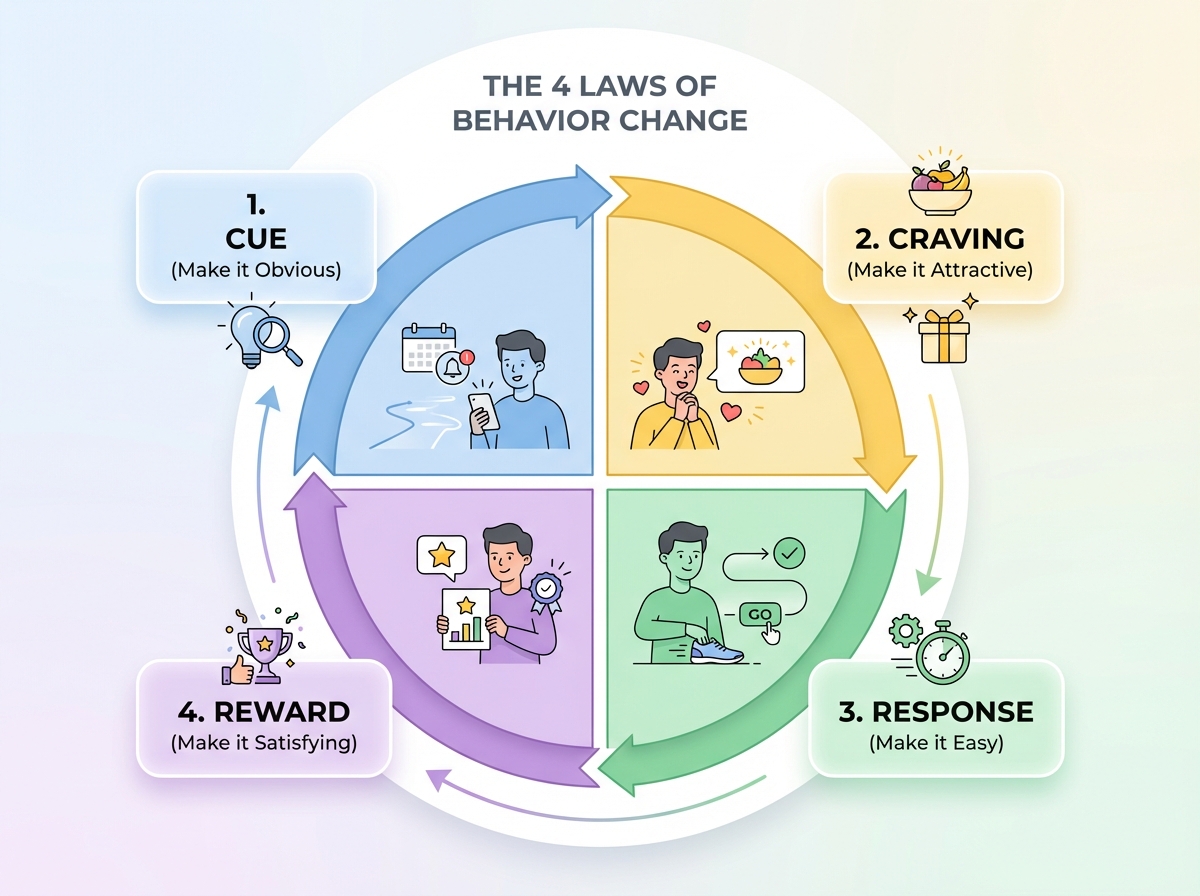
To build better habits, we can look to the feedback loop of human behavior: Cue, Craving, Response, and Reward. Based on this loop, we can establish the "Four Laws of Behavior Change" to create good habits.
The process of behavior change always starts with awareness. You need to be aware of your habits before you can change them.
Strategy: Implementation Intentions Many people think they lack motivation when what they really lack is clarity. An implementation intention is a plan you make beforehand about when and where to act. The formula is: "I will [BEHAVIOR] at [TIME] in [LOCATION]."
Strategy: Habit Stacking One of the best ways to build a new habit is to identify a current habit you already do each day and then stack your new behavior on top. This is called habit stacking. The habit stacking formula is: "After I [CURRENT HABIT], I will [NEW HABIT]."
The more attractive an opportunity is, the more likely it is to become habit-forming. Dopamine is driven by the anticipation of a reward, not just the receipt of it.
Strategy: Temptation Bundling Temptation bundling works by linking an action you want to do with an action you need to do. For example, you only allow yourself to listen to your favorite podcast (want) while exercising (need).
Human behavior follows the Law of Least Effort. We will naturally gravitate toward the option that requires the least amount of work. To build a habit, you must reduce the friction associated with the good behavior.
Strategy: The 2-Minute Rule When you start a new habit, it should take less than two minutes to do.
The point is not to do the one thing. The point is to master the habit of showing up. A habit must be established before it can be improved.
We are more likely to repeat a behavior when the experience is satisfying. The human brain evolved to prioritize immediate rewards over delayed rewards. This is why bad habits (smoking, overeating) are easy to pick up—the reward is immediate, while the cost is delayed.
Strategy: The Habit Tracker Making progress is satisfying, and visual measures provide clear evidence of your progress. A habit tracker is a simple way to measure whether you did a habit. It creates a visual chain that you don't want to break.
To break a bad habit, you simply invert the Four Laws:
Motivation is overrated; environment often matters more. Many of the actions we take each day are shaped not by purposeful drive and choice but by the most obvious option.
If you want to practice guitar more, place your guitar stand in the middle of the living room. If you want to drink more water, fill up a few water bottles each morning and place them in common locations around the house.
Stop relying on willpower and self-control. Instead, become the architect of your environment. Create a space where doing the right thing is the easiest thing.
Understanding the theory of Atomic Habits is the first step, but application is where transformation happens. This is where GPTnius bridges the gap between knowledge and action.
GPTnius offers AI Mentors that have been trained on proprietary research analyzing the published works, philosophies, and proven methodologies of thought leaders in behavior change and psychology. For example, our "Architect" mentor draws from research on frameworks like mental models and habit systems, combined with proven coaching models.
Here is how a GPTnius AI Mentor supports your habit-building journey:
By synthesizing these researched frameworks into personalized coaching conversations, GPTnius allows you to apply proven principles directly to your unique challenges.
> 💡 Build Your Systems with The Architect > > Don't let another burst of motivation fade away. Engage with an AI Mentor trained on the research behind the world's most effective habit-building frameworks to design a life of continuous improvement. > > Meet the AI mentors built from this research →
Success is not a goal to reach or a finish line to cross. It is a system to improve, an endless process to refine. Atomic Habits teaches us that if you change your habits, you change your life. But you don't change your life by snapping your fingers and deciding to be a completely different person. You change it by making 1% adjustments, designing your environment, and trusting the process of compounding.
The secret to getting results that last is to never stop making improvements. It’s remarkable what you can build if you just don't stop.
The 2-Minute Rule states that when you start a new habit, it should take less than two minutes to do. The goal is to master the art of 'showing up' before optimizing the habit. For example, 'read 30 minutes' becomes 'read one page.'
Goals are the results you want to achieve (e.g., losing 10 pounds), while systems are the processes that lead to those results (e.g., eating healthy daily). Atomic Habits argues that you should focus on systems because goals are temporary, while systems create long-term change.
Habit stacking is a strategy where you pair a new habit with a current habit you already perform automatically. The formula is: 'After I [Current Habit], I will [New Habit].' This leverages existing neural networks to build new behaviors.