Master goal setting with Ray Dalio's 5-Step Process. A comprehensive guide to applying the Dalio goal setting framework for personal and professional success.
Success is rarely a matter of luck; it is a matter of engineering. Ray Dalio’s 5-Step Process offers a proven goal setting framework that treats your life and career as a machine. By cycling through five distinct stages—setting clear goals, identifying problems, diagnosing root causes, designing plans, and executing relentlessly—you can evolve upward toward your ambitions. This guide breaks down each step with actionable advice on how to implement this methodology today.
---
Most people approach goal setting with a burst of enthusiasm followed by a slow fade. We set a New Year’s resolution, launch a new business initiative, or commit to a fitness regime, only to be derailed by the first significant obstacle. We often view these obstacles as signs of failure, or worse, bad luck.
However, according to the research analyzing the methodologies of Ray Dalio, founder of Bridgewater Associates and author of Principles, obstacles are not stop signs—they are data points. Dalio views the path to success not as a straight line, but as a continuous, upward-spiraling loop.
To achieve what you want in life, you must evolve. Evolution requires a systematic approach to processing reality. This is where Ray Dalio’s 5-Step Process comes in. It is a mental model that allows you to confront reality, dissect your failures, and re-engineer your approach to ensure success.
In this guide, we will dissect the Dalio goal setting framework step-by-step, providing you with a roadmap to implement these principles in your own life.
Before diving into the specific steps, it is crucial to understand the philosophy behind the process. Dalio suggests that you should look at your life as a machine. You are the designer of that machine, but you are also a worker inside it. The goal is to evolve the machine so that it produces better results over time.
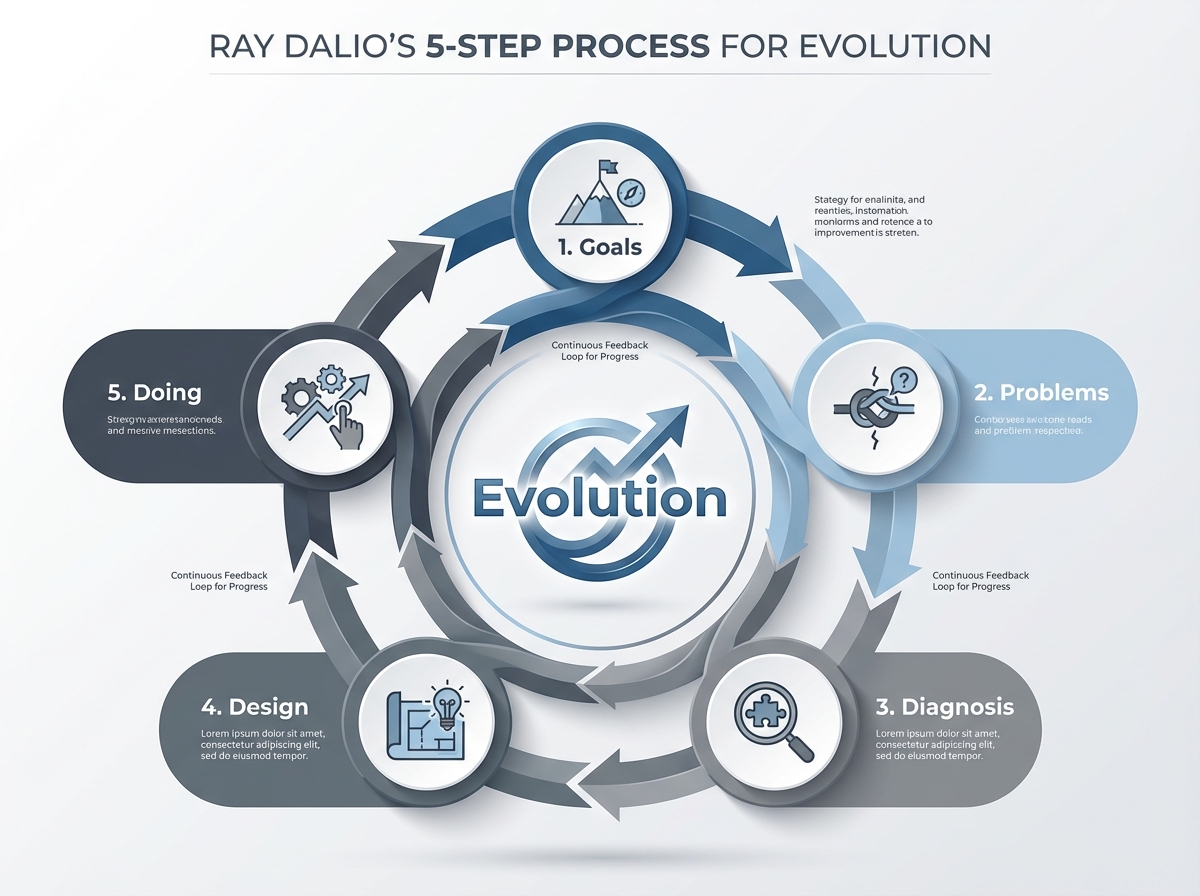
The 5-Step Process is a loop. Once you complete Step 5, you don't stop; you set a higher, more audacious goal (Step 1) and begin again. The steps are:
If you can do these five things well, you will almost certainly succeed. If you fail, it is likely because you are neglecting one of these specific steps.
> 💡 Struggling to Structure Your Path to Success? > > It’s easy to read about frameworks, but harder to implement them alone. GPTnius AI Mentors are trained on proprietary research analyzing frameworks like this to help you audit your current goals and identify where your "machine" is breaking down. > > Meet the AI mentors built from this research →
The first step in the Dalio goal setting framework seems obvious, yet it is where most people falter. The issue is usually a lack of prioritization. You can have virtually anything you want, but you cannot have everything you want.
A goal is something you want to achieve (e.g., "Run a marathon"). A desire is something you want that might prevent you from achieving your goal (e.g., "Eat pizza every night" or "Sleep in until noon"). Desires are often first-order consequences that feel good now but bad later. Goals are often second-order consequences that require short-term sacrifice for long-term gain.
Don't rule out a goal because you think it is unattainable. At this stage, you should not worry about how you will achieve it. That comes later. If you limit your goals to what you currently know how to do, you set the bar too low. Focus on the "what," not the "how."
Once you pursue your goals, reality will hit you. You will encounter obstacles. In the 5 step process to success, problems are not bad things; they are gifts. They are specific indicators that something in your "machine" is broken and needs fixing.
Most people react to problems with anxiety, frustration, or denial. To succeed, you must view pain as a signal. Dalio’s famous equation is: Pain + Reflection = Progress.
identifying a problem is useless if you tolerate it. If you have a team member who consistently underperforms, or a habit that drains your energy, acknowledging it isn't enough. You must decide that the problem is unacceptable. Tolerating a problem is the same as identifying it and choosing not to fix it.
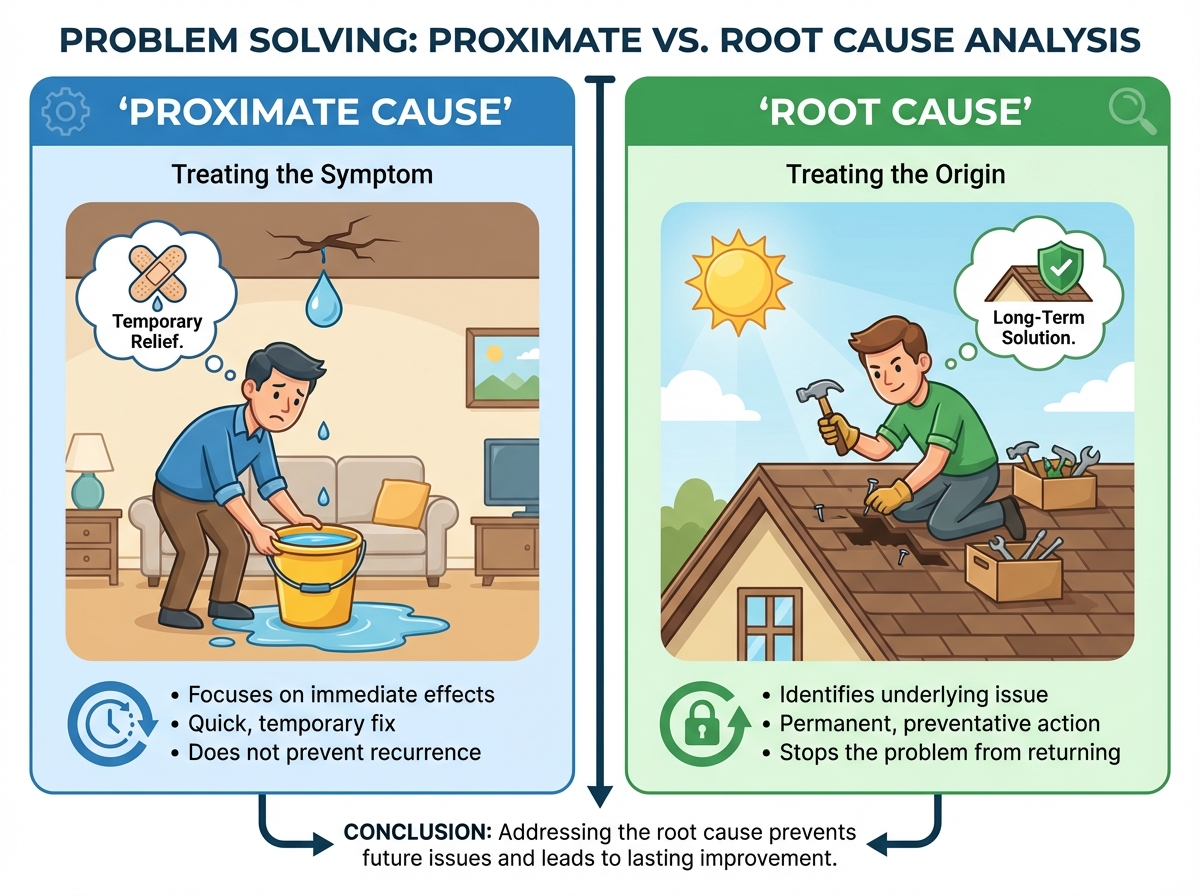
This is perhaps the most intellectually difficult step. When a problem occurs, our instinct is to jump to a quick fix. However, how to achieve goals Ray Dalio style requires you to slow down and find the root cause.
A proximate cause is the immediate reason something happened (e.g., "I missed the bus because I was late"). The root cause is the deeper reason (e.g., "I am chronically disorganized in the mornings because I don't prepare the night before"). If you only fix the proximate cause, the problem will return. If you fix the root cause, the problem disappears forever.
Root causes usually stem from one of two places:
Often, the root cause is you. Your ego may prevent you from admitting a mistake or a weakness. You must be willing to look at your own flaws objectively.
Once you have diagnosed the root cause, you must design a way to get around it. This is where you write the script for your movie. You are the architect determining what needs to be done to fix the machine.
Think of your plan as a bridge connecting where you are now to your goal. You need to visualize the steps required to build that bridge. This step is about strategy, not execution. You are determining who needs to do what by when.
When designing your plan, consider the ripple effects. If you implement a new software to fix an efficiency problem (Step 3), will that create a training bottleneck? A good design anticipates future friction.
Even the best design is worthless without execution. This step requires discipline, good habits, and the drive to get results. This is where the Dalio principles goal setting moves from the intellectual to the physical.
Step 5 is often the longest phase. It requires you to follow the script you wrote in Step 4. Many visionaries fail here because they get bored with the details. Many diligent workers fail here because they are executing a bad plan (skipping Steps 3 and 4).
You must establish clear metrics to know if you are on track. If you drift, you need a mechanism to pull you back.
Why do people fail to use this process? According to the research on Dalio's philosophy, the two biggest barriers are Ego and Blind Spots.
To master the 5-Step Process, you must practice Radical Open-Mindedness. You must be willing to accept that you might be wrong and seek out credible people who disagree with you to stress-test your thinking.
Implementing the Ray Dalio 5-Step Process requires a level of objectivity that is difficult to achieve on your own. It is hard to diagnose your own root causes when your ego is involved. This is where GPTnius can become a vital tool in your personal growth stack.
GPTnius offers AI Mentors that have been trained on proprietary research analyzing the published works, philosophies, and proven methodologies of thought leaders. For example, our "The Architect" mentor draws from research on frameworks like the one discussed in this article, combined with proven coaching models.
Here is how an AI Mentor can assist you through the loop:
By engaging in these personalized coaching conversations, you can apply these proven principles directly to your specific challenges.
> 💡 Ready to Engineer Your Success? > > Stop guessing why your goals aren't manifesting. Use GPTnius AI Mentors to systematically apply the 5-Step Process to your career and life today. > > Meet the AI mentors built from this research →
Achieving your goals is not about hoping for the best. It is about building a machine that generates results. Ray Dalio’s 5-Step Process provides the blueprints for that machine. By clearly defining your goals, identifying problems, diagnosing root causes, designing plans, and executing with discipline, you can evolve faster than you ever thought possible.
Remember, the process is a loop. Every success is simply a platform for a higher, more challenging goal. Start Step 1 today, and begin your ascent.
The 5 steps are: 1. Have clear goals. 2. Identify and don't tolerate problems. 3. Diagnose problems to get at their root causes. 4. Design a plan. 5. Push through to completion.
Diagnosing the root cause ensures you are solving the actual origin of the problem, rather than just treating the symptoms (proximate causes). If you only treat symptoms, the problem will inevitably return.
The Design step involves creating a specific plan to address the root causes you identified. It requires visualizing the path to your goal, writing down who will do what and when, and anticipating potential friction points before you start executing.