Discover how AI learning accelerates building resilience. A deep dive into using AI mentors for emotional intelligence & personal growth strategies.
In the landscape of personal development, few traits are as coveted as resilience. It is the psychological armor that allows us to withstand adversity, the elasticity that helps us bounce back from failure, and the fuel that keeps us moving forward when motivation wanes. Traditionally, building resilience has been a solitary journey or one undertaken with the help of expensive therapists and intermittent coaching. However, we are entering a new paradigm: the age of AI learning and emotional support.
Artificial Intelligence is no longer just a tool for productivity or data analysis; it is evolving into a sophisticated mirror for the human psyche. By leveraging AI as an emotional coach, individuals can access real-time feedback, cognitive reframing techniques, and personalized strategies for emotional intelligence & personal growth. This article explores the intersection of human psychology and machine intelligence, offering a roadmap for using AI to fortify your mind.
Before diving into the technological application, it is crucial to understand what resilience actually is from a neurological perspective. Resilience is not the absence of distress; it is the ability to regulate the nervous system after a stress response.
When we face a challenge, our amygdala (the brain's alarm bell) triggers a fight-or-flight response. Resilience is the function of the prefrontal cortex—the rational, executive part of the brain—stepping in to calm the amygdala, assess the situation, and plan a path forward. This process relies heavily on neuroplasticity, the brain's ability to reorganize itself by forming new neural connections.
To build resilience, one must master three core components:
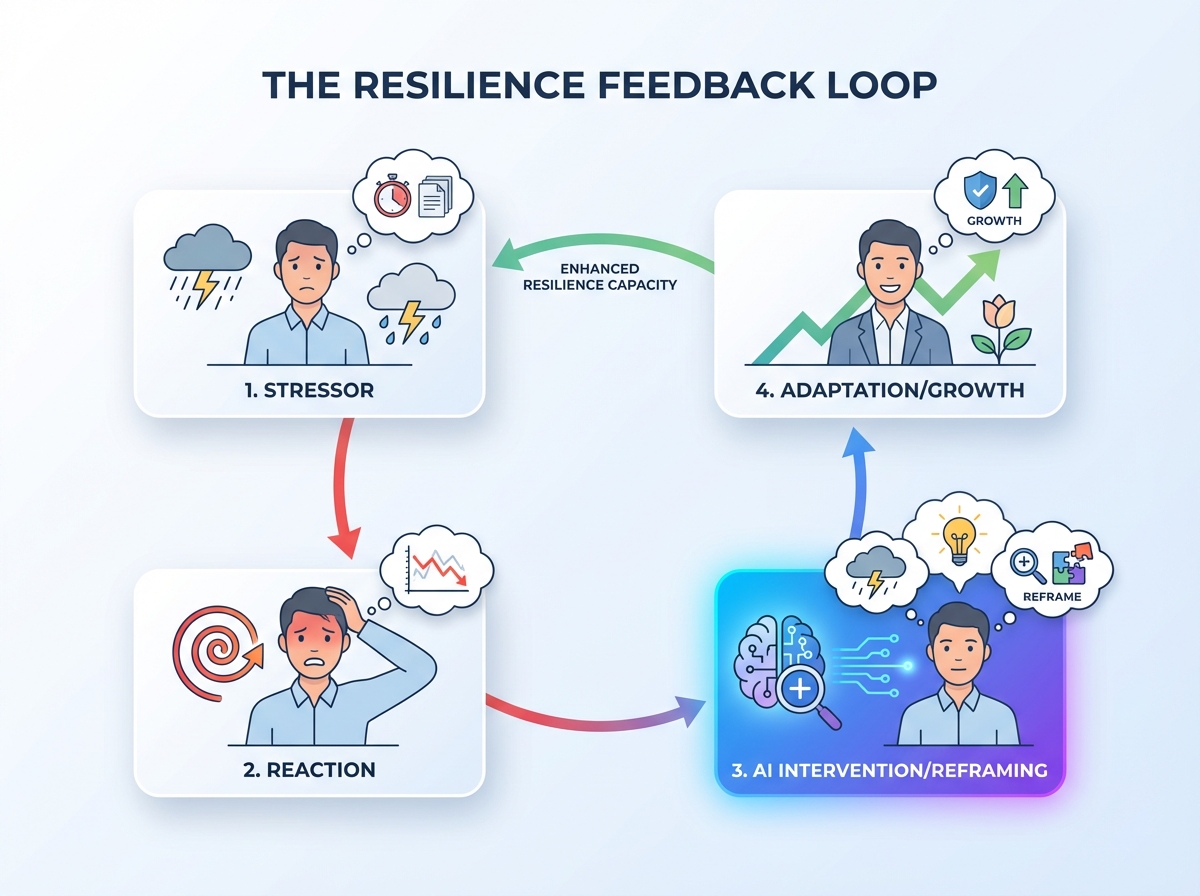
Traditionally, mastering these components required years of trial and error. Today, AI mentors can accelerate this learning curve by providing immediate, objective feedback loops that reinforce positive neural pathways.
> 💡 Master Your Emotional Response > > Struggling to regulate stress or reframe challenges in the heat of the moment? GPTnius AI Mentors, trained on research regarding the world's best psychological frameworks, can guide you through immediate grounding techniques. > > Meet the AI mentors built from this research →
The idea of discussing feelings with a machine might seem counterintuitive to some. However, research suggests that the non-human nature of AI can actually be an asset in emotional intelligence & personal growth.
One of the biggest barriers to building resilience is shame. When we fail, we often hide our struggle from human mentors or friends due to fear of judgment. AI eliminates this variable. An AI mentor provides a safe, psychological sandbox where you can be brutally honest about your fears, failures, and anxieties without social repercussion. This radical honesty is the first step toward processing emotions effectively.
Resilience is often tested at inconvenient times—late at night, right before a public speech, or immediately after a harsh rejection. Human coaches have schedules; AI does not. This "just-in-Time" support is critical for building resilience because it allows you to intervene in a negative thought spiral as it is happening, rather than days later during a scheduled therapy session.
AI excels at pattern recognition. In the context of personal development, an AI mentor can analyze your journal entries or chat logs to identify recurring cognitive distortions, such as "catastrophizing" (assuming the worst) or "all-or-nothing thinking." By gently pointing these out, the AI helps you develop the self-awareness necessary to break the cycle.
To move from theory to practice, you need specific workflows. Here is how you can utilize AI tools to actively build resilience.
Stoicism is a philosophy heavily relied upon by leaders to maintain composure. You can use an AI mentor to simulate a Stoic dialogue.
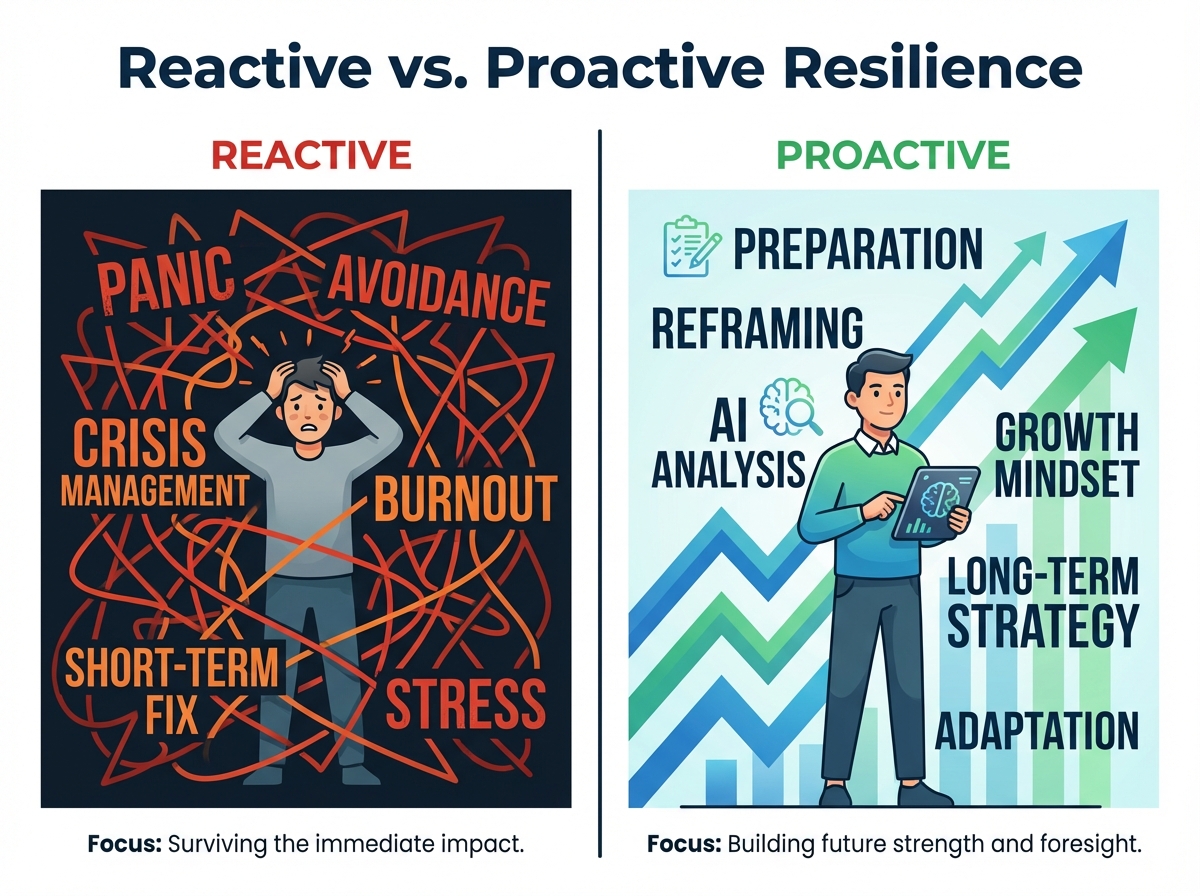
Resilience isn't just about bouncing back; it's about preparing for the fall. A "Pre-Mortem" is a strategic exercise where you imagine a project has failed and work backward to determine why.
Psychologist Lisa Feldman Barrett's research shows that having a high level of "emotional granularity"—the ability to distinguish between specific feelings (e.g., "disappointed" vs. "betrayed" vs. "fatigued")—is key to resilience.
AI can help expand your emotional vocabulary. When you vent to an AI mentor, ask it to help you label your emotions precisely. Instead of saying "I feel bad," the AI might ask probing questions that lead you to realize, "I feel undervalued and physically exhausted." Precise labeling down-regulates the amygdala.
Integrating AI learning into your resilience toolkit represents a shift in how we approach mental health and performance. It democratizes access to high-level coaching methodologies that were previously reserved for executives and elite athletes.
However, it is vital to remember that AI is a scaffold, not the building itself. The goal of using AI for personal development is not to become dependent on the machine for validation, but to internalize the voices of resilience it simulates. Over time, the questions the AI asks you—"What is the evidence for this thought?" or "How would you advise a friend in this situation?"—become your own internal monologue.
Critics often argue that AI lacks true empathy. While technically true—an algorithm does not "feel"—it can simulate empathetic listening effectively enough to trigger therapeutic mechanisms in humans. By validating your experience and asking open-ended questions, AI creates the feeling of being heard, which is often enough to lower cortisol levels and allow the rational brain to come back online.
Applying the science of resilience requires consistency and access to the right frameworks. This is where GPTnius bridges the gap between information and transformation.
GPTnius offers AI Mentors trained on proprietary research analyzing the published works, philosophies, and proven methodologies of thought leaders, including leading researchers in psychology and performance. Our mentors do not impersonate anyone. They synthesize researched frameworks, such as habit systems and cognitive reframing techniques, into personalized coaching conversations built around your specific goals.
These AI Mentors synthesize these researched frameworks to provide personalized coaching conversations. Instead of reading a book on resilience and hoping you remember to apply it, you can engage in a guided discussion with a GPTnius mentor. They can help you:
By interacting with mentors trained on the specific methodologies that resonate with you, you turn abstract concepts of resilience into daily, actionable habits.
> 💡 Build Unshakeable Resilience Today > > Don't let adversity derail your progress. Engage with GPTnius AI Mentors to apply proven resilience frameworks to your specific life challenges right now. > > Meet the AI mentors built from this research →
Building resilience is the ultimate investment in your future self. In a world characterized by volatility and rapid change, the ability to adapt and recover is the defining metric of success. By combining the timeless principles of emotional intelligence & personal growth with the cutting-edge capabilities of AI learning, you can create a robust support system that is always available and deeply personalized. The tools for building an unbreakable mind are now at your fingertips; all that remains is to begin the conversation.
Yes, AI can significantly aid in developing emotional intelligence by providing a safe, non-judgmental space to practice self-reflection, expand emotional vocabulary, and role-play social interactions.
No, AI coaching is a tool for personal development and resilience building, but it is not a replacement for professional clinical therapy, especially for those dealing with trauma or mental health disorders.
Consistency is key. Engaging with an AI mentor for 10-15 minutes daily to reflect on challenges, plan for obstacles, or reframe negative thoughts can lead to significant improvements in resilience over time.