Carl Jung’s Archetypes Explained: Unlocking the Secrets of the Collective Unconscious
Explore the comprehensive Jungian archetypes list and discover how these universal patterns shape your personality, behavior, and personal growth path.
Introduction: The Universal Language of the Human Psyche
Have you ever watched a movie or read a novel and felt an instant, almost primal recognition of a character? You know the "Wise Old Man" before he speaks, or you understand the motivations of the "Rebel" without needing their backstory. This isn't a coincidence; it is a manifestation of what Swiss psychiatrist Carl Jung called archetypes.
!Key Concept Diagram
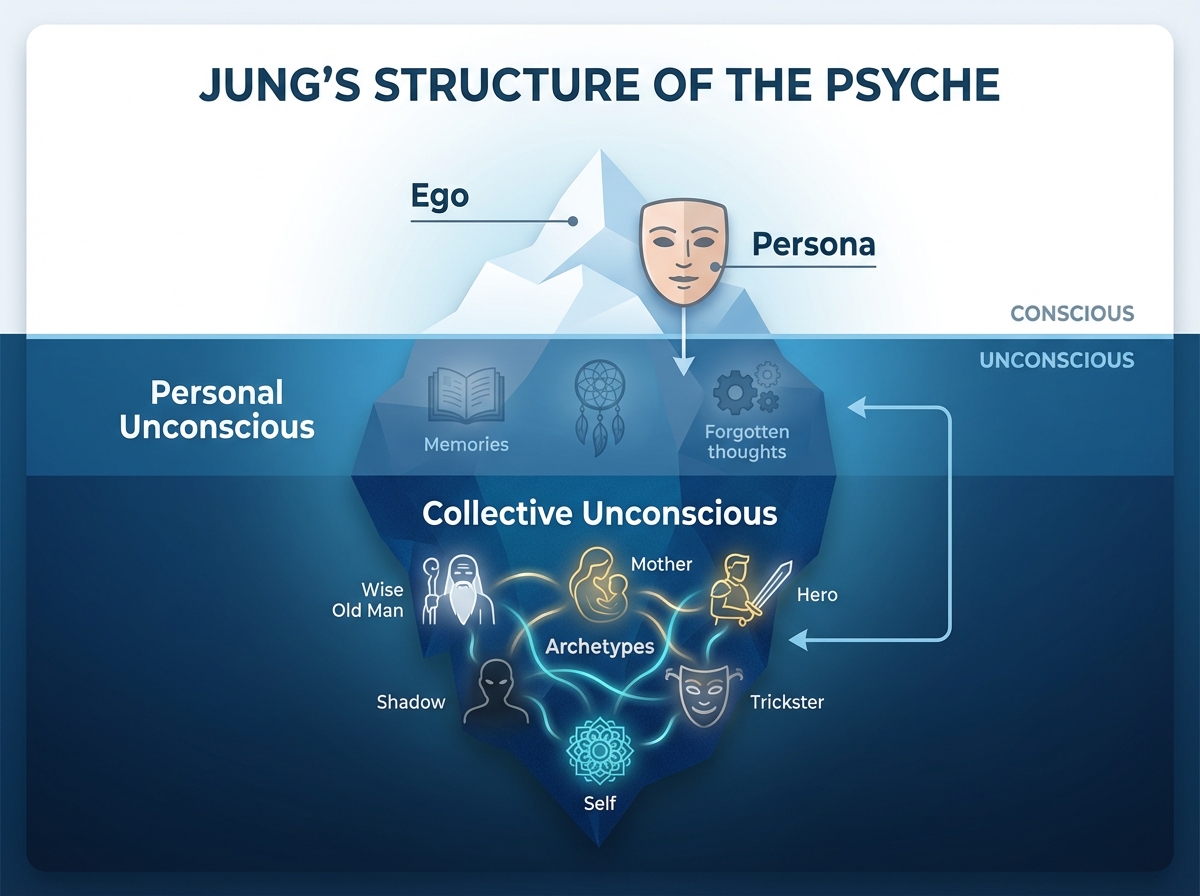
Jung believed that beneath our personal memories and experiences lies a deeper layer of the psyche: the collective unconscious. This reservoir contains the entire psychic heritage of mankind, structured by archetypes—universal, archaic patterns and images that derive from the collective unconscious and are the psychic counterpart of instinct.
Understanding these patterns is not merely an academic exercise in psychology. It is a powerful tool for self-discovery. By recognizing the archetypes active in your own life, you can unlock the secrets of your motivations, fears, and potential, moving from unconscious reaction to conscious creation.
What Are Archetypes?
At their core, archetypes are the "DNA" of the human psyche. They are not specific images or ideas, but rather potentials for images and ideas. Jung described them as forms without content, representing the possibility of a certain type of perception and action.
Think of archetypes like the dry riverbeds of the mind. They are not the water itself, but they determine the direction the water (your psychic energy or libido) will flow when it rains. When an archetype is activated—perhaps by a life event, a crisis, or a piece of art—it seizes us with a peculiar power.
The Collective Unconscious vs. The Personal Unconscious
To understand what are archetypes, we must distinguish between two layers of the unconscious mind defined by Jung:
- The Personal Unconscious: This consists of lost memories, repressed ideas, and subliminal perceptions. Its contents are unique to you and your life history.
- The Collective Unconscious: This is the deepest layer of the psyche, shared by all human beings. It contains the accumulated experiences of our species, organized into archetypes. This is why similar myths, symbols, and religious figures appear in cultures that had no contact with one another.
The Structure of the Psyche: Ego, Persona, and Self
Before diving into the Jungian archetypes list, it is helpful to visualize the stage upon which these figures play out.
- The Ego: The center of consciousness. It is the "I" that you identify with—your thoughts, feelings, and memories that you are aware of.
- The Persona: The mask we wear to show the world. It is the social face the individual presents to society—"a kind of mask, designed on the one hand to make a definite impression upon others, and on the other to conceal the true nature of the individual."
- The Shadow: The dark side of the psyche, consisting of the traits we dislike and repress. It is everything the individual refuses to acknowledge about themselves.
- The Self: The unification of consciousness and unconsciousness. It represents the psyche as a whole and is the ultimate goal of Jungian psychology (a process called individuation).
> 💡 Uncover the Hidden Patterns Driving Your Decisions > > Understanding the structure of your psyche is the first step, but applying it requires personalized guidance. GPTnius AI Mentors, trained on proprietary research analyzing Jungian frameworks and modern psychology, can help you identify which archetypes are currently influencing your career and relationships. > > Meet the AI mentors built from this research →
The 12 Common Archetypes: A Comprehensive List
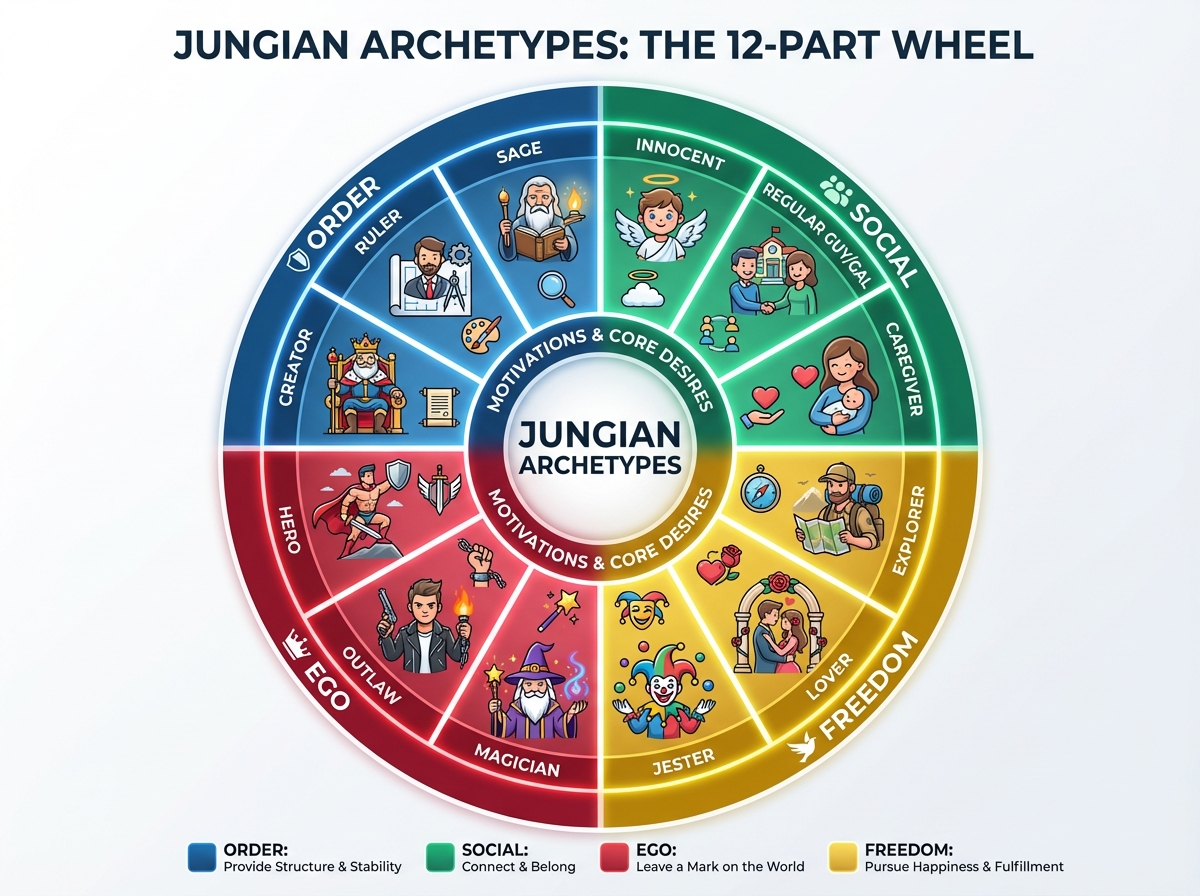
While there are countless archetypes, Jungian psychology and subsequent scholars (like Carol Pearson) have identified 12 primary archetypes that represent the full spectrum of basic human motivations. These are often grouped into four cardinal orientations: Ego (leaving a mark), Order (structure), Social (connecting), and Freedom (spirituality).
1. The Innocent
- Goal: To be happy.
- Fear: Being punished for doing something bad or wrong.
- Strategy: Do things right.
- Talent: Faith and optimism.
- Shadow: Naivety, denial of reality.
- Example: Buddy the Elf, Forrest Gump.
2. The Everyman (The Orphan)
- Goal: To belong.
- Fear: Being left out or standing out from the crowd.
- Strategy: Develop ordinary solid virtues, be down to earth.
- Talent: Realism, empathy, lack of pretense.
- Shadow: Losing one's own self in an effort to blend in.
- Example: Ron Weasley, Bilbo Baggins (initially).
3. The Hero
- Goal: To exert mastery in a way that improves the world.
- Fear: Weakness, vulnerability, being a "chicken."
- Strategy: To be as strong and competent as possible.
- Talent: Competence and courage.
- Shadow: Arrogance, needing another war to fight.
- Example: Achilles, Wonder Woman, Luke Skywalker.
4. The Caregiver
- Goal: To help others.
- Fear: Selfishness and ingratitude.
- Strategy: Doing things for others.
- Talent: Compassion, generosity.
- Shadow: Martyrdom, enabling others.
- Example: Mary Poppins, Samwise Gamgee.
5. The Explorer
- Goal: To experience a better, more authentic, more fulfilling life.
- Fear: Getting trapped, conformity, and inner emptiness.
- Strategy: Journey, seeking out and experiencing new things.
- Talent: Autonomy, ambition, being true to one's soul.
- Shadow: Aimless wandering, inability to commit.
- Example: Indiana Jones, Moana.
6. The Rebel (The Outlaw)
- Goal: To overturn what isn't working.
- Fear: To be powerless or ineffectual.
- Strategy: Disrupt, destroy, or shock.
- Talent: Radical freedom, adaptability.
- Shadow: Crossing over to the dark side, crime.
- Example: Robin Hood, Han Solo, Katniss Everdeen.
7. The Lover
- Goal: Being in a relationship with the people, work, and surroundings they love.
- Fear: Being alone, a wallflower, unwanted, unloved.
- Strategy: To become more and more physically and emotionally attractive.
- Talent: Passion, gratitude, appreciation, commitment.
- Shadow: Obsession, jealousy, loss of self.
- Example: Romeo and Juliet, Rose (Titanic).
8. The Creator
- Goal: To realize a vision.
- Fear: Mediocre vision or execution.
- Strategy: Develop artistic control and skill.
- Talent: Creativity and imagination.
- Shadow: Perfectionism, bad creation.
- Example: Tony Stark, Steve Jobs.
9. The Jester
- Goal: To have a great time and lighten up the world.
- Fear: Being bored or boring others.
- Strategy: Play, make jokes, be funny.
- Talent: Joy.
- Shadow: Frivolity, wasting time, hiding pain behind humor.
- Example: The Genie (Aladdin), Tyrion Lannister.
10. The Sage
- Goal: To use intelligence and analysis to understand the world.
- Fear: Being duped, misled, or ignorant.
- Strategy: Seeking out information and knowledge; self-reflection.
- Talent: Wisdom, intelligence.
- Shadow: Can study details forever and never act (paralysis by analysis).
- Example: Yoda, Gandalf, Dumbledore.
11. The Magician
- Goal: To make dreams come true.
- Fear: Unintended negative consequences.
- Strategy: Develop a vision and live by it.
- Talent: Finding win-win solutions, transforming situations.
- Shadow: Becoming manipulative.
- Example: Merlin, Doctor Strange.
12. The Ruler
- Goal: Create a prosperous, successful family or community.
- Fear: Chaos, being overthrown.
- Strategy: Exercise power.
- Talent: Responsibility, leadership.
- Shadow: Tyranny, being authoritarian.
- Example: Mufasa, Miranda Priestly.
Archetypes in Literature and Pop Culture
One of the easiest ways to understand common archetypes is to look at storytelling. Stories resonate with us because they reflect the internal drama of the human psyche. Writers, consciously or unconsciously, tap into these universal forms.
Archetypes in literature provide a shorthand for character development. When we see a "Mentor" figure (The Sage) hand a weapon to a young protagonist (The Hero), we immediately understand the stakes. However, great storytelling—and great psychological development—occurs when these archetypes are nuanced.
For example, Walter White in Breaking Bad begins as an Everyman/Caregiver but slowly transitions into a corrupted Ruler/Magician (Heisenberg). This shift in archetypal dominance is what makes his character arc so compelling and tragic.
!Process Diagram
The Shadow: The Archetype We Fear
No discussion of Jung is complete without addressing the Shadow. The Shadow is not inherently evil; it is simply the "other." It contains all the parts of ourselves that we have rejected—our aggression, our sexual desires, our perceived weaknesses, but also our latent creativity and power.
Jung famously stated, "One does not become enlightened by imagining figures of light, but by making the darkness conscious."
When we ignore our Shadow, we tend to project it onto others. If you find yourself irrationally irritated by someone who is loud and boastful, it may be because you have repressed your own "Ruler" or "Jester" energy and are projecting that suppression onto them. Integrating the Shadow—accepting these parts of ourselves—is essential for becoming a whole person.
Why Understanding Archetypes Matters for You
Why should you care about these ancient patterns? Because they are running your life, whether you know it or not.
- Breaking Repetitive Cycles: Do you always date the same type of person? Do you always quit jobs at the same point? You may be acting out a negative aspect of the "Lover" or "Explorer" archetype.
- Career Alignment: A person dominated by the "Creator" archetype will likely wither in a bureaucratic job suited for the "Ruler" or "Everyman."
- Personal Branding: In the modern world, understanding your archetype helps you communicate your value. Are you the "Sage" who offers wisdom, or the "Rebel" who disrupts the status quo?
- Empathy: Understanding that others are driven by different archetypal needs helps reduce conflict. You realize the "Ruler" isn't trying to control you personally; they are trying to create order out of chaos.
How GPTnius Helps You Apply These Principles
Reading about archetypes provides intellectual understanding, but integrating them into your life requires active reflection and application. This is where GPTnius bridges the gap between theory and practice.
GPTnius offers AI Mentors trained on proprietary research analyzing the published works and methodologies of psychology thought leaders and renowned coaches. These mentors do not simply recite definitions; they help you apply the frameworks to your specific context.
Here is how a GPTnius AI Mentor can assist you in your individuation journey:
- Archetypal Assessment: Through guided conversation, the AI Mentor can help you identify which archetypes are currently dominant in your life and which are suppressed in your Shadow.
- Shadow Work Simulation: You can engage in safe, private roleplay scenarios to confront difficult aspects of your personality or prepare for conflicts, using frameworks analyzed from Jungian research.
- Strategic Alignment: If you are a "Creator" stuck in a "Ruler" role, the AI Mentor can synthesize coaching methodologies to help you restructure your habits or career path to better align with your natural psychological makeup.
- Objective Reflection: Unlike a human friend who might project their own biases, the AI Mentor provides feedback based strictly on the logic of the frameworks it has been trained on, acting as a mirror for your psyche.
> 💡 Ready to Meet Your Mentor? > > Stop guessing which patterns are holding you back. Engage with a GPTnius AI Mentor—trained on the deepest research into human behavior and success frameworks—to unlock your full potential today. > > Meet the AI mentors built from this research →
Conclusion
Carl Jung’s archetypes offer a profound map of the human soul. They explain our shared humanity while providing a key to our individual uniqueness. Whether you identify with the courage of the Hero, the wisdom of the Sage, or the freedom of the Explorer, recognizing these patterns is the first step toward living a conscious, integrated life. By making the unconscious conscious, you cease to be a puppet of ancient patterns and become the author of your own story.
Frequently Asked Questions
What are the 12 main archetypes?
The 12 main Jungian archetypes are the Ruler, Creator/Artist, Sage, Innocent, Explorer, Rebel, Hero, Wizard/Magician, Jester, Everyman, Lover, and Caregiver. These represent the spectrum of basic human motivations.
How do I find my Jungian archetype?
You can identify your dominant archetype by examining your core desires, fears, and behaviors. Reflect on which stories resonate with you and what roles you naturally take in groups. Working with a mentor or using self-reflection tools can also help clarify your primary patterns.
Can your archetype change over time?
Yes, your dominant archetype can shift as you move through different stages of life. For example, young adults often embody the Hero or Explorer, while older adults may transition toward the Ruler or Sage as their priorities shift from discovery to legacy.
What is the difference between an archetype and a stereotype?
An archetype is a universal, primal pattern or container for personality that allows for individual nuance. A stereotype is a simplified, often overused and rigid generalization about a group of people. Archetypes add depth to character; stereotypes reduce it.
Related Articles