Discover why happiness is a skill you can learn, not a trait you inherit. Explore Naval's philosophy on desire, peace, and training your mind for contentment.
We live in an age of unprecedented abundance, yet genuine happiness feels more elusive than ever. We are taught that happiness is a destination—a place we arrive at once we get the promotion, buy the house, or find the perfect partner. We treat it as a reward for suffering, a prize waiting at the finish line of a marathon called "success."
However, one of the most profound modern philosophical frameworks challenges this narrative entirely. Derived from the thoughts and tweets of Naval Ravikant, a philosophy has emerged that reframes happiness not as a destination, but as a skill.
Just as you go to the gym to train your muscles or study code to learn programming, you must train your mind to be happy. It is not something you inherit; it is something you choose, practice, and eventually master. This perspective shifts the power dynamic. If happiness is a skill, it means you are not a victim of your biochemistry or your circumstances. It means you have agency.
In this comprehensive guide, we will dismantle the misconceptions surrounding contentment and explore the actionable frameworks behind the idea that happiness is a choice you make, moment by moment.
Most people view happiness as a variable dependent on external inputs. The equation usually looks like this: If [Good Thing] happens, then I will be happy.
Naval’s philosophy flips this equation. It suggests that the default state of the human mind is peace and happiness, but we cloud it with a constant stream of desires, judgments, and anxieties. Therefore, happiness is not about adding something to your life; it is about subtracting the noise that obscures your natural state.
To view happiness as a skill requires accepting that your emotional reaction to an event is distinct from the event itself. The event is neutral; your reaction is the filter.
Developing this skill requires "debugging" your mind. You must identify the loops of negative self-talk and judgmental conditioning that run in the background of your consciousness and rewrite the code.
> 💡 Master the Skill of Emotional Regulation > > Learning to separate events from your reactions is difficult without guidance. An AI Mentor can help you role-play challenging scenarios to practice this "neutrality" skill in real-time. > > Meet the AI mentors built from this research →
Perhaps the most famous axiom in this philosophical framework is the definition of desire:
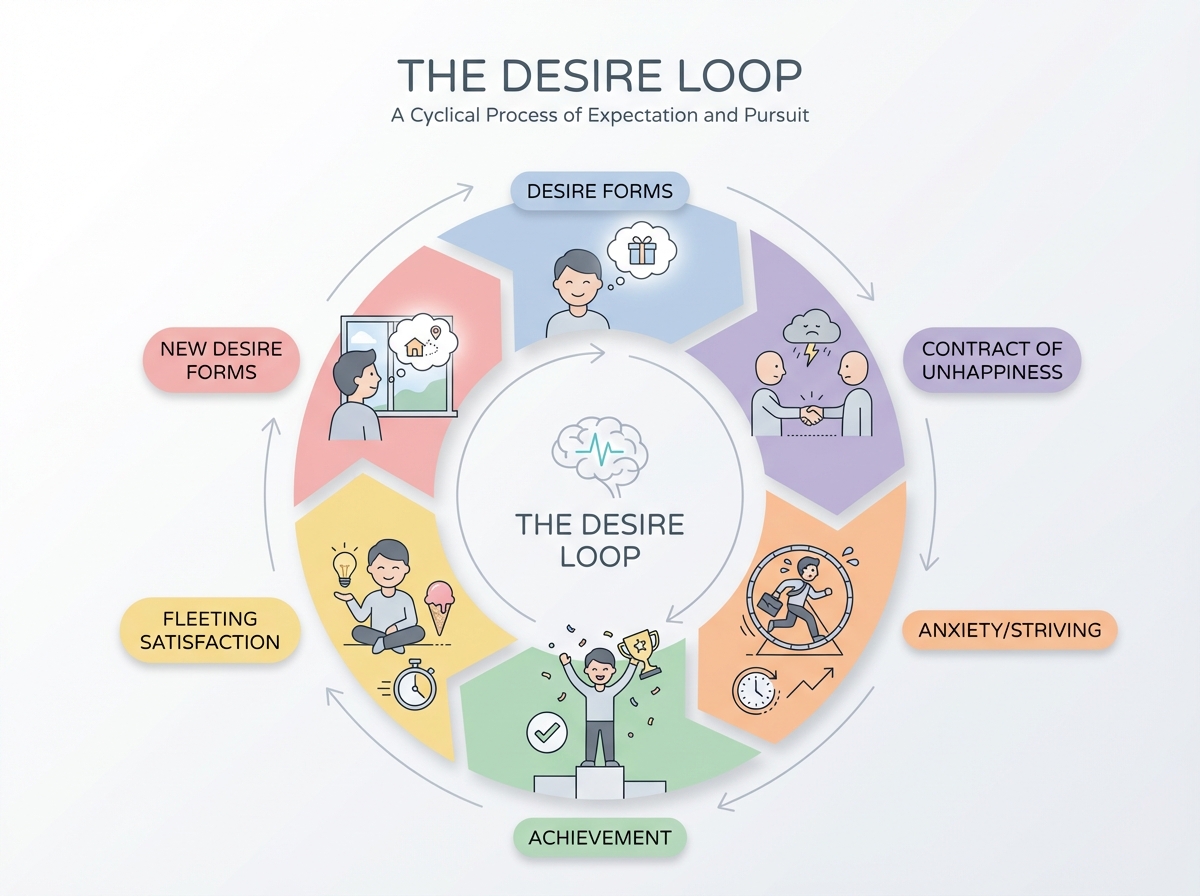
"Desire is a contract that you make with yourself to be unhappy until you get what you want."
This is a radical way to view goal-setting. Society celebrates ambition and desire as the engines of progress. While desire drives external progress, it simultaneously destroys internal peace. When you desire something, you are essentially telling yourself, "I am not enough, and my life is not enough, until X happens."
The problem with this contract is that it is never truly fulfilled. As soon as you get what you want—the car, the job, the status—the happiness you feel is fleeting. It isn't the presence of the object that makes you happy; it is the temporary absence of the desire for it.
For a brief moment, you have no "contracts" open. You are content. But inevitably, a new desire forms, a new contract is signed, and the suffering begins again.
Does this mean you should never want anything? No. It means you should be extremely selective about your desires.
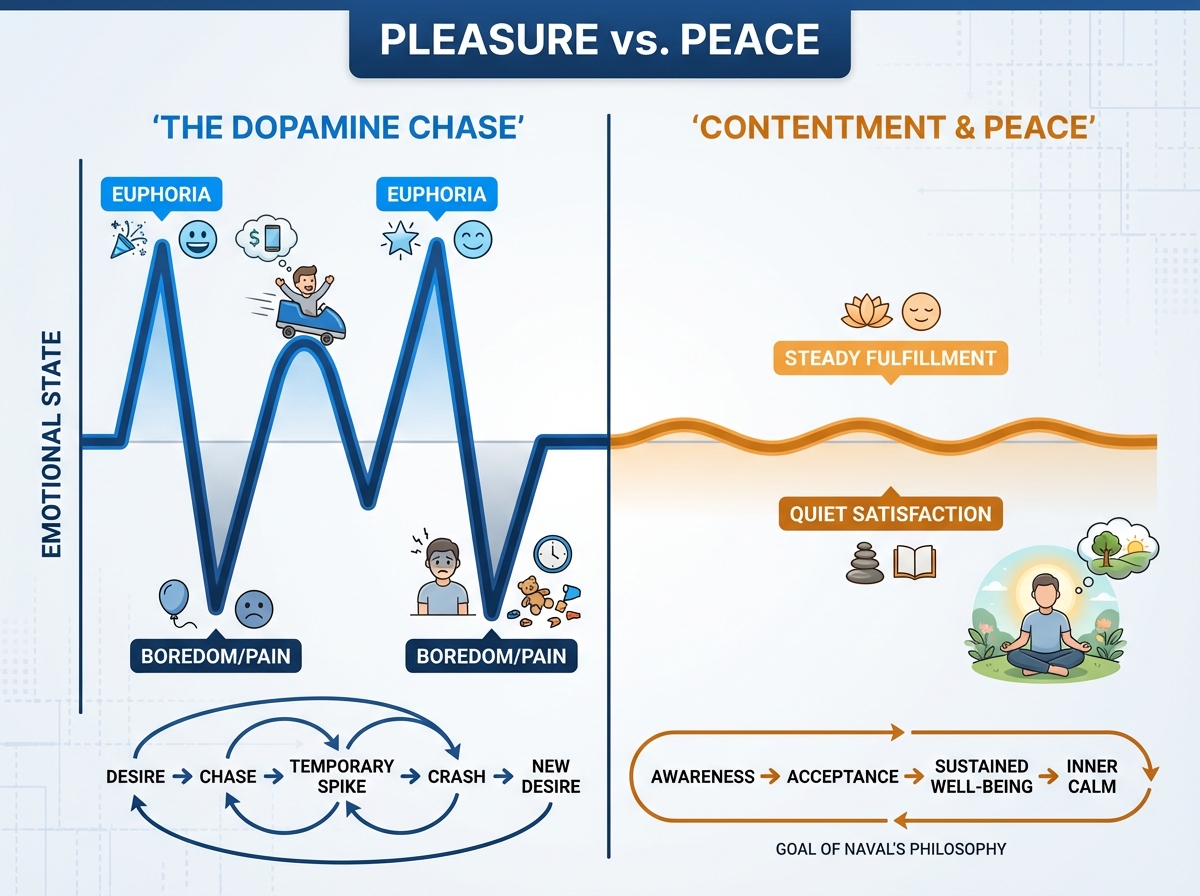
When people say they want to be "happy," they often mean they want to be "excited" or "euphoric." They are chasing a dopamine high.
However, in the context of Naval’s philosophy, happiness is synonymous with peace.
If you chase the highs, you must accept the lows. If you seek peace, you are looking for a baseline of contentment that isn't easily shaken by external events. A peaceful mind is a mind that is not constantly problem-solving or reviewing the past.
If happiness is a skill, how do we practice it? You cannot just "decide" to be happy without changing your habits. Here are several actionable techniques derived from research into these mental models.
Meditation is often mystified, but it is simply the practice of sitting with your thoughts until they settle. It is the art of doing nothing.
Envy is the enemy of happiness. We often look at a successful person and think, "I want their money" or "I want their body."
Naval proposes a powerful mental check: You cannot cherry-pick. If you want to trade places with someone, you must take their entire life. You must take their age, their family trauma, their health issues, their anxieties, and their sleepless nights along with their money or fame.
When you view the swap in its totality, you will almost always choose to be yourself. This realization instantly dissolves envy.
Anxiety lives in the future; guilt lives in the past. Happiness lives in the present.
Most of our internal monologue is obsessed with time travel. We re-litigate past arguments or rehearse future confrontations. Training your focus on the immediate sensation of being alive—the feeling of the sun, the taste of coffee, the sound of the wind—anchors you in the only time that actually exists.
Reality is neutral. Your interpretation is what colors it.
You can train yourself to interpret events in a way that serves your peace rather than your anger. This isn't about delusion; it's about utility. Which interpretation makes your life better?
While happiness is internal, external freedom helps. It is difficult to be peaceful when you are struggling to survive or are trapped in a job you hate.
This is where the intersection of wealth and happiness occurs. Money does not buy happiness, but it buys freedom. It solves your money problems so you can focus on your mental problems.
When you have financial freedom, you remove a massive source of low-level anxiety from your life, making the skill of happiness easier to practice. However, do not fall into the trap of thinking the money itself will fix you. It will simply leave you with a different set of problems—but better problems to have.
Reading about happiness as a skill is the first step, but applying it requires consistent practice and feedback. This is where GPTnius bridges the gap between theory and application.
GPTnius offers AI Mentors trained on proprietary research analyzing the published works, philosophies, and proven methodologies of thought leaders. For example, our "The Architect" mentor draws from research on mental models and habit systems similar to those discussed in this article.
Here is how an AI Mentor can assist you in building the skill of happiness:
By engaging in guided discussions with an AI Mentor, you turn abstract philosophy into a personalized coaching conversation, allowing you to synthesize these frameworks into your daily life.
> 💡 Train Your Mind with an AI Mentor > > Stop letting external events dictate your internal state. Use GPTnius to practice the mental models that lead to genuine peace and autonomy. > > Meet the AI mentors built from this research →
Happiness is not a magical trait bestowed upon a lucky few. It is a skill, a muscle, and a choice. It requires the discipline to say no to unnecessary desires, the wisdom to stop comparing yourself to others, and the patience to sit with your own thoughts until they clear.
Naval’s philosophy reminds us that the world simply reflects our own feelings back at us. If you can master your mind, you can master your reality. Start treating your peace as your highest priority, and remember: you are the only person responsible for your happiness.
Yes, according to Naval's philosophy, happiness is a skill similar to fitness or nutrition. It involves training the mind to interpret events neutrally, lowering expectations, and reducing the noise of desire and anxiety.
This concept suggests that when you desire something, you create a mental gap between where you are and where you want to be. This gap creates suffering or discontentment that persists until the desire is fulfilled or dropped.
Wealth is viewed as a tool for freedom, not a direct source of happiness. Money solves money problems and buys autonomy over your time, which removes stressors, but true internal peace comes from mindset, not material possessions.