Discover how AI utilizes sentiment analysis and pattern recognition to understand your emotions and provide personalized personal growth support.
For years, the relationship between humans and machines was purely transactional. You gave a command; the machine executed a function. However, the landscape of personal development is shifting rapidly with the advent of Affective Computing—often referred to as Emotion AI. This branch of artificial intelligence strives to close the gap between human emotion and digital logic, creating systems capable of detecting, interpreting, and responding to human emotional cues.
In the realm of coaching and mentorship, this capability is revolutionary. It moves the user experience from a static Q&A session to a dynamic, evolving relationship. But how exactly does an algorithm understand frustration, hesitation, or inspiration? And more importantly, how can it use that understanding to provide better, more actionable support for your personal growth?
This guide dives deep into the mechanics of AI emotional learning and how these sophisticated systems are being used to foster resilience, emotional intelligence (EQ), and sustained behavioral change.
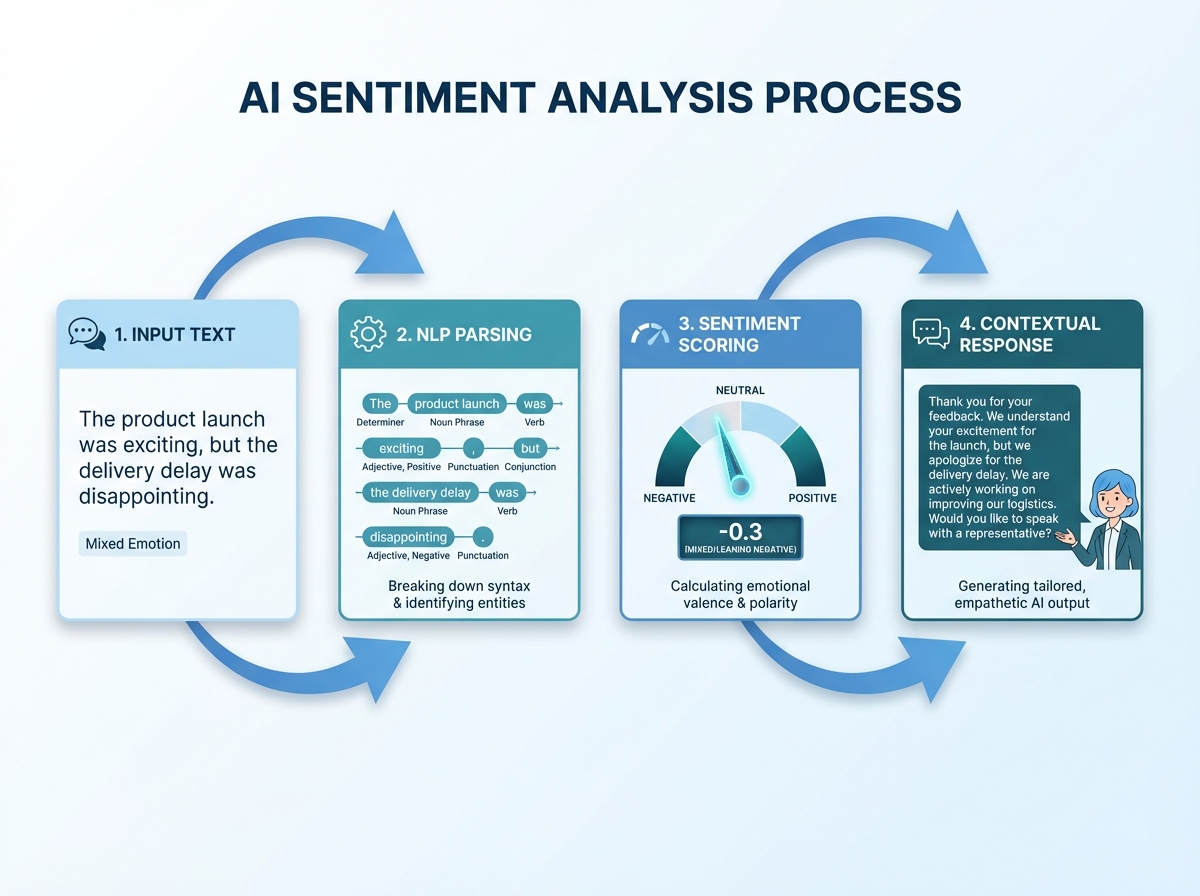
AI doesn't "feel" emotions in the biological sense, but it can identify them with increasing accuracy through data analysis. This process relies on three core pillars: Natural Language Processing (NLP), Sentiment Analysis, and Contextual Memory.
At its most basic level, AI analyzes the structure of your communication. It looks at sentence length, punctuation usage, and grammar. For example, short, clipped sentences combined with heavy punctuation might indicate agitation or urgency. Conversely, long, meandering sentences with hedging words (like "maybe," "sort of," "I guess") often signal uncertainty or low confidence.
Sentiment analysis assigns a "score" to the emotional tone of text. It categorizes inputs as positive, negative, or neutral, but modern AI goes much deeper. It can differentiate between anger (high arousal, negative valence) and sadness (low arousal, negative valence). By analyzing word choice—specifically the use of "absolutist" words like always, never, or completely—AI can detect signs of cognitive distortion or distress.
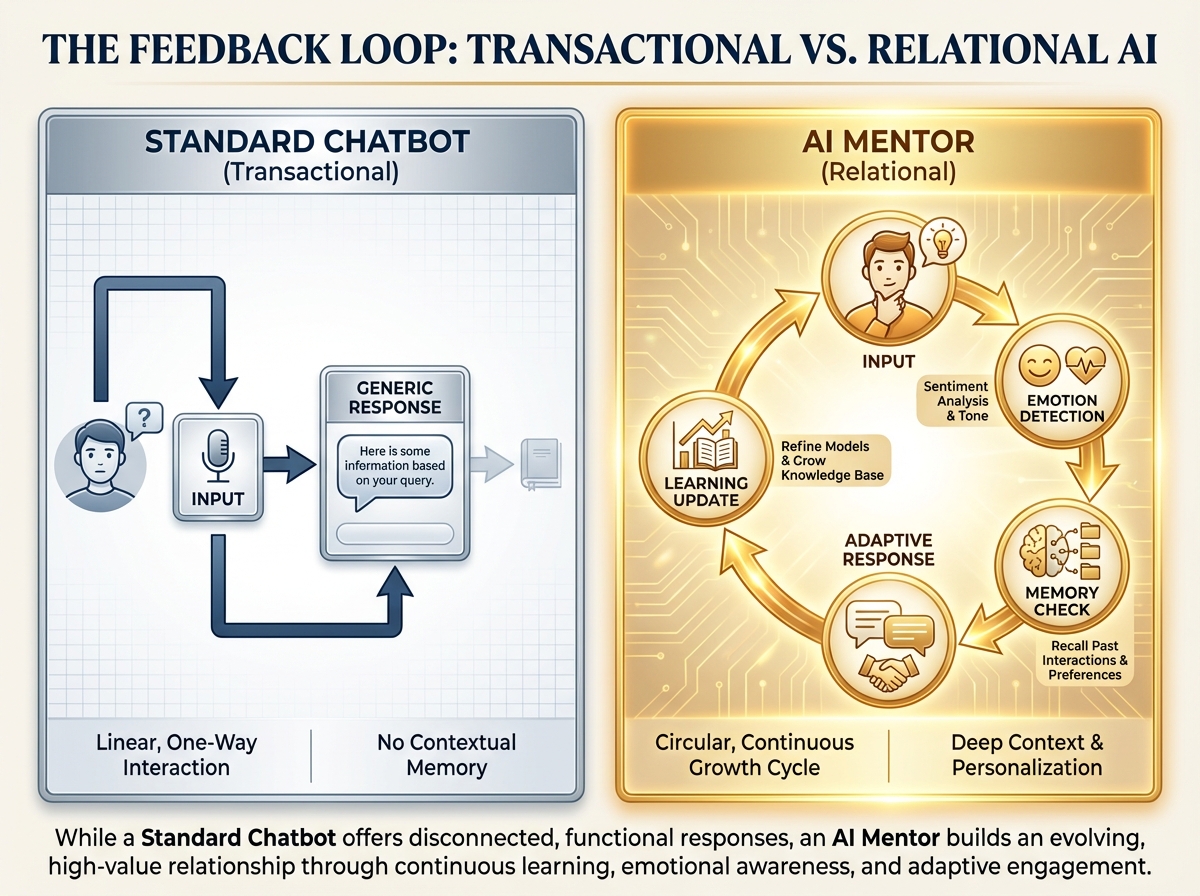
The true power of AI mentorship lies in its ability to remember. Unlike a search engine that forgets you the moment you close the tab, advanced AI mentors build a profile of your interaction history. If you typically write in a formal, structured manner but suddenly switch to chaotic, lowercase text, the AI notes this deviation as a potential emotional anomaly. It learns your "baseline" so it can detect when you are off-balance.
> 💡 Unlock Deep Self-Awareness with AI Mentorship > > Understanding the science of emotional patterns is the first step; having a mentor that actively helps you navigate them is the second. GPTnius AI Mentors are trained to recognize these nuances in your communication to provide tailored guidance. > > Meet the AI mentors built from this research →
Human emotions are rarely binary. We are rarely just "happy" or "sad." We are often "anxious but hopeful" or "frustrated but determined." High-quality AI support systems are designed to detect these subtle blends of emotion to provide nuanced advice.
Research in computational linguistics shows that our word choices betray our internal states long before we explicitly state them.
By tracking these markers over time, an AI mentor can gently steer a conversation. If an AI detects a loop of "past tense + negative sentiment," it might prompt the user with a forward-looking question to break the cycle of rumination.
When humans are stressed, our cognitive load increases, and our ability to articulate complex thoughts decreases. We tend to make more typos, use simpler vocabulary, and repeat ourselves. AI systems trained on cognitive behavioral principles can recognize this degradation in communication quality. Instead of offering complex, multi-step strategic advice during these moments, the AI adapts to offer simple, grounding techniques to lower the user's cognitive load first.
Recognition is only half the battle. For AI to provide "better support," it must translate emotional data into an appropriate response. This is where the "Feedback Loop" comes into play.
Depending on the emotional context, an AI mentor will choose between different interaction models:
Perhaps the most significant advantage of AI in emotional learning is its patience. It can track emotional patterns over months. It might notice, for example, that your motivation consistently drops every third week of the month, or that specific topics (like public speaking or financial planning) trigger a defensive tone.
By highlighting these patterns, the AI moves from being a chatbot to a mirror, reflecting your own habits back to you so you can address them.
You don't need to be a data scientist to benefit from this technology. Here is how you can utilize AI learning capabilities to enhance your personal development:
Use an AI mentor as a safe space to vent without judgment. After a difficult day, type out exactly how you feel, unfiltered. Then, ask the AI to analyze your text for cognitive distortions (like catastrophizing or black-and-white thinking). This trains you to spot these patterns in your own thinking.
If you are anxious about a negotiation or a confrontation, AI can simulate the other party. Because the AI understands emotional sentiment, you can ask it to react as a "hostile negotiator" or a "disappointed boss." This allows you to practice emotional regulation in a low-stakes environment before the real event.
Traditional journaling is powerful, but it is a monologue. AI-assisted journaling is a dialogue. By having an AI analyze your entries over a week, you can ask for a summary of your emotional themes. You might be surprised to learn that you were more optimistic than you felt, or that a specific person was the root cause of 80% of your stress.
While AI is a powerful tool for emotional support, it is vital to remember its role. AI is a scaffold, not the building. It provides structure, data, and frameworks, but the emotional work must be done by the human.
GPTnius has developed a unique approach to AI mentorship by grounding its AI Mentors in proven methodologies. Rather than generic chatbots, GPTnius offers AI Mentors trained on proprietary research analyzing the published works, philosophies, and proven methodologies of thought leaders, including leading researchers on habit formation and emotional intelligence. Our mentors do not impersonate anyone. They synthesize researched frameworks, such as habit systems and emotional pattern tracking, into personalized coaching conversations built around your specific goals. The AI can recognize when you are falling into an emotional slump and guide you back using specific, research-backed strategies.
Because these mentors are designed to track your goals and learning paths, they apply the principles of "Affective Computing" discussed in this article. They remember your past struggles, recognize your current tone, and offer strategic advice that fits your specific context—helping you apply proven principles to your unique challenges.
> 💡 Ready to Optimize Your Personal Growth? > > Stop guessing what works. Engage with AI Mentors trained on the research of top thought leaders to receive personalized, emotionally intelligent coaching. > > Meet the AI mentors built from this research →
AI is no longer just about processing numbers; it is about processing context. By learning your emotional patterns, syntax, and behavioral baselines, modern AI tools offer a level of support that is personalized, consistent, and deeply insightful. Whether you are looking to improve your leadership skills, manage stress, or simply understand yourself better, leveraging the emotional learning capabilities of AI can be the catalyst for your next breakthrough.
AI does not 'feel' emotions biologically, but it uses Natural Language Processing and Sentiment Analysis to detect patterns in language, tone, and syntax that correlate with specific human emotions, allowing it to respond with high degrees of empathy and relevance.
Reputable platforms prioritize data encryption and privacy. However, users should always review the privacy policy of any AI service. GPTnius, for example, is designed with user privacy and secure authentication in mind.
Standard chatbots usually respond to immediate queries with fixed answers. AI Mentors, like those at GPTnius, utilize long-term memory, context retention, and specific training on proven frameworks to guide users through ongoing development and goal tracking.