Master Cognitive Load Theory to learn faster. Discover how AI reduces mental overwhelm and simplifies complex concepts using proven research-backed frameworks.
We live in an era of information abundance but attention scarcity. Whether you are an entrepreneur trying to grasp a new market dynamic, a developer learning a new language, or a student tackling advanced physics, the sensation is often the same: a feeling of mental saturation, often described as "drinking from a firehose."
This phenomenon isn't just a lack of focus; it is a biological limitation known as Cognitive Load.
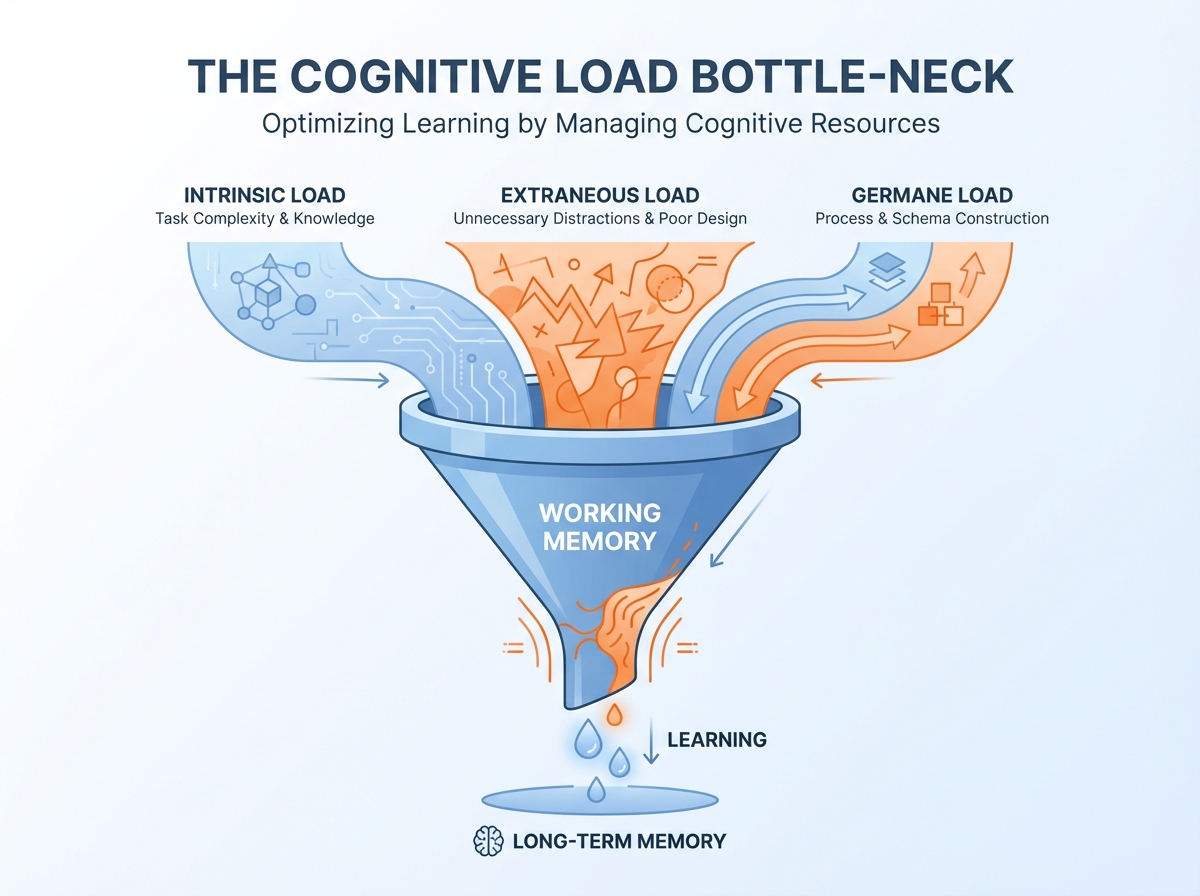
Your brain’s working memory is arguably the most significant bottleneck in your ability to learn. Unlike long-term memory, which is effectively infinite, working memory is strictly limited. When you try to process too much new information at once, the system jams. Understanding ceases. Frustration mounts.
However, the rise of Artificial Intelligence offers a new solution to this biological limit. AI does not just provide answers; when used correctly, it acts as a pre-processor for your brain, optimizing information flow to match your cognitive capacity.
This guide explores Cognitive Load Theory (CLT) and provides actionable strategies on how to use AI to bypass your brain's bottlenecks and master complex concepts faster than ever before.
---
Developed by educational psychologist John Sweller in the late 1980s, Cognitive Load Theory posits that learning is most efficient when the demands on working memory are aligned with the brain's architecture.
To hack your learning process, you must first understand the three distinct types of load that burden your mind:
Intrinsic load is the complexity native to the material itself. Learning the alphabet has a low intrinsic load; learning Quantum Mechanics has a high intrinsic load. This load is fixed by the nature of the subject and your prior knowledge.
This is the "bad" load. It refers to the mental effort wasted on processing how the information is presented rather than the information itself. Poorly written textbooks, disorganized lectures, or a cluttered interface all increase extraneous load. This steals bandwidth from actual learning.
This is the "good" load. Germane load is the mental effort dedicated to processing, constructing, and automating schemas (mental models). It is the effort of turning information into knowledge.
The Goal of Accelerated Learning: Minimizing extraneous load and managing intrinsic load so that your mental energy can be poured entirely into germane load.
> 💡 Stop Drowning in Information, Start Mastering It > > Your working memory is limited, but your potential isn't. GPTnius AI Mentors help you manage cognitive load by breaking down complex goals into actionable steps tailored to your learning style. > > Meet the AI mentors built from this research →
---
Before AI, managing cognitive load was a manual process. You had to read the dense textbook (high extraneous load) to find the core concept (intrinsic load). You had to organize your own notes to build schemas (germane load).
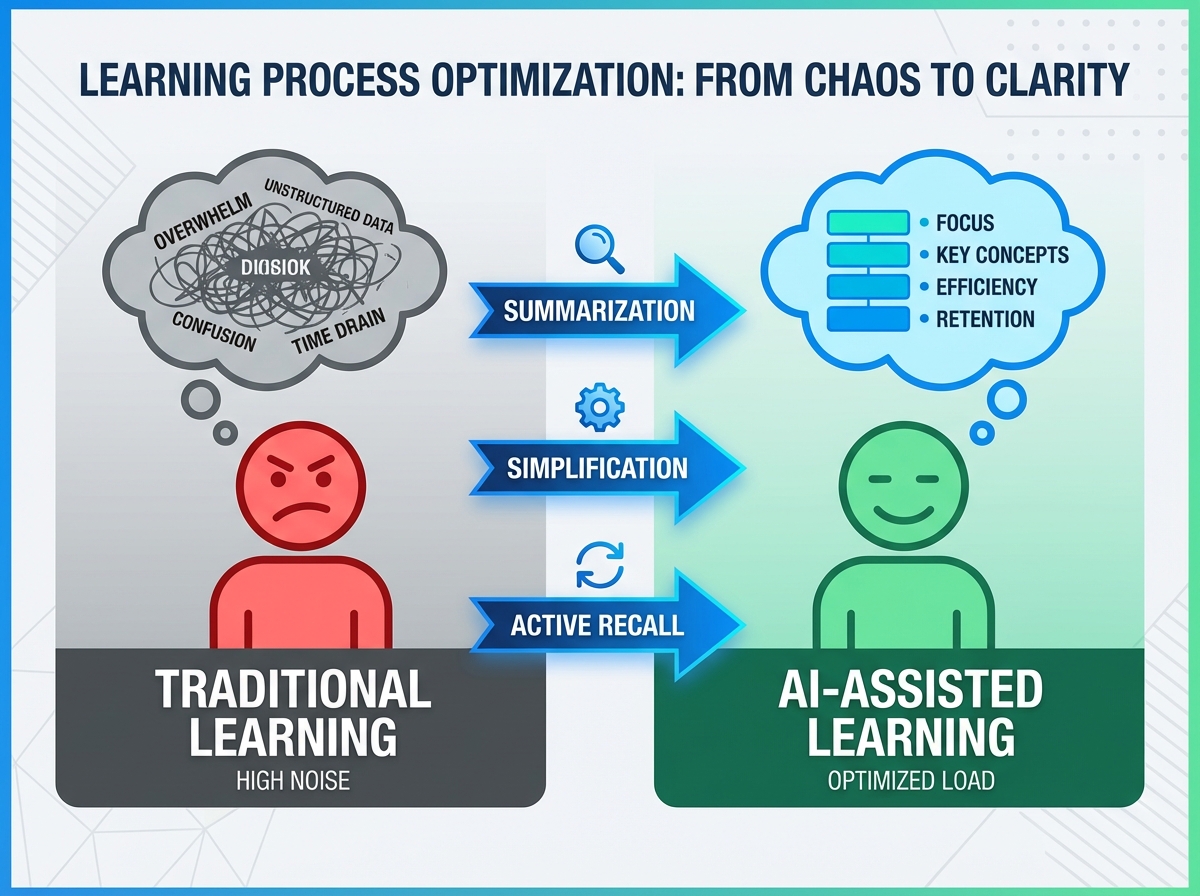
Today, AI serves as an external cognitive processor. It can handle the heavy lifting of sorting and simplifying, delivering information to your working memory in a format that is ready to be absorbed.
The internet is noisy. Finding a specific answer often requires navigating ads, SEO-fluff, and irrelevant tangents. This is classic extraneous load.
AI tools dramatically reduce this noise. By asking an AI to "summarize the key arguments of this paper" or "extract the actionable steps from this transcript," you strip away the packaging and leave only the product. The AI takes the hit on the extraneous load so your brain doesn't have to.
When a topic is too complex (high intrinsic load), the standard human reaction is to disengage. The gap between what you know and what you need to know is too wide.
AI bridges this gap through progressive simplification. You can ask an AI to explain a concept at a 5th-grade level, then a high-school level, and finally at a collegiate level. This allows you to build a foundational mental scaffold before adding the heavy bricks of technical detail. This technique essentially "chunks" the intrinsic load into manageable bites.
Passive reading creates the illusion of competence, but it rarely leads to deep learning. To generate germane load—the schema-building effort—you need to interact with the material.
AI makes the Socratic Method scalable. Instead of just reading about a topic, you can debate it with an AI. You can ask the AI to quiz you, to find holes in your logic, or to ask you to apply a theoretical concept to a real-world scenario. This forces your brain to engage in the deep processing required for long-term retention.
---
How do we translate this theory into practice? Here are three specific frameworks you can use immediately with AI tools to leverage Cognitive Load Theory.
The Principle: Research shows that users learn complex systems better if they already know the names and characteristics of the key components.
The AI Application: Before diving into a dense book or course, ask an AI to generate a "Glossary of Core Concepts" and a "High-Level Map" of the topic.
By pre-loading these definitions into your long-term memory, you free up working memory space when you encounter them in context later.
The Principle: The brain processes visual and verbal information through separate channels. Using both simultaneously expands your working memory capacity.
The AI Application: When you are stuck on a text-based explanation, ask the AI to describe a visual analogy or, if using multimodal models, to generate a diagram.
The Principle: Novices learn better by studying detailed solutions to problems (worked examples) rather than trying to solve problems themselves immediately.
The AI Application: Don't just ask AI for the answer; ask for the reasoning.
---
Cognitive Load Theory teaches us that there is no "one size fits all" for learning. A novice needs low intrinsic load and high guidance. An expert needs high intrinsic load and minimal guidance to avoid the "expertise reversal effect" (where too much hand-holding actually hurts performance).
AI is the first technology capable of adapting to this dynamic in real-time. It creates a personalized learning environment that expands and contracts based on your current cognitive capacity. It is not just about learning faster; it is about learning with less friction and less fatigue.
Understanding Cognitive Load Theory is powerful, but applying it consistently to your personal growth requires discipline and the right tools. This is where GPTnius bridges the gap between theory and practice.
GPTnius offers AI Mentors trained on proprietary research analyzing the published works, philosophies, and proven methodologies of thought leaders, including leading researchers on learning science and decision-making. Our mentors do not impersonate anyone. They synthesize researched frameworks, such as mental models and habit systems, into personalized coaching conversations built around your specific goals. These mentors are designed to act as the ultimate cognitive filter.
Instead of you having to read dozens of books to synthesize these frameworks (high extraneous load), the AI Mentor synthesizes this research to provide personalized coaching conversations. It helps you:
> 💡 Turn Insight into Action with Your Personal AI Board of Advisors > > Don't let cognitive overload stall your progress. Access AI Mentors trained on the research of world-class thought leaders to simplify your challenges and accelerate your growth. > > Meet the AI mentors built from this research →
We cannot upgrade our biological working memory, but we can upgrade the tools we use to feed it. By viewing AI through the lens of Cognitive Load Theory, we stop seeing it as a shortcut for cheating and start seeing it as a tool for acceleration. It allows us to strip away the noise, manage the difficulty, and focus our limited mental energy on what truly matters: understanding, synthesis, and growth.
The three types are Intrinsic Load (the inherent difficulty of the subject), Extraneous Load (unnecessary distractions or poor presentation), and Germane Load (the effort used to create permanent mental models).
AI reduces extraneous load by summarizing long texts, filtering out irrelevant information, and reformatting complex data into clear, concise structures, allowing the learner to focus on the core content.
Yes. While AI cannot change the difficulty of a topic (like Quantum Physics), it can manage the intrinsic load by breaking the topic down into smaller 'chunks,' using analogies, and offering progressive simplification to help the learner build a foundation.