Discover how embracing vulnerability builds courage and authentic leadership. Learn actionable strategies for shame resilience and daring greatly in life and work.
Many of us were raised to believe that vulnerability is a liability—a chink in the armor that must be hidden. However, research into human connection and leadership suggests the exact opposite. Vulnerability is the birthplace of innovation, creativity, and change. This article explores the concept of "Daring Greatly," breaking down how to dismantle the shields of perfectionism, build shame resilience, and practice authentic leadership. You will learn practical frameworks to transform how you navigate uncertainty and risk.
---
It is not the critic who counts. It is the man who is actually in the arena, whose face is marred by dust and sweat and blood.
This famous quote by Theodore Roosevelt serves as the philosophical backbone for one of the most transformative concepts in modern psychology and leadership: Daring Greatly. For decades, we have equated professional success and personal strength with invulnerability—the ability to never let them see you sweat. Yet, in a world that is increasingly volatile and complex, the old armor is weighing us down.
Through the lens of extensive research on shame, empathy, and courage, particularly the frameworks popularized by thought leaders like Brené Brown, we now understand that vulnerability is not a weakness. It is our greatest measure of courage. To dare greatly is to show up and let yourself be seen, even when there are no guarantees of the outcome.
In this comprehensive guide, we will dismantle the myths surrounding vulnerability, explore the mechanics of shame resilience, and provide actionable steps to become an authentic leader in your own life.
If you ask a room full of people to list examples of vulnerability, they will often list things like: asking for help, initiating sex with a spouse, firing someone, or admitting a mistake. If you then ask that same room to list examples of courage, the list looks almost identical.
This is the paradox. When we look at others, we see their vulnerability as courage. When we look at ourselves, we see our vulnerability as weakness.
At its core, vulnerability is defined by three components:
If you think about your daily life—launching a new product, falling in love, having a difficult conversation with a colleague—it is impossible to engage in these acts without those three elements. Therefore, it is impossible to be courageous without being vulnerable.
The goal of "daring greatly" is not to feel comfortable. The goal is to develop the capacity to stay in the discomfort of vulnerability long enough to reap the rewards: trust, innovation, and genuine connection.
Western culture often champions the "self-made" individual. However, the research indicates that we are neurobiologically wired for connection. When we deny our vulnerability, we shut down the pathways to that connection. We mistakenly believe that if we armor up, we can protect ourselves from judgment. In reality, that armor prevents us from being seen, known, and supported.
> 💡 Master the Art of Emotional Courage > > Understanding the theory of vulnerability is the first step, but practicing it requires a safe space to rehearse difficult conversations and dismantle your defenses. GPTnius AI Mentors can role-play these high-stakes scenarios with you. > > Meet the AI mentors built from this research →
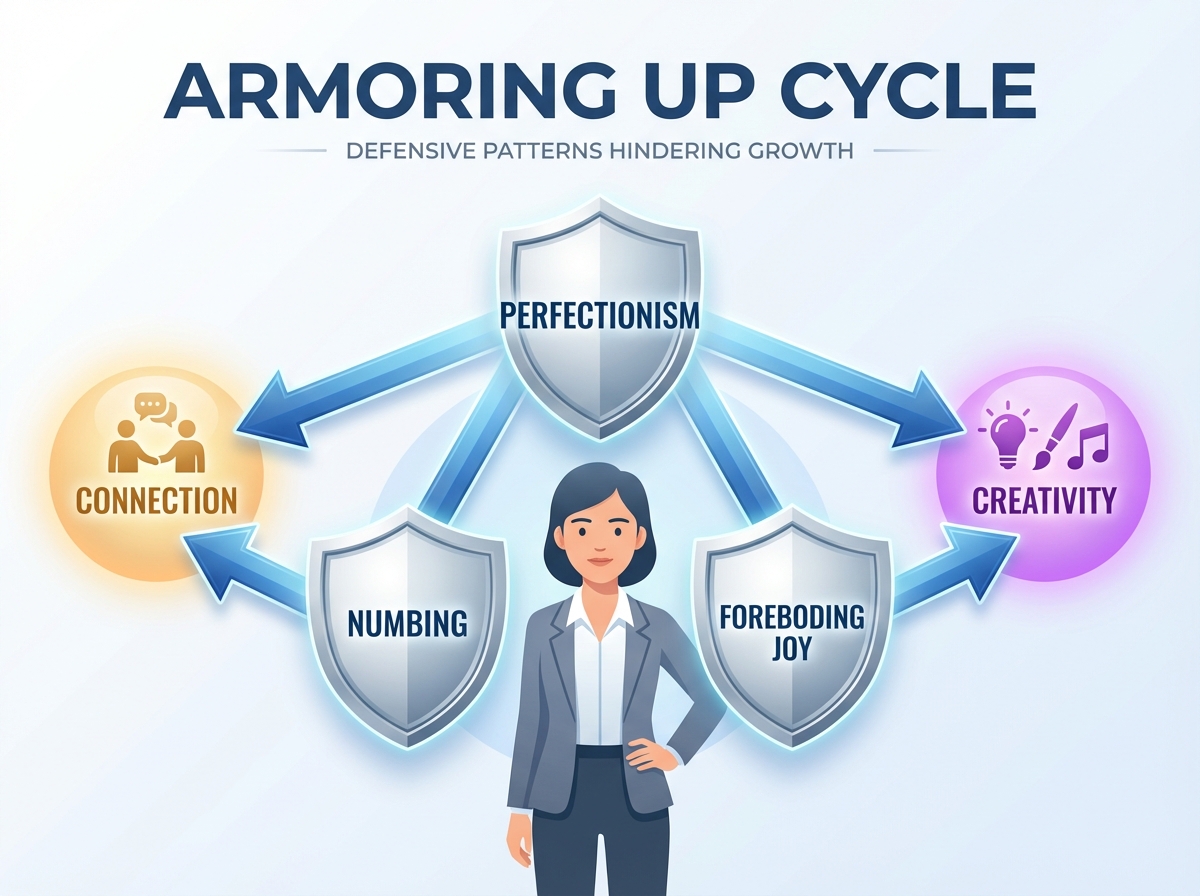
When the fear of vulnerability strikes—when we are afraid of being criticized or perceived as "less than"—we instinctively reach for our armor. While these defense mechanisms might offer temporary relief, they ultimately sabotage our growth and authentic leadership.
Perfectionism is not the same as striving for excellence. Excellence is internally focused (How can I grow?). Perfectionism is externally focused (What will they think?). It is a twenty-ton shield we lug around, thinking it will protect us from judgment. The logic of perfectionism is: If I look perfect and do everything perfectly, I can avoid or minimize the painful feelings of shame, judgment, and blame.
The Reality: Perfectionism hampers success. It leads to missed deadlines (because it’s never "ready"), risk aversion, and creative paralysis.
Have you ever stood over your sleeping child, felt a wave of intense love, and immediately pictured something terrible happening to them? Or perhaps you landed a huge promotion and immediately worried about getting fired?
This is "foreboding joy." It is the paradoxical method we use to protect ourselves from the vulnerability of happiness. We try to beat vulnerability to the punch by imagining the worst-case scenario, believing it will hurt less if we are prepared.
The Antidote: Gratitude. Research shows that people who can fully lean into joy without the foreboding practice active gratitude.
We cannot selectively numb emotions. When we numb the dark (grief, shame, fear, disappointment), we also numb the light (joy, gratitude, happiness). Whether through alcohol, endless scrolling on social media, or being "busy" as a status symbol, numbing is a flight from vulnerability.
To understand why vulnerability is so difficult, we must address the primary barrier: Shame. Shame is the intensely painful feeling or experience of believing that we are flawed and therefore unworthy of love and belonging.
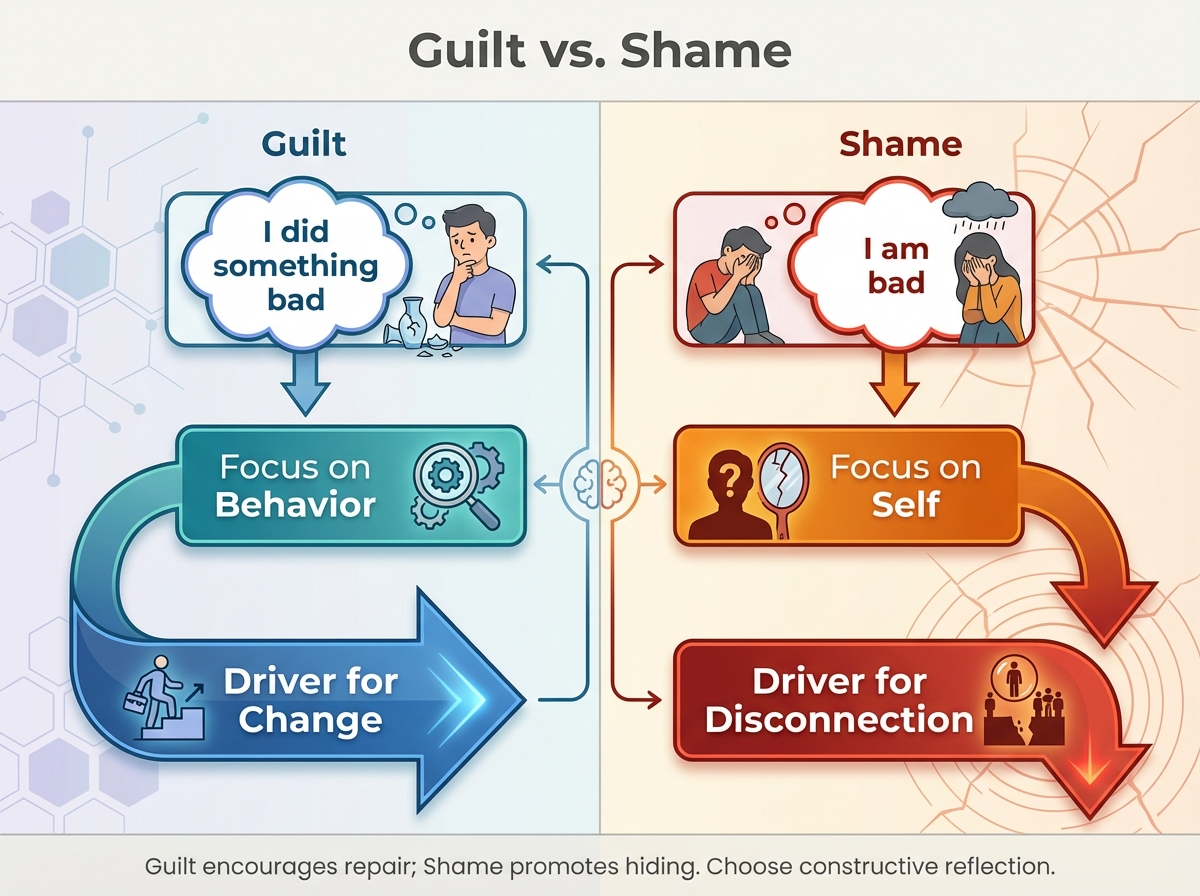
It is critical to distinguish between these two:
Guilt can be a helpful driver for change. Shame is highly correlated with addiction, depression, and aggression. It erodes our ability to change because it attacks our identity.
If we want to be vulnerable, we must be resilient to shame. This doesn't mean we never feel shame; it means we can recognize it and move through it constructively.
How does this translate to the boardroom or the office? Authentic leadership is not about oversharing or crying in every meeting. It is about "vulnerability with boundaries."
For years, the model of leadership was the stoic general—unflappable, all-knowing, and distant. In the modern knowledge economy, this model fails. Innovation requires failure. If a leader never shows vulnerability, they signal to their team that failure is not an option. Consequently, the team stops innovating, hides mistakes, and engages in "cover-up" culture.
Authentic leaders:
This behavior builds psychological safety, which Google’s Project Aristotle identified as the number one predictor of high-performing teams.
If you are ready to drop the armor and step into the arena, here are specific ways to begin.
Adopt language that invites curiosity rather than defensiveness. When you are in a conflict or a moment of uncertainty, use phrases like:
Using "The story I'm telling myself" is a powerful tool from Brené Brown’s research. It admits that your perspective is a subjective interpretation, not necessarily the objective truth, which lowers the defenses of the person you are talking to.
Write the names of the people whose opinions truly matter to you on a small 1x1 inch piece of paper. This is your "Square Squad."
Vulnerability without boundaries is not vulnerability; it is confession or manipulation. You do not owe everyone your story. Share only with those who have earned the right to hear it. In a leadership context, share vulnerability that is processed—share the lesson from the struggle, not the open wound, unless you are in a safe therapeutic setting.
Reading about vulnerability is vastly different from practicing it in the heat of the moment. The gap between knowing you should be vulnerable and actually doing it is often filled with fear and old habits.
GPTnius offers AI Mentors that have been trained on proprietary research analyzing the published works, philosophies, and proven methodologies of thought leaders in emotional intelligence and leadership.
For example, "The Architect" mentor synthesizes research on mental models and habits, while other specialized mentors draw from frameworks similar to those discussed in this article. Here is how they can help you:
These guided discussions allow you to apply proven principles to your specific challenges, turning abstract concepts into daily habits.
> 💡 Step Into the Arena with Confidence > > Don't let the fear of judgment keep you on the sidelines. Use GPTnius to practice your "rumble" skills and build the habits of an authentic leader today. > > Meet the AI mentors built from this research →
Daring greatly is not a one-time event; it is a daily practice. It is the conscious choice to let go of who you think you should be and embrace who you are. It requires the willingness to risk failure and the resilience to get back up when you fall.
By understanding the physics of vulnerability—that it is the only path to courage—you can begin to drop the heavy armor of perfectionism. You can build teams that trust one another, relationships that are deeply connected, and a life that is authentically yours.
The arena awaits. It is dusty and scary, but it is the only place where true life happens.
The phrase comes from Theodore Roosevelt's 'Man in the Arena' speech. In the context of emotional intelligence, it means having the courage to be vulnerable, to show up and be seen, even when the outcome is uncertain and there are no guarantees of success.
No. Research indicates that vulnerability is the most accurate measure of courage. Leaders who admit mistakes and ask for help build higher levels of trust and psychological safety, which leads to greater innovation and team performance.
The key is boundaries. Vulnerability is about sharing your feelings and experiences to build connection and trust, whereas oversharing is often done to soothe oneself or gain attention. Authentic leaders share lessons learned (processed emotion) rather than open wounds (unprocessed emotion).
Guilt is behavior-focused: 'I did something bad.' It can be a positive driver for change. Shame is self-focused: 'I am bad.' Shame is destructive and correlates with addiction, depression, and paralysis.