Discover the critical difference between effectiveness vs efficiency. Learn how applying Peter Drucker's principles can transform busywork into tangible results.
Efficiency is about speed and process optimization—doing things right. Effectiveness is about direction and impact—doing the right things. While both are necessary, prioritizing efficiency over effectiveness is the quickest route to irrelevance. This guide explores Peter Drucker’s timeless wisdom to help you audit your workflow, identify high-impact activities, and stop wasting energy on tasks that don't move the needle.
---
In the modern business climate, "busy" has become a status symbol. We fill our calendars with back-to-back meetings, optimize our email response times, and pride ourselves on clearing our to-do lists by 5:00 PM. Yet, despite this flurry of activity, many professionals and entrepreneurs end their weeks feeling a strange paradox: they are exhausted, yet they haven't actually moved forward.
This is the classic trap of mistaking motion for progress. It is the result of failing to distinguish between two critical concepts: effectiveness vs. efficiency.
The legendary management consultant Peter Drucker famously clarified this distinction in his seminal works on executive management. His insight was simple but revolutionary: "Efficiency is doing things right; effectiveness is doing the right things."
Understanding this difference is not just a semantic exercise; it is the single most important factor in determining whether your hard work translates into real-world success or merely efficient failure.
To master productivity, we must first decouple these two terms. They are often used interchangeably in casual conversation, but in the context of high-performance management, they are distinct variables.
Efficiency is a measure of volume, speed, and resource usage. It asks the question: "How can I achieve this task with the least amount of waste, time, or money?"
Effectiveness is a measure of outcome, value, and alignment with goals. It asks the question: "Is this task actually worth doing? Does it contribute to the mission?"
Peter Drucker’s effectiveness philosophy argues that no amount of efficiency can compensate for a lack of effectiveness. You can be the most efficient person in the world at typing reports, but if those reports are irrelevant to your company’s revenue or strategy, your efficiency is worthless. As Drucker noted, there is nothing quite so useless as doing with great efficiency that which should not be done at all.
> 💡 Stop Spinning Your Wheels—Start Moving Forward > > Identifying "the right things" is difficult when you are stuck in the weeds of daily operations. GPTnius AI Mentors, trained on proprietary research into Peter Drucker’s management frameworks, can help you audit your priorities. > > Meet the AI mentors built from this research →
If effectiveness is so critical, why do we naturally gravitate toward efficiency? The answer lies in human psychology and corporate culture.
Efficiency is tangible and immediate. When you clear your inbox, you get a dopamine hit. When you automate a spreadsheet, you save visible time. Efficiency feels like control. It is easy to measure—you can track hours saved or widgets produced.
Effectiveness, however, is often ambiguous and long-term. Developing a new strategy, nurturing a key client relationship, or learning a new skill doesn't always provide immediate feedback. It requires deep work and cognitive strain.
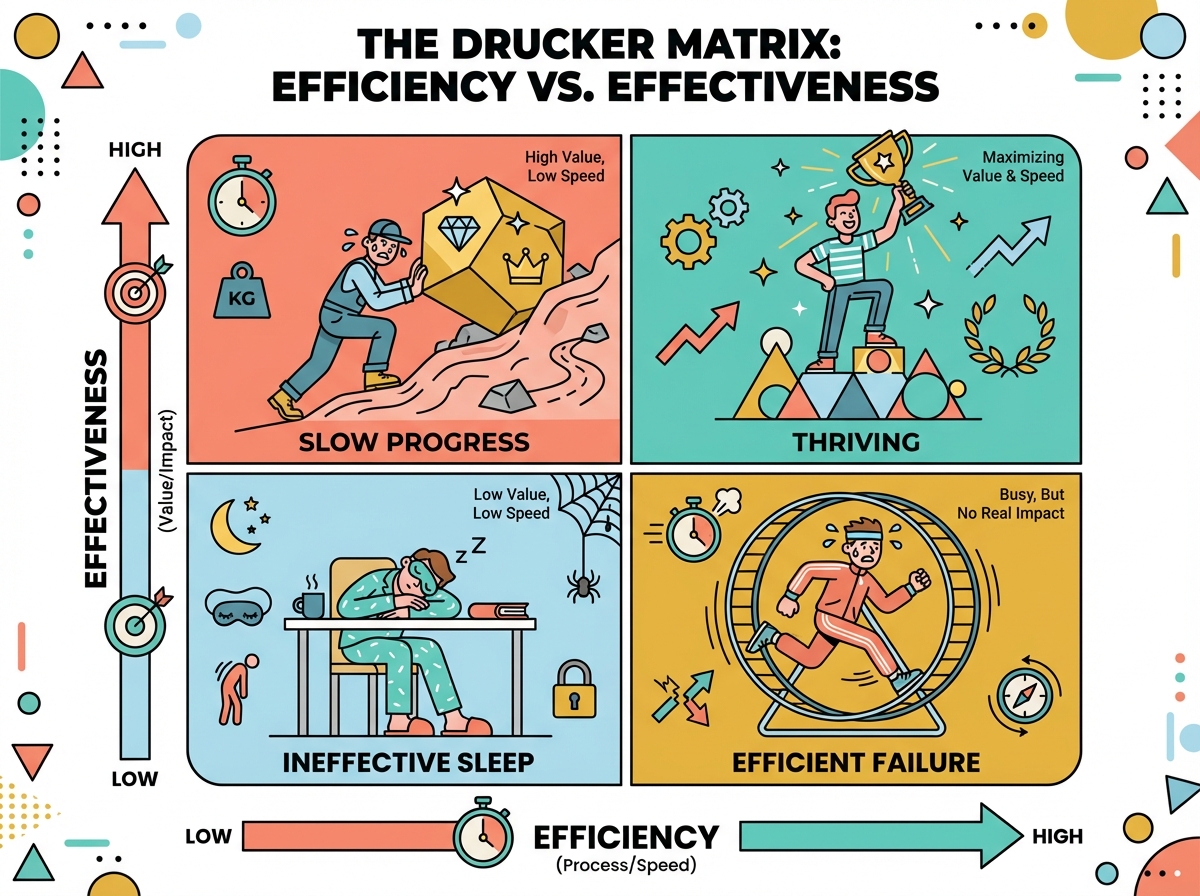
Prioritizing efficiency without effectiveness leads to "efficient failure." This occurs when a business or individual perfects a process that is becoming obsolete.
Consider the classic example of effectiveness vs. efficiency in business: A company manufacturing typewriters in the late 1980s might have had the most efficient assembly line in the world. They had low waste and high output. However, they were ineffective because they failed to see the rise of the personal computer. They were efficiently climbing a ladder that was leaning against the wrong wall.
To visualize where you stand, imagine a matrix with two axes: Efficiency (X-axis) and Effectiveness (Y-axis).
To truly grasp the importance of effectiveness, let’s look at specific scenarios across different domains.
shifting from an efficiency mindset to an effectiveness mindset requires a conscious change in behavior. Here is how to apply Drucker’s wisdom to your daily life.
Effectiveness requires focus. You cannot be effective at everything. Look at your goals for the quarter. If you could only accomplish one of them, which one would have the greatest impact on your career or business? That is your priority. Everything else is secondary.
Review your last week of work. Highlight tasks in green that directly contributed to your top goals (Effectiveness). Highlight tasks in red that were administrative, maintenance, or "busy work" (Efficiency/Waste). If your calendar is mostly red, you are efficiently failing.
Peter Drucker famously refused almost all interviews and speaking engagements later in his life. He knew that his effectiveness came from writing and thinking, not talking. To increase effectiveness, you must ruthlessly eliminate low-value obligations. Every "yes" to a low-impact request is a "no" to a high-impact project.
Drucker argued that effectiveness is built on strengths, not on fixing weaknesses. Identify what you are naturally best at—the areas where your input generates outsized output. Delegate or deprioritize areas where you are weak. Trying to become "average" in an area of weakness is an inefficient use of time compared to becoming "world-class" in an area of strength.
Stop measuring your day by how many hours you sat at your desk. Start measuring by deliverables. Did you ship the feature? Did you close the deal? Did you write the chapter? Shift your KPIs (Key Performance Indicators) to track outcomes rather than hours logged.
Does this mean efficiency is bad? Absolutely not. Efficiency is vital—but only after effectiveness has been established.
Once you have identified the right thing to do (Effectiveness), you should then apply every tool in your arsenal to do it as quickly and cheaply as possible (Efficiency). The sequence matters:
If you reverse this order, you simply accelerate your arrival at the wrong destination.
Understanding the theory of effectiveness vs. efficiency is one thing; applying it to your unique situation is another. This is where personalized mentorship becomes invaluable.
GPTnius offers AI Mentors trained on proprietary research analyzing the published works, philosophies, and proven methodologies of thought leaders, including thinkers like Peter Drucker. Our mentors do not impersonate anyone. They synthesize researched frameworks, such as Drucker's effectiveness principles, into personalized coaching conversations built around your specific goals.
You can present your current to-do list or business strategy to the AI Mentor, and it can help you:
By engaging in these guided discussions, you move beyond passive reading to active application, using proven principles to navigate your specific challenges.
> 💡 Ready to Optimize for Impact? > > Don't let another week go by efficiently doing the wrong things. Let a GPTnius AI Mentor, trained on the world's best management research, guide you toward true effectiveness. > > Meet the AI mentors built from this research →
In a world of constant distraction, the ability to distinguish between effectiveness and efficiency is a superpower. Peter Drucker’s wisdom remains as relevant today as it was decades ago: focus first on doing the right things. Once you have your compass set, then—and only then—should you look at your stopwatch. By prioritizing impact over activity, you ensure that your hard work actually counts.
Efficiency is defined as 'doing things right' (focusing on speed, process, and minimizing waste), while effectiveness is defined as 'doing the right things' (focusing on outcomes, goals, and value creation).
Peter Drucker believed that efficiency is useless if applied to the wrong tasks. He argued that there is nothing as useless as doing efficiently that which should not be done at all, making effectiveness the prerequisite for success.
Yes. A business can be highly efficient at manufacturing a product that no one wants to buy. This is known as 'efficient failure'—optimizing a process that does not lead to a valuable business outcome.