Discover why Emotional Intelligence (EQ) is the critical skill of 2025. Learn how AI automates IQ and why human connection is your competitive advantage.
For decades, the formula for success was relatively straightforward: high cognitive intelligence (IQ) plus hard work equaled career advancement. If you could process information faster, recall facts more accurately, and solve logical problems more efficiently than your peers, you were indispensable.
By 2025, that equation has fundamentally broken.
We have entered an era where raw cognitive processing power is a utility. Generative AI and advanced language models can now pass the bar exam, diagnose complex medical conditions, and write code faster than any human. When "smart" is a commodity available for a monthly subscription, the value of human IQ—while still important—has relatively diminished.
In this new landscape, Emotional Intelligence (EQ) has not just risen in value; it has become the only sustainable competitive advantage. The ability to navigate complex social dynamics, manage one's own psychology, and influence others with empathy is something AI cannot authentically replicate. As we navigate the hybrid workplaces and digital-first relationships of 2025, EQ is no longer a "soft skill"—it is the hard currency of leadership and growth.
To understand why EQ beats IQ in 2025, we must look at the nature of work. Tasks that rely on convergent thinking (finding the one correct answer) are increasingly automated. Tasks that rely on divergent thinking (creativity) and social cohesion (teamwork) remain deeply human.
In a world saturated with AI-generated content and algorithmic interactions, humans crave genuine connection more than ever. The "Human-in-the-Loop" premium refers to the increased value placed on interactions that involve genuine empathy, ethical judgment, and nuanced understanding.
> 💡 Master Your Emotional Landscape > > Developing high EQ requires constant reflection and feedback, yet honest feedback is rare in the workplace. GPTnius AI Mentors provide a safe, judgment-free space to roleplay difficult conversations and analyze your emotional responses before you enter the boardroom. > > Meet the AI mentors built from this research →
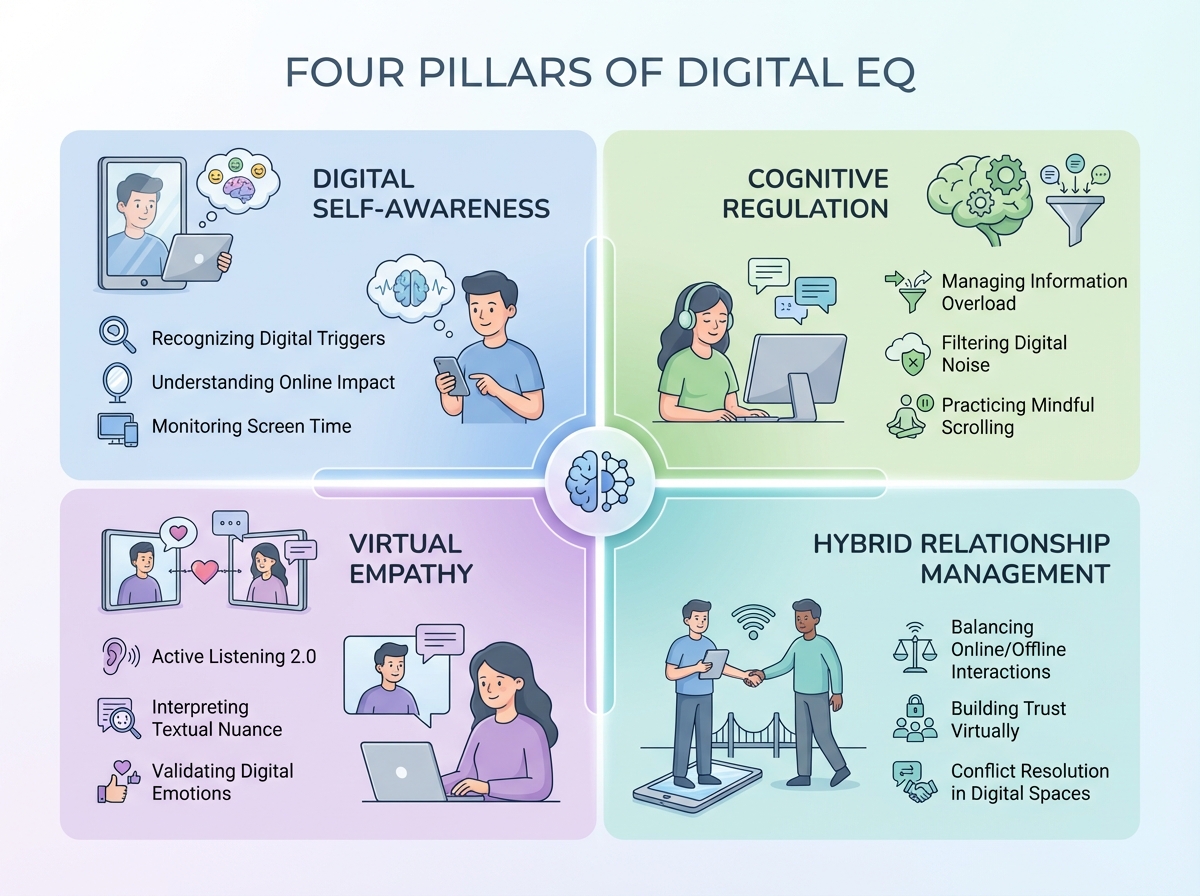
Traditional models of Emotional Intelligence, popularized by researchers in the late 20th century, focused on Self-Awareness, Self-Regulation, Social Awareness, and Relationship Management. In 2025, these pillars have evolved to address specific modern challenges.
In an attention economy designed to fragment your focus, self-awareness involves recognizing how digital inputs affect your emotional state. It is the ability to notice, "I am feeling anxious because I have been doom-scrolling," or "I am feeling defensive because of the tone of this text message."
High EQ in 2025 means recognizing your "digital triggers." It involves understanding your biological rhythms and how screen time impacts your mood, allowing you to disconnect before you reach a breaking point.
Self-regulation is no longer just about controlling anger; it is about controlling attention. With the constant barrage of notifications, the ability to maintain deep focus and emotional equilibrium is a superpower.
Leaders with high EQ model this for their teams. They do not send emails at 2 AM. They respect boundaries. They regulate their own anxiety to prevent it from cascading down to their direct reports—a phenomenon known as emotional contagion, which spreads faster than ever through Slack and Zoom.
Reading the room is easy when you are in the room. Reading the room on a video call with twenty participants, half of whom have their cameras off, requires a heightened level of Social Awareness.
Virtual Empathy involves:
Building trust without physical proximity is the defining management challenge of our time. Relationship management in 2025 relies on intentionality. Spontaneous "water cooler" moments are gone; they must be replaced by deliberate check-ins that prioritize human connection over status updates.
Unlike IQ, which is relatively static, EQ is highly plastic. You can train it, refine it, and improve it at any age. Here are three research-backed strategies adapted for the modern professional.
When you are in the grip of a strong emotion, your amygdala (the brain's threat detection center) hijacks your prefrontal cortex (the logic center). To regain control, practice the "Third-Person" technique.
Instead of saying, "I am angry," narrate the situation as an observer: "[Your Name] is feeling anger arising because his idea was dismissed." This linguistic shift creates psychological distance, allowing you to examine the emotion objectively rather than being consumed by it. This is crucial during high-stakes video calls where visible frustration can damage your reputation.
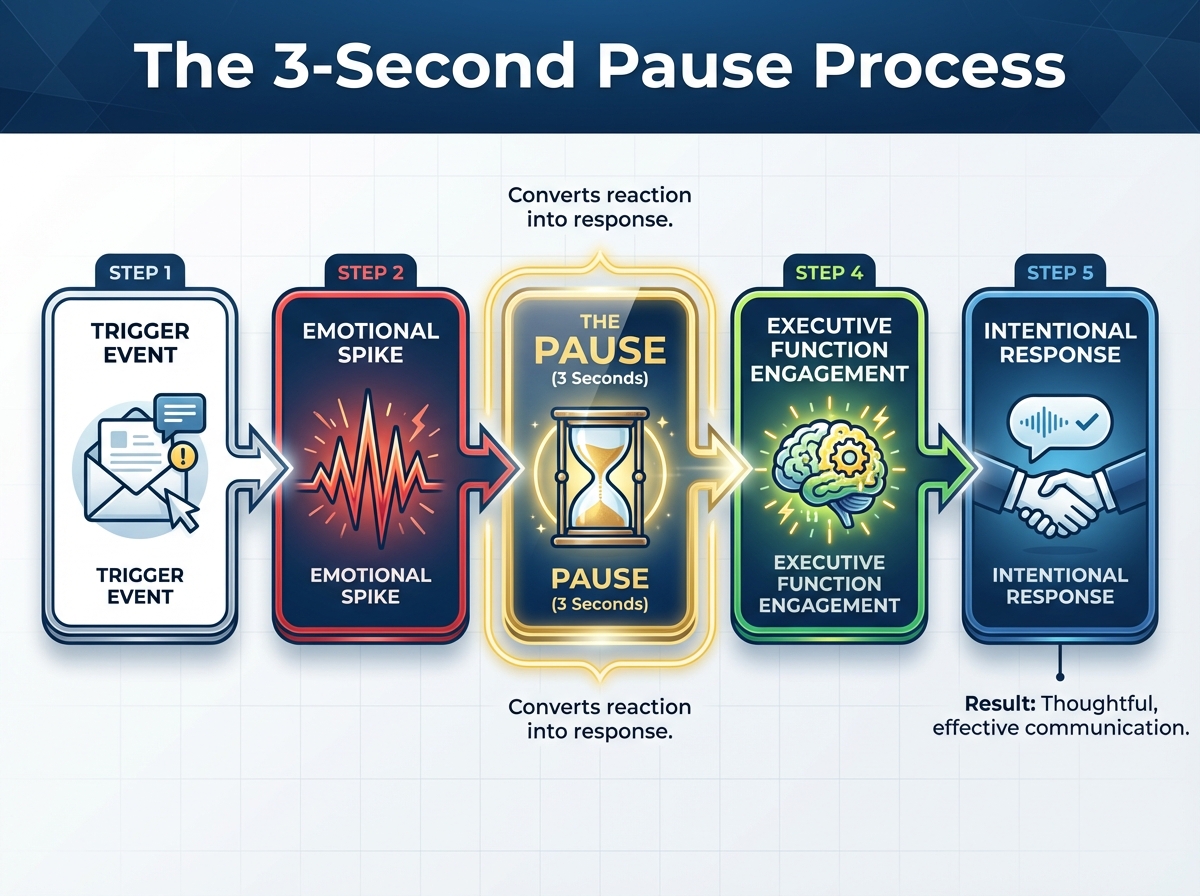
In digital communication, the speed of response is often confused with efficiency. However, immediate reactions are often emotional rather than strategic. Implement a mandatory 3-second pause before speaking in meetings, and a 2-minute pause before hitting "send" on emotional emails.
This gap allows your executive functions to catch up with your emotional impulses. It turns a reaction (instinctual) into a response (intentional).
Judgment shuts down connection; curiosity opens it up. When a colleague misses a deadline or a client sends a rude email, the low-EQ response is judgment: "They are lazy" or "They are unprofessional."
The high-EQ response is curiosity: "I wonder what is going on in their world that caused this?" This reframing not only reduces your own stress but often leads to problem-solving rather than conflict. In 2025, where we often lack context on our remote colleagues' lives, assuming positive intent is a strategic necessity.
Developing Emotional Intelligence is not a passive activity; it requires dialogue, reflection, and the application of proven frameworks to real-world situations. This is where GPTnius bridges the gap between theory and practice.
GPTnius offers AI Mentors that have been trained on proprietary research analyzing the published works, philosophies, and proven methodologies of thought leaders in psychology, leadership, and personal development.
For example, if you are struggling to manage a conflict with a coworker, you can engage with a mentor like "The Architect." This AI Mentor draws from research on mental models and habit systems, combined with proven coaching methodologies. It can help you:
Because these AI Mentors are trained on proprietary research analyzing successful methodologies, they provide high-level strategic advice tailored to your specific context. They allow you to apply the principles of Emotional Intelligence directly to your unique challenges through guided discussions.
> 💡 Turn Insight into Action > > Reading about Emotional Intelligence is the first step; practicing it is where growth happens. Let a GPTnius AI Mentor guide you through personalized coaching conversations to build the resilience and empathy required for 2025. > > Meet the AI mentors built from this research →
As we move further into 2025, the technology we use will continue to become more advanced, more capable, and more human-like in its outputs. However, the simulation of empathy is not empathy. The generation of text is not the creation of trust.
Your IQ may help you understand the tools of the future, but your EQ will determine how well you can lead the people who use them. By investing in your emotional intelligence—cultivating self-awareness, practicing regulation, and prioritizing genuine connection—you future-proof your career. In the age of AI, being deeply, authentically human is the ultimate innovation.
As AI automates technical and cognitive tasks (IQ-based work), the unique human ability to connect, empathize, and lead (EQ) becomes the primary differentiator for career success and effective leadership.
Yes. AI tools like GPTnius can act as non-judgmental partners for roleplaying difficult conversations, providing feedback on communication styles, and helping users reflect on their emotional responses through guided coaching.
Digital EQ includes Digital Self-Awareness (managing screen-induced emotions), Virtual Empathy (reading tone in text/video), and Hybrid Relationship Management (building trust remotely).