Discover the psychology behind Amy Poehler's 'Good for her! Not for me' mantra. Learn actionable strategies to stop social comparison and build lasting self-esteem.
We have all been there. You are scrolling through your social media feed, feeling relatively content with your Tuesday evening, when you see it: a photo of a peer accepting an industry award, a friend announcing a luxury engagement, or a fitness influencer posting a progress picture that defies human anatomy. Suddenly, your quiet evening feels inadequate. Your career feels stagnant. Your life feels small.
This is the mechanism of social comparison, a psychological drive that has existed as long as humanity but has been weaponized by the algorithm-driven world we live in. Theodore Roosevelt famously called comparison the "thief of joy," but in the modern era, it steals more than joy—it robs us of our agency, our focus, and our self-esteem.
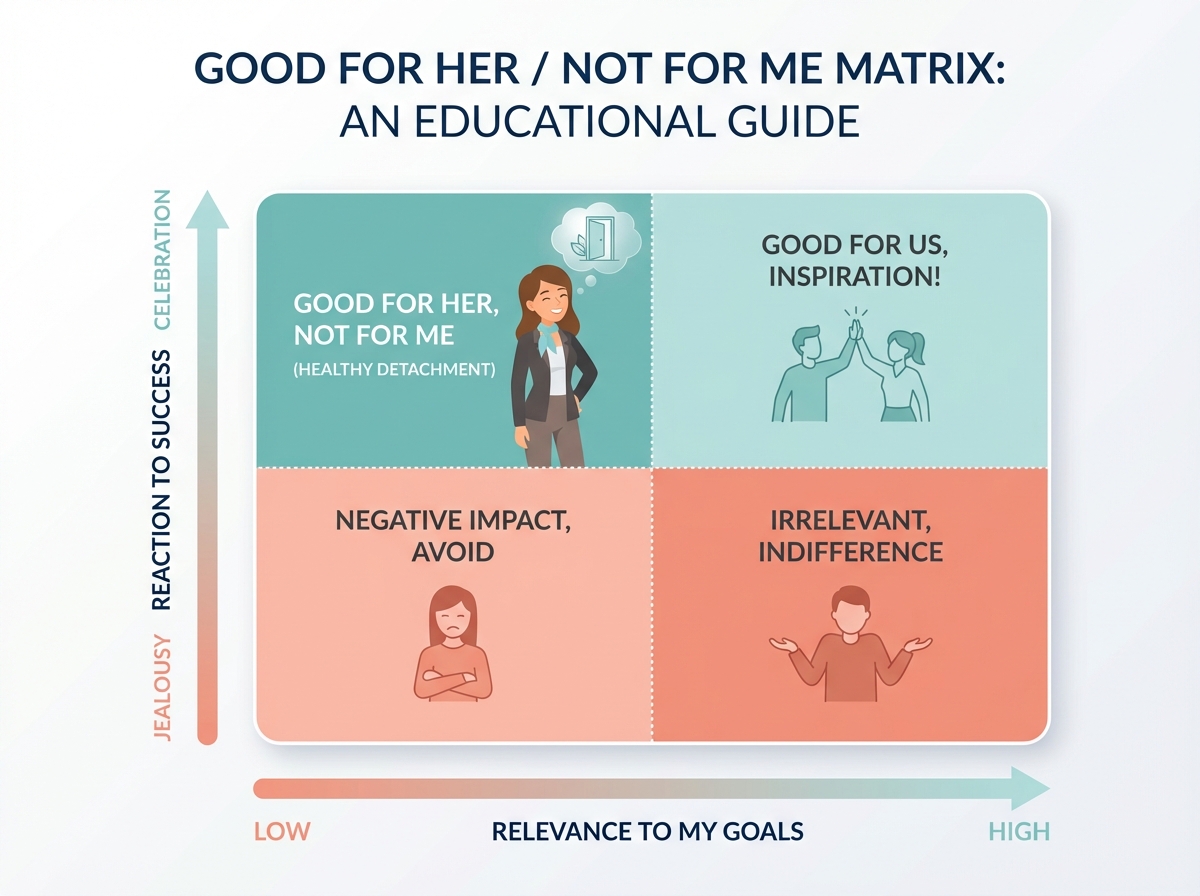
However, there is a powerful antidote to this toxic cycle, encapsulated in six simple words popularized by comedian and writer Amy Poehler: "Good for her! Not for me."
This article delves into the profound psychology behind this mantra, offering a comprehensive guide on how to stop comparing yourself to others and instead build a fortress of self-esteem that external validation cannot shake.
In her memoir Yes Please, Amy Poehler introduces this mantra as a way to navigate the competitive, often jealous waters of Hollywood and womanhood. But the "Good for her! Not for me" meaning extends far beyond show business. It is a dual-action mental framework that addresses two critical aspects of self-esteem: abundance and autonomy.
The first half of the phrase combats the scarcity mindset. When we feel envious of another person's success, it is often because we subconsciously believe there is a limited amount of success available in the world. We feel that if she has the promotion, the partner, or the accolade, there is less left for us.
Saying "Good for her" is a radical act of celebrating another's victory. It acknowledges that:
The second half is the boundary. It is the recognition that just because something is valuable, beautiful, or successful, it does not mean it fits your specific life path, values, or desires. It reinforces your personal agency.
Perhaps she runs marathons (Good for her!), but you prefer yoga (Not for me). Perhaps she is climbing the corporate ladder to become a CEO (Good for her!), but you prioritize a flexible schedule for creative pursuits (Not for me).
By combining these two sentiments, you neutralize the sting of comparison. You allow others to be great without feeling the need to copy them or compete with them.
> 💡 Stop Measuring Your Life by Someone Else's Ruler > > Struggling to separate what you actually want from what you think you should want based on social media? Our AI Mentors, trained on proprietary research into mental models and value alignment, can help you define your own metrics for success. > > Meet the AI mentors built from this research →
To effectively deal with social comparison, we must understand why we do it. In 1954, psychologist Leon Festinger proposed the Social Comparison Theory, suggesting that individuals determine their own social and personal worth based on how they stack up against others.
The danger of modern social comparison is that it is rarely an apples-to-apples comparison. When you look at an influencer's life or a colleague's LinkedIn update, you are comparing your behind-the-scenes (your doubts, struggles, and messy mornings) with their highlight reel (their curated, edited, and filtered best moments).
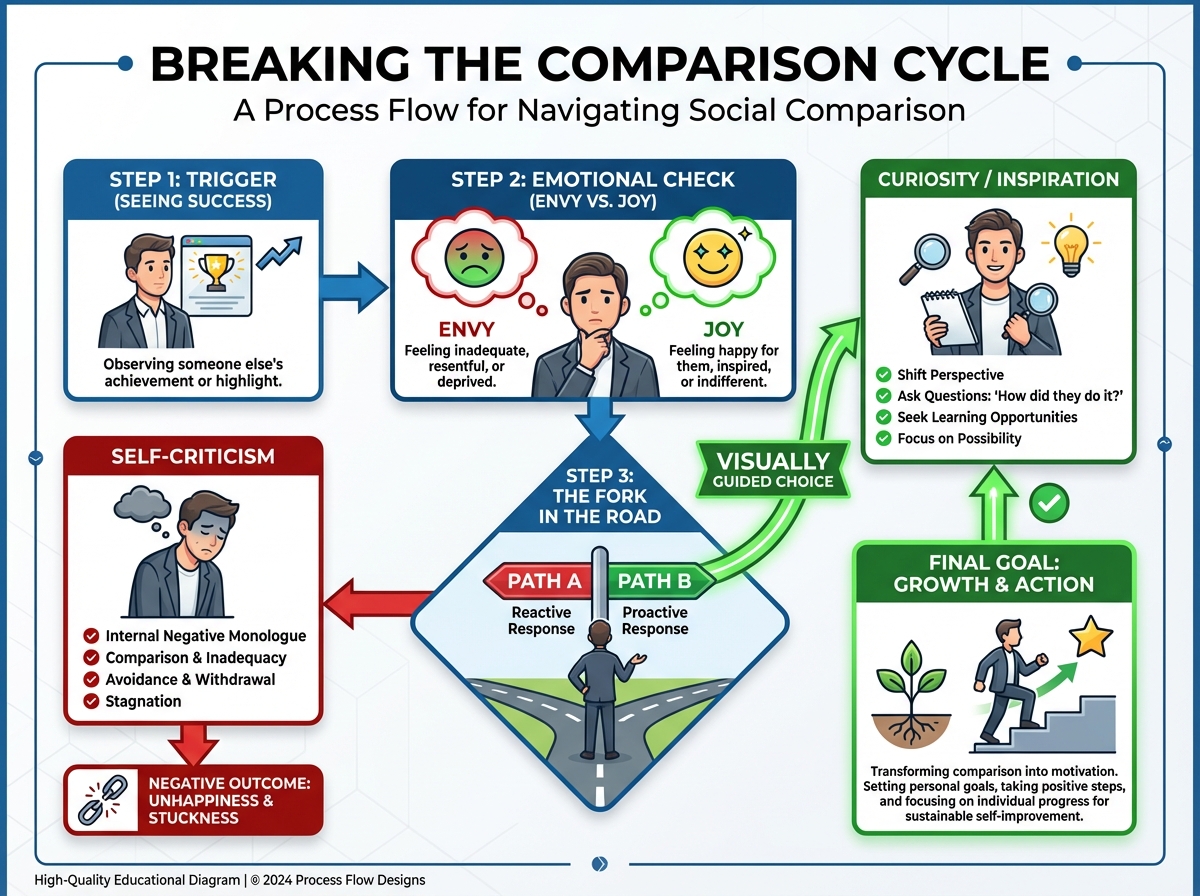
This asymmetry creates a distorted reality where everyone else seems to have "figured it out" while you are struggling. Breaking this cycle requires a strategic shift in how we process information about others.
Understanding the theory is the first step; applying it requires practice. Here are actionable strategies to integrate the "Good for her! Not for me" philosophy into your daily life.
Envy is an uncomfortable emotion, but it is also highly informative. Instead of suppressing envy or letting it turn into bitterness, use it as data.
When you feel a pang of jealousy, ask yourself: What specifically am I jealous of?
Once you identify the root desire, you can create a plan to achieve it in a way that aligns with your values—turning a passive negative emotion into an active positive goal.
If you were allergic to peanuts, you wouldn't keep a bowl of them on your desk. If you are prone to comparison, do not fill your digital feed with triggers.
To say "Not for me," you must know what is for you. Many women struggle with building self-esteem because they have not clearly defined their own values.
Take time to write down your non-negotiables. What does a successful life look like to you?
When you are grounded in your own values, another person's success in a different arena feels irrelevant rather than threatening. It becomes easy to say, "That is a beautiful life for her, but it would be a cage for me."
FOMO (Fear of Missing Out) drives comparison. JOMO is the antidote. It is the satisfaction of knowing you are exactly where you need to be, doing exactly what you want to do—even if that means staying in when everyone else is out, or renting when everyone else is buying.
JOMO is the emotional manifestation of "Not for me." It is the relief of not having to participate in races you never signed up for.
The root cause of excessive comparison is a reliance on external validation. When your self-worth depends on being "better" than others, you are on a treadmill that never stops. Building self-esteem for women (and men) involves shifting the source of validation from outside to inside.
Jordan Peterson, among other psychologists, advocates for the rule: "Compare yourself to who you were yesterday, not to who someone else is today."
This shifts the focus from a variable you cannot control (other people) to a variable you can control (your own progress).
This is the only comparison that yields accurate data and productive growth.
Compersion is often described as the opposite of jealousy—it is the feeling of joy associated with seeing a loved one experience joy. While often used in relationship contexts, it applies socially as well.
Practice the muscle of compersion. When a friend succeeds, consciously try to feel happy for them. Send the congratulatory text immediately. Force the brain to associate their win with a positive communal feeling. Over time, this rewires the neural pathways that default to comparison.
Reading about ending social comparison is one thing; rewiring your brain to stop doing it is another. This is where personalized mentorship becomes essential. GPTnius offers AI Mentors that have been trained on proprietary research analyzing the published works, philosophies, and proven methodologies of thought leaders in psychology and personal development.
Here is how utilizing a GPTnius AI Mentor can help you master the "Good for her, not for me" mindset:
By engaging in guided discussions with mentors trained on the best psychological research available, you move from understanding the concept of self-esteem to actively living it.
> 💡 Ready to Build Unshakeable Self-Esteem? > > Stop letting social comparison dictate your happiness. Engage with AI Mentors trained on the world's best frameworks for mindset and personal growth to build a life that is unapologetically "For You." > > Meet the AI mentors built from this research →
The phrase "Good for her! Not for me" is more than a catchy quote; it is a survival mechanism for the modern age. It allows us to walk through a world screaming for our attention and validation without losing our center.
Eliminating social comparison does not happen overnight. It is a daily practice of noticing the impulse to compare, pausing, and choosing a different thought. It is the practice of celebrating abundance while fiercely protecting your autonomy.
Remember: Her victory is not your loss. Her path is not your path. And the only person you need to be better than is the person you were yesterday.
The quote comes from Amy Poehler's 2014 memoir, 'Yes Please.' She describes it as a mantra she uses to combat jealousy and support other women while maintaining her own boundaries and identity.
Social media exacerbates social comparison by presenting a curated 'highlight reel' of others' lives. This leads to 'upward comparison,' where users compare their everyday reality to others' best moments, often resulting in feelings of inadequacy.
Yes, in moderation. 'Benign envy' can sometimes serve as inspiration or motivation to improve oneself. However, when it turns into 'malicious envy' or chronic feelings of inferiority, it becomes harmful to mental health.