Unlock your potential through Growth Mindset Training with Adaptive Feedback. Discover how AI-driven insights and psychology accelerate personal growth.
For decades, personal development and education followed a linear path: study material, take a test, receive a grade. This static model often reinforces a "Fixed Mindset"—the belief that intelligence and talent are innate traits that cannot be significantly changed. However, the intersection of cognitive psychology and artificial intelligence has given rise to a powerful new methodology: Growth Mindset Training with Adaptive Feedback.
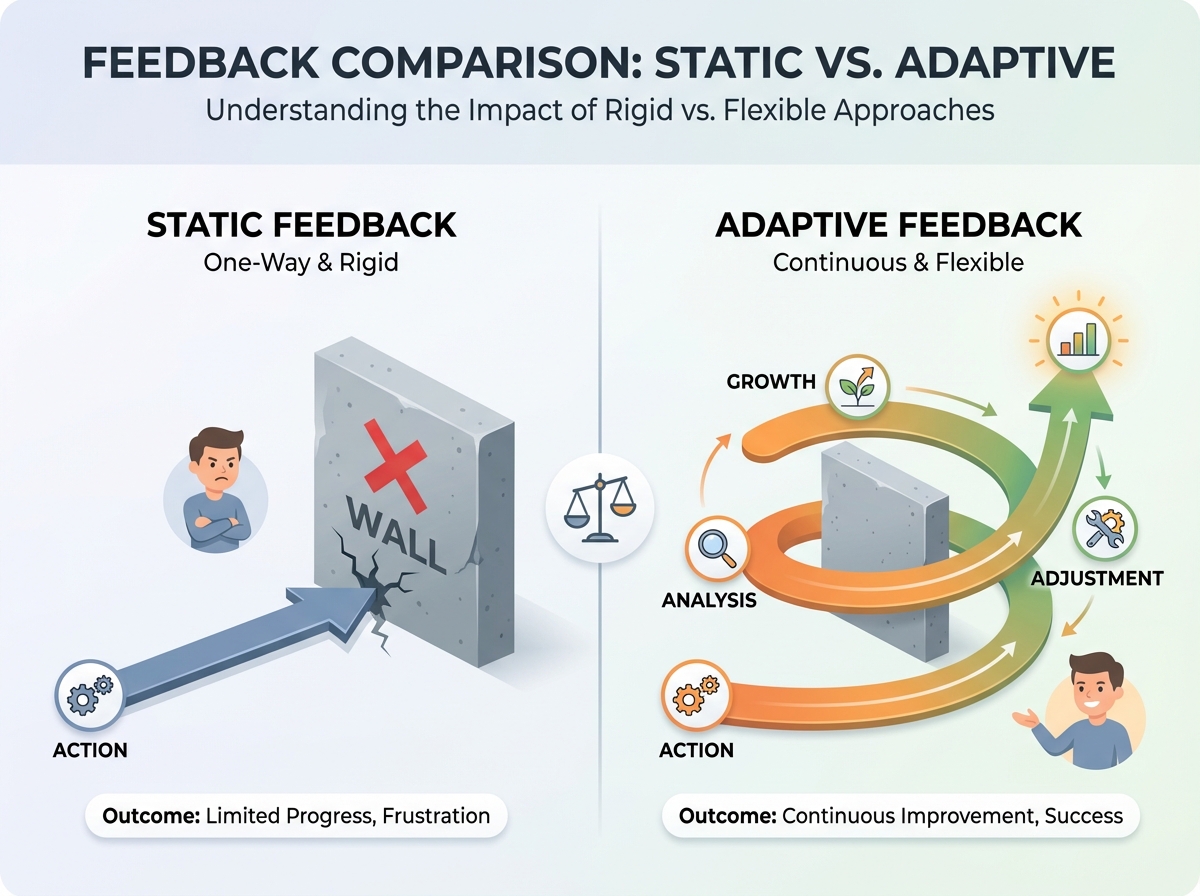
This approach does not merely assess what you know; it analyzes how you learn, adjusting the difficulty and nature of the guidance in real-time. By moving from static criticism to dynamic, process-oriented feedback, learners can rewire their brains to view challenges as opportunities rather than threats.
In this comprehensive guide, we will explore the neuroscience behind this training, how adaptive feedback loops accelerate mastery, and how you can leverage AI tools to cultivate a resilient, growth-oriented mind.
To understand why this combination is so potent, we must first decouple the concepts.
Popularized by psychologist Carol Dweck, the Growth Mindset is the understanding that abilities can be developed through dedication and hard work. In a fixed mindset, effort is seen as fruitless if you aren't "naturally" good at something. In a growth mindset, effort is the path to mastery.
Standard feedback is often binary: Correct or Incorrect. Adaptive feedback is nuanced. It is a pedagogical approach where the environment (or mentor) responds to the learner's specific actions, misconceptions, and pace.
When combined, Growth Mindset Training with Adaptive Feedback creates a psychological safety net. It tells the learner, "You didn't fail; you just haven't found the right strategy yet. Here is a specific adjustment to try next."
> 💡 Break Free from Limiting Beliefs > > Are you stuck thinking your skills are set in stone? GPTnius AI Mentors, trained on research into cognitive reframing and high-performance psychology, can help you identify and dismantle these mental blocks in real-time. > > Meet the AI mentors built from this research →
Why does adaptive feedback work better than a simple textbook? The answer lies in the brain's dopamine reward system and neuroplasticity.
When we receive feedback that matches our expectations, our brain remains in a neutral state. However, when we receive corrective feedback that bridges the gap between what we know and what we need to know, it triggers a "prediction error."
If the feedback is constructive and actionable (Adaptive), the brain releases dopamine associated with learning and curiosity. If the feedback is harsh or vague (Non-Adaptive), the brain triggers a cortisol stress response, effectively shutting down the prefrontal cortex where learning happens. Adaptive feedback keeps the brain in the optimal state for neuroplasticity—the ability to form new neural connections.
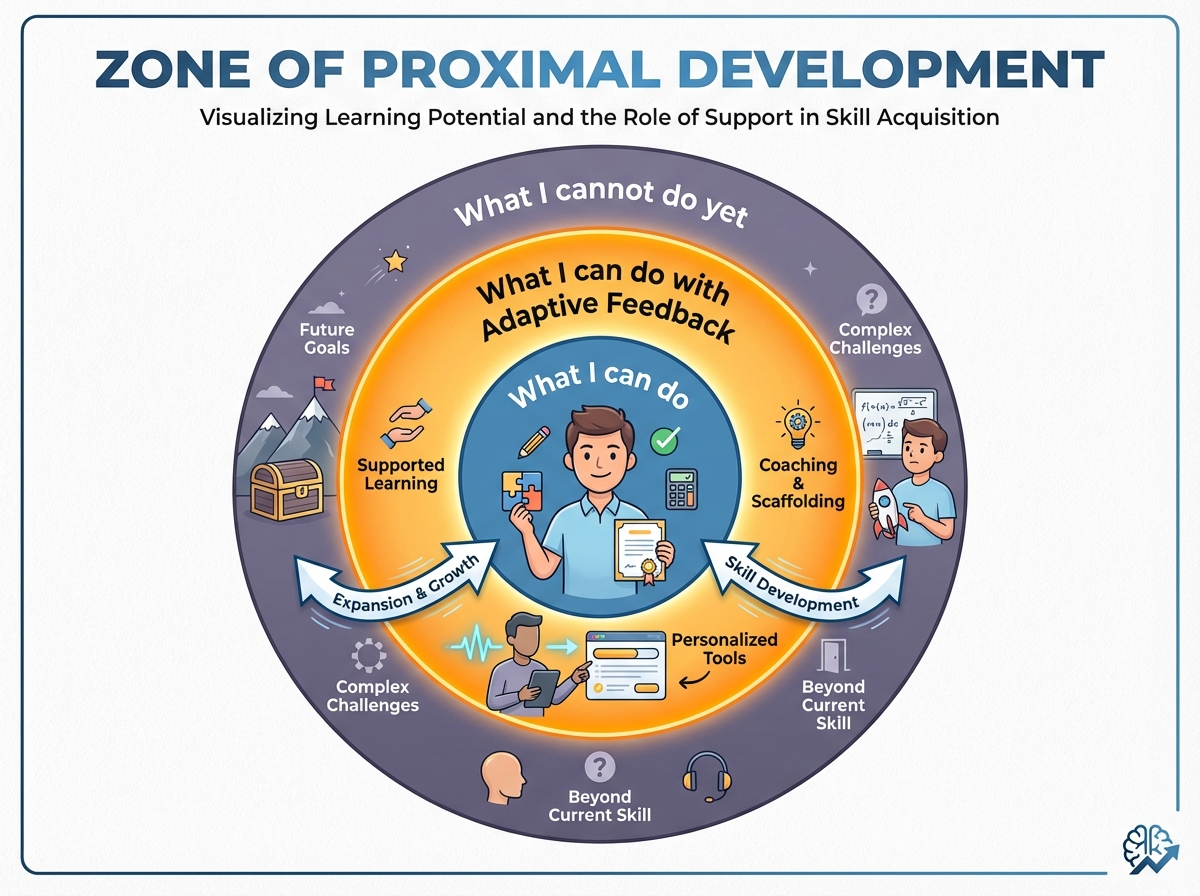
Adaptive feedback utilizes a concept known as "Scaffolding." Just as construction workers use scaffolds to reach higher levels of a building, adaptive training provides temporary support that is removed as you gain competence.
This keeps you in the Zone of Proximal Development (ZPD)—the sweet spot where a task is challenging enough to be engaging but not so difficult that it causes anxiety. Static learning often misses the ZPD, leading to boredom (too easy) or frustration (too hard). Adaptive feedback ensures you stay in the zone.
Historically, true adaptive feedback required a one-on-one human tutor—a luxury unavailable to most. This is where AI Learning revolutionizes the landscape.
AI Mentors and learning algorithms can process inputs instantly and generate feedback that is:
You don't need to wait for a formal course to begin utilizing these principles. Here is how you can structure your own Growth Mindset Training with Adaptive Feedback loops.
When reviewing your own work or leading a team, stop focusing solely on the result.
When you encounter a failure, verbally append the words "not yet."
This linguistic shift primes the brain for adaptive problem-solving rather than resignation.
Instead of asking for general advice ("How am I doing?"), ask for adaptive, specific feedback ("I'm trying to improve my opening hook in meetings. Did the first 30 seconds grab your attention, or was it too slow?"). Specific questions yield specific data, allowing you to adapt your behavior immediately.
Understanding the theory of the Growth Mindset is one thing; consistently applying it when you are frustrated or stuck is another. This is where GPTnius bridges the gap between theory and practice.
GPTnius offers AI Mentors that have been trained on proprietary research analyzing the published works, philosophies, and proven methodologies of thought leaders in psychology, productivity, and leadership.
For example, if you are struggling to learn a new skill, you can engage with a GPTnius mentor designed to emulate the coaching style of high-performance trainers. The AI Mentor synthesizes researched frameworks to provide personalized coaching conversations.
Here is how a GPTnius session facilitates Adaptive Feedback:
By engaging in these guided discussions, you aren't just reading about a growth mindset; you are actively training your brain to operate within one.
> 💡 Turn Principles into Practice > > Don't let another day pass in a fixed mindset. Use GPTnius to access AI Mentors trained on the world's best frameworks for learning and adaptation. > > Meet the AI mentors built from this research →
Growth Mindset Training with Adaptive Feedback represents the pinnacle of modern personal development. It moves us away from the outdated notion that we are defined by our innate talents and toward a reality where our capacity to learn is the only ceiling. By leveraging the immediacy and personalization of AI tools, we can create a continuous loop of improvement, turning every stumbling block into a stepping stone for mastery.
A Fixed Mindset assumes intelligence and talent are static traits you are born with. A Growth Mindset, a term coined by Carol Dweck, is the belief that abilities can be developed through dedication, hard work, and feedback.
Standard feedback is usually summative (grades, pass/fail) and static. Adaptive feedback is formative and dynamic; it adjusts based on the learner's performance, offering specific guidance to help them navigate the immediate challenge.
AI cannot 'feel' emotions, but it can be trained on vast amounts of research regarding emotional intelligence frameworks. It can help users recognize patterns in their behavior, role-play difficult conversations, and provide objective feedback to improve EQ.