Learn about How an AI Life Coach Helps You Set and Achieve Goals with this comprehensive guide from GPTnius.
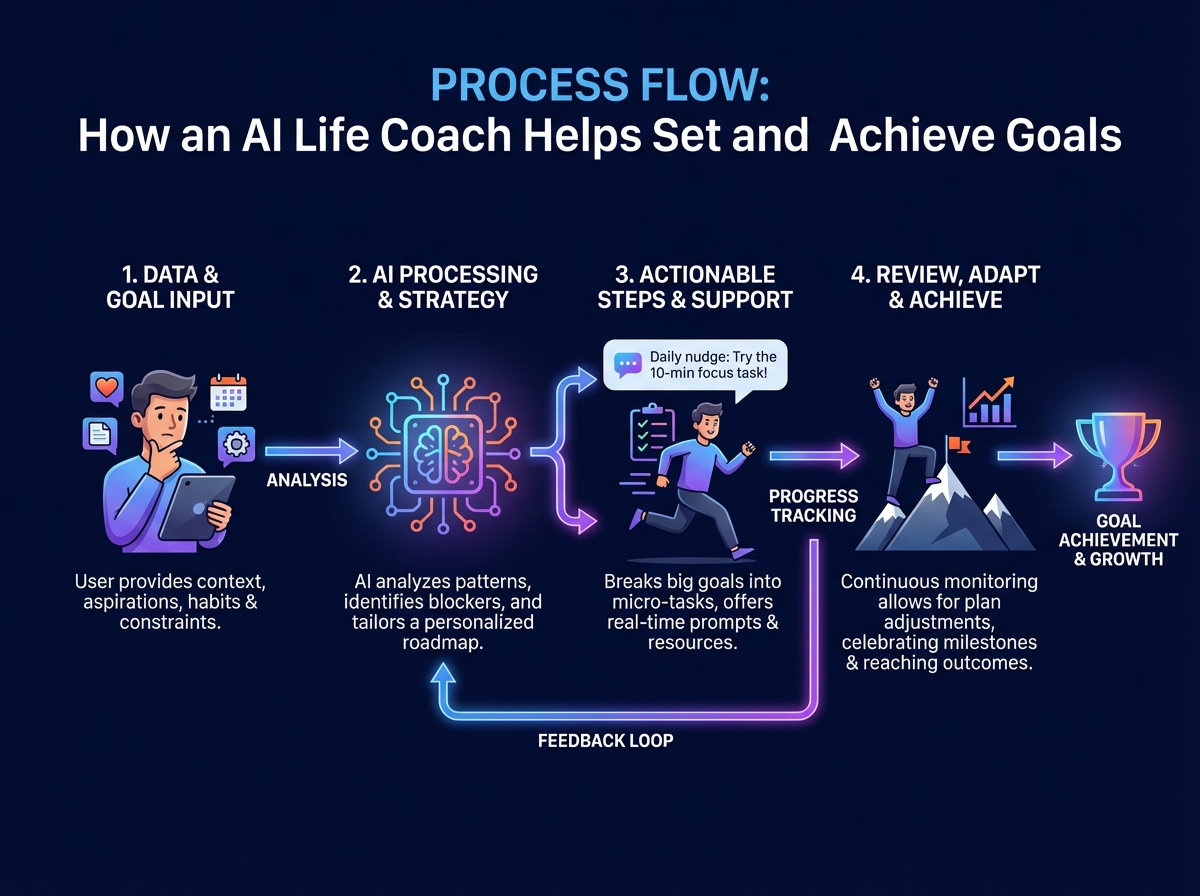
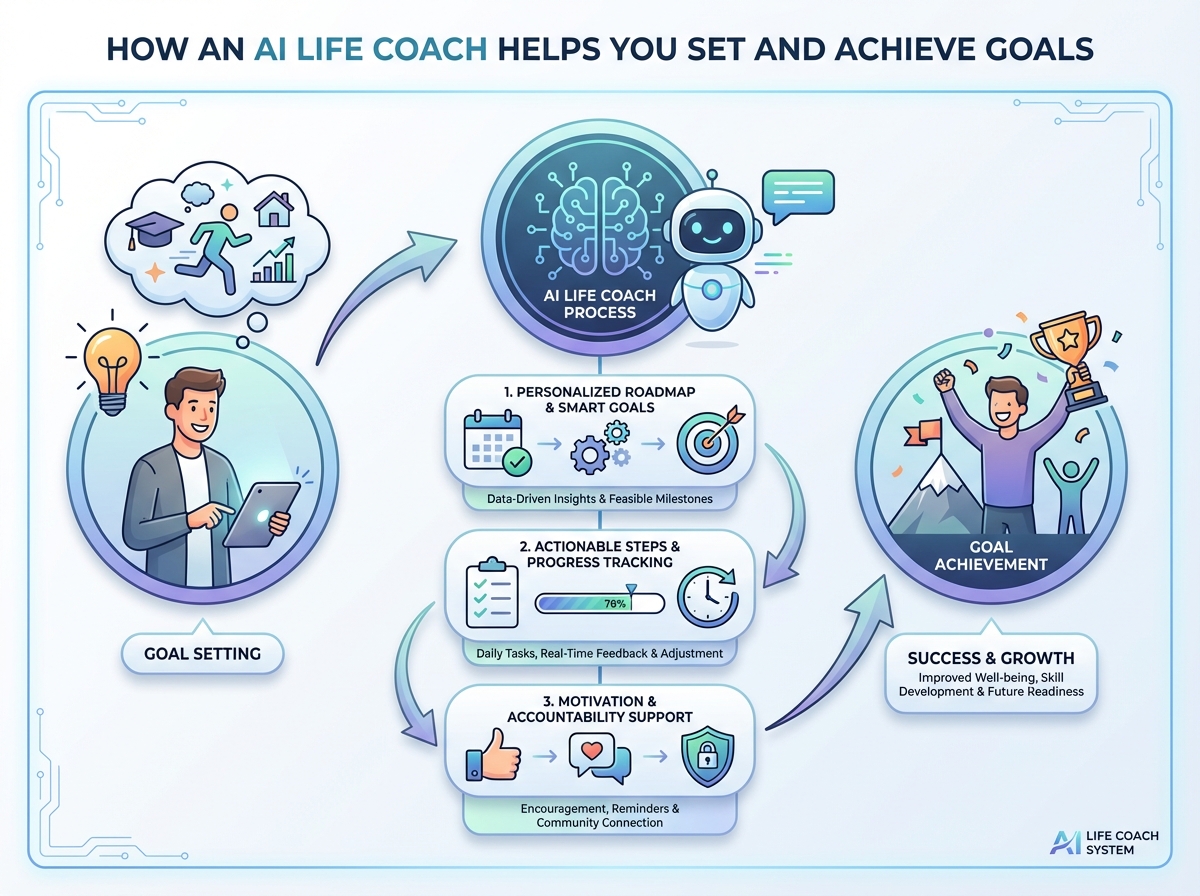
{ "title": "How an AI Life Coach Helps You Set and Achieve Goals: The Future of Personal Development", "description": "Discover how an AI life coach helps you set and achieve goals using data-driven insights, proven frameworks, and 24/7 accountability. Start your journey today.", "tldr": "AI life coaches are revolutionizing personal development by offering 24/7 availability, unbiased accountability, and personalized strategy based on proven psychological frameworks. This guide explores how AI mentors bridge the gap between setting goals and actually achieving them through continuous feedback loops and micro-habit formation.", "content": "## The Evolution of Mentorship: Why AI is the Missing Link\n\nWe live in an era of information overload but implementation starvation. You likely have a shelf full of self-help books, a saved list of motivational podcasts, and a notes app filled with New Year’s resolutions that lost their momentum by February. The problem is rarely a lack of knowledge; it is a lack of sustained execution and personalized guidance.\n\nHistorically, bridging this gap required hiring a human life coach—a luxury often reserved for executives or the wealthy. Enter the AI life coach. By democratizing access to high-level strategic thinking and accountability, AI learning tools are fundamentally changing how we approach personal development.\n\nAn AI life coach doesn't just offer generic advice; it acts as a dynamic mirror, reflecting your habits back to you and helping you navigate the complex psychology of goal achievement. Whether you are trying to scale a business, improve your health, or master a new skill, understanding how to leverage AI mentorship is the modern competitive advantage.\n\n## The Psychology of the \"Intention-Action Gap\"\n\nTo understand why an AI life coach helps you set and achieve goals effectively, we must first understand why we fail on our own. Psychologists refer to this as the \"Intention-Action Gap.\" It is the disconnect between what we plan to do and what we actually do.\n\nResearch suggests that goals often fail due to three primary friction points:\n\n1. Vagueness: \"I want to get fit\" is a wish, not a goal. It lacks the specificity required for the brain to formulate a plan.\n2. Lack of Immediate Feedback: Human brains are wired for instant gratification. Long-term goals have delayed rewards, making it hard to sustain motivation.\n3. Decision Fatigue: When the path isn't clear, every step requires a decision. Eventually, willpower depletes, and we default to old habits.\n\nAn AI mentor addresses these friction points by externalizing the executive function required to manage them. It turns vague desires into concrete data points and provides the immediate feedback loop necessary to keep the dopamine flowing.\n\n> 💡 Turn Your Ambition into Actionable Steps\n> \n> Struggling to bridge the gap between your big dreams and your daily to-do list? GPTnius AI Mentors use research-backed frameworks to break down complex goals into manageable, execution-ready tasks.\n> \n> Meet the AI mentors built from this research →\n\n## How an AI Life Coach Transforms Goal Setting\n\nUsing an AI mentor is not about replacing human intuition; it is about augmenting human discipline. Here is how AI brings structure to the chaos of personal growth.\n\n### 1. Transforming Vague Wishes into SMART Goals\nOne of the most immediate benefits of an AI life coach is its ability to interrogate your logic. If you tell an AI, \"I want to be more productive,\" it will not simply cheer you on. It will ask clarifying questions:\n \"How do you define productivity in this context?\"\n \"What metrics will we use to track success?\"\n \"Are we optimizing for output volume or quality of deep work?\"\n\nThrough this Socratic dialogue, the AI forces you to construct SMART goals (Specific, Measurable, Achievable, Relevant, Time-bound). It acts as a forcing function for clarity, ensuring that you aren't chasing a ghost.\n\n### 2. The Power of Unbiased Accountability\nHuman accountability partners are great, but they come with social baggage. You might feel embarrassed to admit you skipped a workout, or your friend might be too polite to call you out on your excuses.\n\nAn AI life coach provides radical, non-judgmental transparency. It doesn't care if you had a bad day; it only cares about the data. If you miss a milestone, the AI doesn't judge you—it analyzes why. Was the goal too ambitious? Was the timeline unrealistic? This objective analysis allows you to pivot strategies without the emotional weight of failure.\n\n### 3. Simulating Mental Models of Great Thinkers\nThe most powerful aspect of advanced AI mentorship is its ability to synthesize vast amounts of literature. Instead of just giving advice, an AI can help you solve problems using specific mental models.\n\nFor example, if you are stuck on a difficult career decision, an AI mentor trained on proprietary research regarding decision-making frameworks might prompt you to use:\n Inversion: \"Instead of asking how to succeed, let's analyze what would guarantee failure in this project, and then avoid those things.\"\n* First Principles: \"Let's strip away the assumptions you have about your industry and look at the fundamental truths.\"\n\n
\n\n### 4. Dynamic Learning Paths and Course Correction\nStatic goals often fail because life is dynamic. You might get sick, change jobs, or face a family emergency. A paper planner cannot adjust itself, but an AI can.\n\nIf you fall behind, an AI life coach can instantly recalculate your \"Learning Path.\" It can condense the remaining curriculum or suggest a \"minimum viable habit\" to keep the streak alive during busy periods. This adaptability prevents the \"what the hell\" effect—the psychological phenomenon where one small slip-up causes you to abandon the entire goal.\n\n## The Feedback Loop: Data-Driven Personal Growth\n\nThe magic of AI coaching lies in the feedback loop. In traditional coaching, you might review progress once a week or once a month. With AI, the feedback can be continuous.\n\n### Micro-Journaling and Pattern Recognition\nBy engaging in daily micro-conversations with your AI mentor, you generate a dataset of your own psychology. Over time, the AI can identify patterns you might miss:\n \"I notice you tend to report high anxiety on Tuesdays. Let's look at your schedule for that day.\"\n \"You consistently underestimate the time required for creative tasks by 30%.\"\n\nThis level of granular insight allows you to optimize your routine with the precision of a Formula 1 pit crew, rather than relying on guesswork.\n\n## How GPTnius Helps You Apply These Principles\n\nTheory is useful, but application is everything. GPTnius is designed specifically to operationalize these concepts through AI Mentors that have been trained on proprietary research analyzing the published works, philosophies, and proven methodologies of world-renowned thought leaders.\n\nHere is how GPTnius helps you set and achieve goals:\n\n Research-Backed Frameworks: GPTnius mentors draw from research on frameworks like Charlie Munger's mental models and James Clear's habit systems. They synthesize these researched frameworks to provide personalized coaching conversations that help you build systems, not just goals.\n Personalized Strategic Advice: Unlike a standard chatbot, GPTnius mentors are designed to maintain context. They remember your long-term objectives and ensure that today's advice aligns with tomorrow's vision.\n Mentor Deep Dives: If you are struggling with a specific concept—like overcoming procrastination—you can engage in a focused Deep Dive where the mentor guides you through a step-by-step application of proven principles to your unique situation.\n Goal Tracking & Learning Paths: GPTnius allows you to structure your development into clear paths, ensuring you are always moving forward.\n\nDisclaimer: GPTnius AI Mentors are NOT endorsed by, affiliated with, or impersonating any real individuals. They are advanced AI tools trained to synthesize public methodologies for educational and coaching purposes.\n\n> 💡 Build Your Personal Board of Advisors\n> \n> Stop guessing and start strategizing. Access AI Mentors trained on the research behind the world's most effective mental models and coaching frameworks to build a roadmap for your success.\n> \n> Meet the AI mentors built from this research →\n\n## Conclusion\n\nThe era of the AI life coach is not about surrendering human agency to machines; it is about using technology to elevate human potential. By leveraging AI for structure, data analysis, and accountability, you free up your mental energy for the creative and executive work that actually moves the needle.\n\nWhether you are looking to refine your daily habits or overhaul your life's trajectory, the combination of proven frameworks and AI adaptability offers a powerful solution to the age-old problem of goal achievement. The tools are ready. The question is, are you?",
!Key Concept Diagram "keywords": [ "AI Life Coach", "How an AI Life Coach Helps You Set and Achieve Goals", "Personal Development", "AI Mentorship", "Goal Setting Frameworks", "Smart Goals", "Mental Models" ], "faqs": [ { "question": "Can an AI life coach replace a human therapist?", "answer": "No. AI life coaches and mentors are designed for goal setting, productivity, and professional development. They are not mental health professionals and cannot treat mental illness. They are excellent for strategy and accountability but should not replace clinical therapy." }, { "question": "How does an AI mentor keep me accountable?", "answer": "AI mentors provide accountability through consistent check-ins, tracking progress against defined metrics, and offering non-judgmental feedback. They can identify patterns in your behavior and suggest adjustments when you fall off track." }, { "question": "Is my data safe with an AI life coach?", "answer": "Reputable platforms prioritize user privacy. However, you should always review the privacy policy of any AI tool you use. GPTnius, for example, focuses on secure, personalized interactions designed to foster learning." }, { "question": "What frameworks do AI coaches use?", "answer": "Advanced AI coaches, like those on GPTnius, are trained on research regarding various proven methodologies. This includes concepts like SMART goals, Atomic Habits (habit stacking), First Principles thinking, and various productivity systems used by successful leaders." } ], "heroImagePrompt": "A photorealistic, cinematic close-up of a wooden desk in a dimly lit, modern study. On the desk, a chaotic pile of colorful, glowing puzzle pieces represents 'scattered goals.' A sleek, holographic interface emanates from a tablet, where digital hands are assembling these puzzle pieces into a clear, glowing golden path leading upward. The scene symbolizes clarity emerging from chaos through technology. 16:9 aspect ratio.", "inlineImagePrompt": "A clean, minimalist vector infographic on a white background illustrating the 'Intention-Action Gap.' On the left, a thought bubble labeled 'Intention' (Plan). On the right, a gear labeled 'Action' (Execution). In the middle, a bridge labeled 'AI Mentorship' connects them. Under the bridge, a pit labeled 'Procrastination & Distraction.' 4:3 aspect ratio.", "inlineImage2Prompt": "A comparative split-screen chart. The left side shows 'Traditional Goal Setting' as a static, linear line that breaks upon hitting an obstacle. The right side shows 'AI-Assisted Goal Setting' as a fluid, sine-wave curve that adapts around obstacles, labeled 'Dynamic Adaptation.' The color scheme should be professional blue and green. 4:3 aspect ratio." }