Discover how interleaved practice outperforms blocked study by leveraging neuroplasticity. Learn actionable strategies to master skills faster with AI learning techniques.
Most people learn by focusing on one subject at a time (blocked practice), but research shows this creates an "illusion of competence." Interleaved practice—the art of mixing related topics or skills within a single session—forces the brain to work harder to retrieve information. This "desirable difficulty" triggers stronger neuroplasticity, improves your ability to distinguish between concepts, and significantly boosts long-term retention. By leveraging AI tools, you can easily structure interleaved sessions to accelerate your personal development.
---
If you want to master a tennis serve, common wisdom suggests you hit 50 forehands, then 50 backhands, then 50 volleys. If you want to learn Spanish, you might spend Monday on verbs, Tuesday on vocabulary, and Wednesday on grammar. This approach is known as blocked practice, and it feels intuitively correct. It allows you to get into a "groove," creating a sensation of rapid improvement.
There is just one problem: neuroscience suggests this method is largely inefficient for long-term mastery.
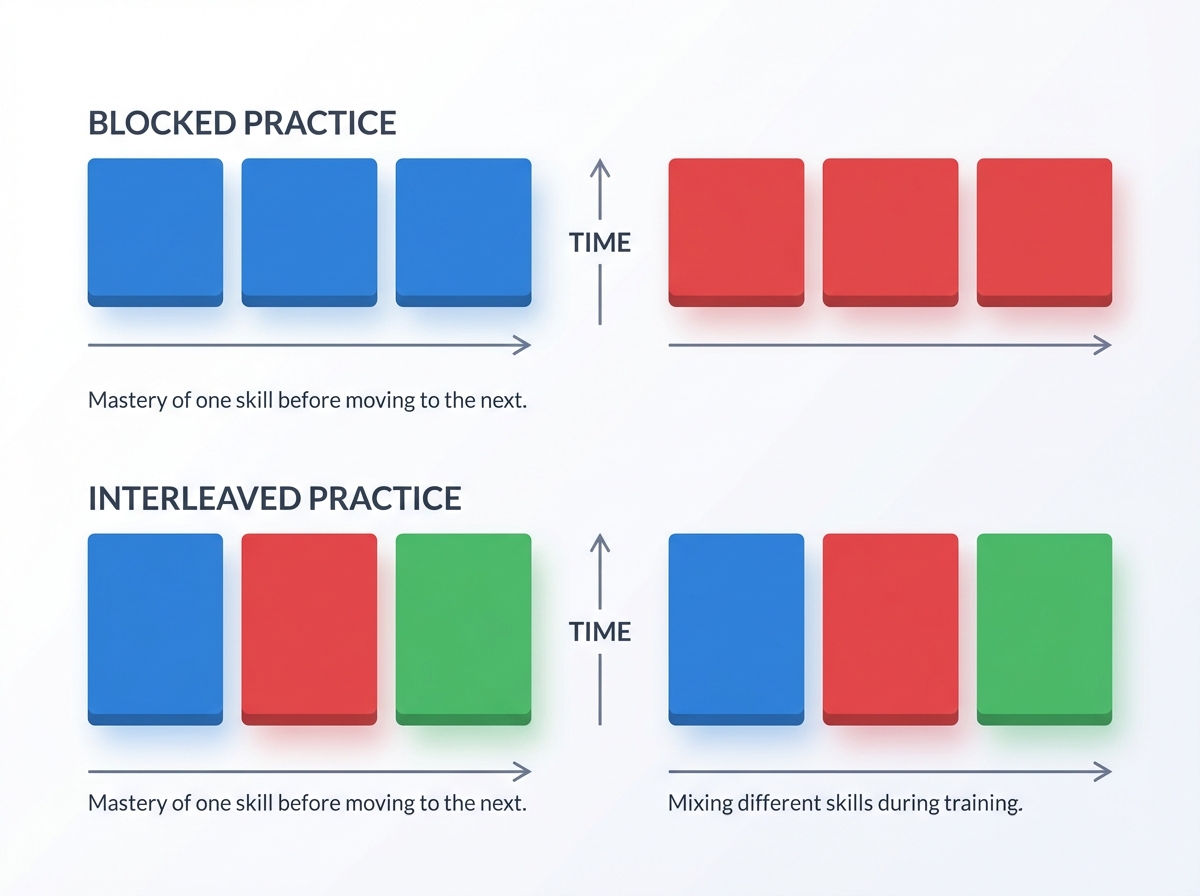
Enter Interleaved Practice, a cognitive science framework that flips the script on traditional learning. Instead of mastering one sub-topic before moving to the next (AAABBBCCC), interleaving mixes them up (ABCABCABC). While it feels more difficult in the moment, it is one of the most potent drivers of neuroplasticity and accelerated learning available to us.
To understand why interleaving works, we must look at how the brain encodes memory. When you engage in blocked practice (doing the same thing repeatedly), your brain holds the strategy or solution in its working memory. You don't have to "reload" the concept for every repetition; you just execute.
However, when you interleave topics, you force your brain to engage in two critical cognitive processes:
Every time you switch topics—say, moving from a math problem to a history question and back again—your brain must "dump" the previous solution strategy from working memory and "retrieve" the new one from long-term memory. This constant reloading strengthens the neural pathways associated with that information. It creates a stronger memory trace, making the knowledge more durable.
The real power of interleaving lies in discrimination. In the real world, problems don't come labeled with the strategy required to solve them. You have to identify what kind of problem you are facing before you can solve it.
Blocked practice teaches you how to solve a problem. Interleaved practice teaches you which strategy to use. By seeing different types of problems side-by-side, your brain learns to identify the subtle nuances and differences between them. This promotes higher-level conceptual thinking rather than rote memorization.
> 💡 Stop Memorizing, Start Mastering > > Struggling to differentiate between complex concepts or strategies? Your brain needs a challenge, not a repetition. > > Meet the AI mentors built from this research →
If interleaving is so effective, why isn't it the standard in schools and corporate training? The answer lies in human psychology.
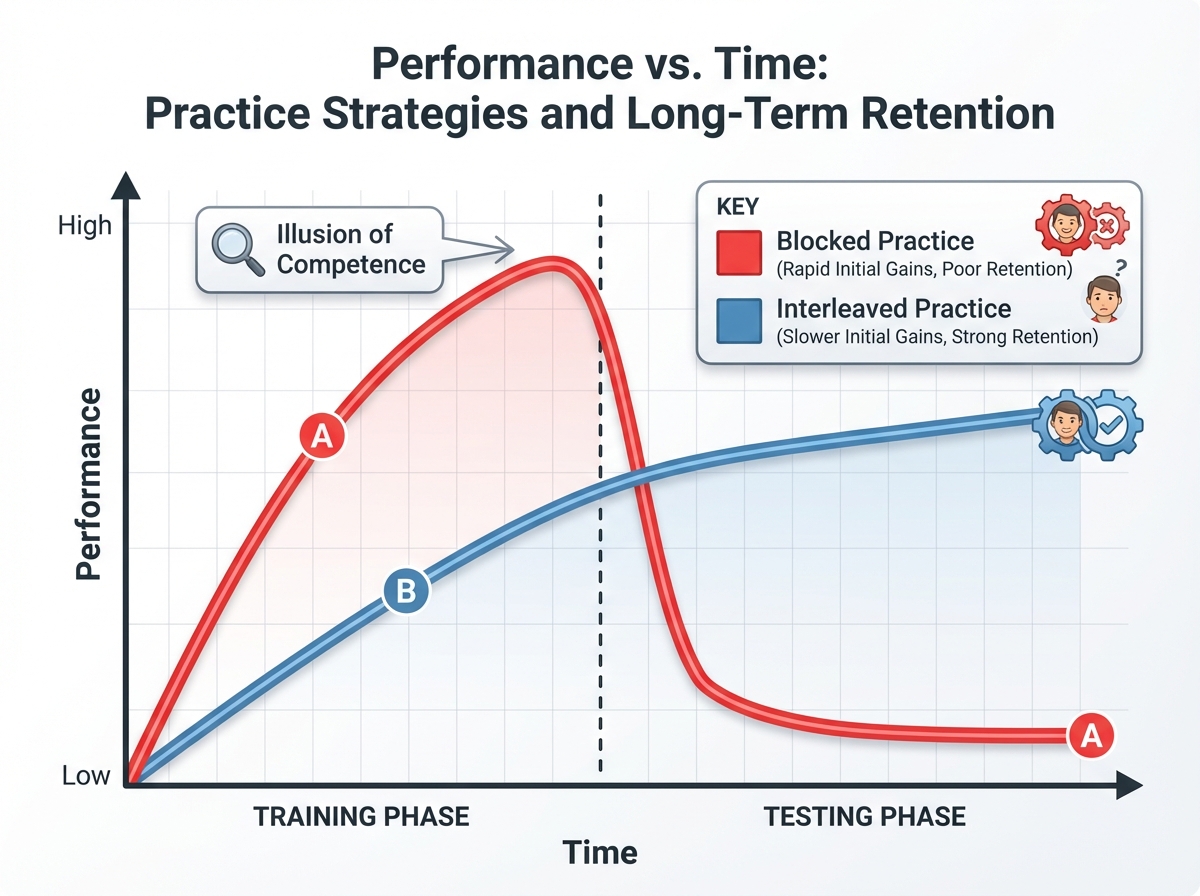
Blocked practice provides immediate feedback. You see rapid improvement during the session because you are relying on short-term working memory. This creates an illusion of competence. You walk away feeling like you've mastered the material.
Interleaved practice, conversely, feels frustrating. Because you are constantly context-switching, you make more errors during the practice session. You feel like you are learning slower. However, research consistently shows that while interleaved learners perform worse during practice, they significantly outperform blocked learners on final tests and long-term application.
Embracing this "desirable difficulty" is the key to unlocking accelerated learning.
How do you apply this to your personal development or professional upskilling? Here are specific frameworks for different domains.
If you are learning a new software stack, leadership framework, or marketing strategy, avoid dedicating whole days to single concepts.
Don't spend a week solely on past tense verbs.
This is where interleaving shines brightest.
One of the difficulties of interleaving is the administrative burden; it takes effort to organize a randomized study plan. This is where AI learning tools become invaluable.
You can prompt AI tools to generate practice scenarios that switch contexts rapidly. For example, you might ask an AI mentor to present you with a series of business challenges that require different mental models to solve, without telling you which model applies.
Advanced AI platforms can track your performance across different topics. If the AI detects you are getting too comfortable with a specific topic (indicating the illusion of competence), it can inject a completely different topic to force a context switch, ensuring your brain remains in a state of high neuroplasticity.
Understanding the theory of interleaved practice is one thing; consistently applying it to your daily growth is another. This is where GPTnius offers a distinct advantage.
GPTnius offers AI Mentors that have been trained on proprietary research analyzing the published works, philosophies, and proven methodologies of thought leaders. For example, "The Architect" mentor draws from research on frameworks like mental models and habit systems, combined with proven coaching models.
Here is how these AI Mentors facilitate interleaved practice:
By engaging in guided discussions with an AI Mentor, you are naturally practicing retrieval and discrimination, turning every conversation into a high-impact neuroplasticity session.
> 💡 Accelerate Your Growth with AI Coaching > > Stop wasting time on passive study. Engage with AI Mentors trained on proven methodologies to practice interleaving and master skills faster. > > Meet the AI mentors built from this research →
Interleaved practice is the antidote to the stagnation of rote memorization. It requires a mindset shift: you must be willing to struggle more during practice to perform better in reality. By mixing topics, diversifying your inputs, and utilizing AI tools to structure your learning, you turn your brain into a flexible, highly adaptive machine. The path to mastery isn't a straight line—it's an interleaved web of connections.
Blocked practice involves studying one topic thoroughly before moving to the next (AAABBB). Interleaved practice mixes related topics within a single session (ABCABC), which improves long-term retention and the ability to distinguish between concepts.
It feels harder because of 'desirable difficulty.' Your brain must constantly reload information and switch contexts, which requires more cognitive effort than repetitive blocked practice. This effort is exactly what builds stronger neural connections.
Yes. Athletes often use interleaving by mixing different types of drills (e.g., serving, volleying, and groundstrokes) in a random order rather than doing mass repetitions of a single movement.
AI tools can act as a 'randomizer,' generating practice questions or scenarios from different topics in a mixed order. This saves you the time of organizing materials and ensures you are constantly testing your ability to retrieve the correct information.