Unlock the power of consistency with Jerry Seinfeld's productivity secrets. Learn how the 'Don't Break the Chain' method transforms habits and fuels success.
Jerry Seinfeld is arguably one of the most successful comedians of all time. His observational humor defined a generation, and his work ethic is the stuff of legend. But behind the laughter and the massive syndication deals lies a simple, unglamorous truth: Seinfeld didn't get there by waiting for lightning to strike. He got there by showing up, every single day.
In the world of productivity tips, few strategies are as famous—or as misunderstood—as the "Don't Break the Chain" method. Often attributed directly to Seinfeld, this technique has been adopted by software developers, writers, athletes, and entrepreneurs worldwide. It is the ultimate antidote to procrastination and the "all-or-nothing" mindset that kills so many dreams.
However, there is nuance to this strategy that often gets lost in the memes and motivational posters. It isn't just about marking an 'X' on a calendar; it is about a fundamental shift in how we view work, creativity, and progress. This article dives deep into the real mechanics of Seinfeld’s productivity secrets and how you can leverage them to master your craft.
The story goes like this: A young comic named Brad Isaac once cornered Jerry Seinfeld in a comedy club and asked for advice on how to be a better comedian. Seinfeld allegedly told him that the way to be a better comic was to create better jokes, and the way to create better jokes was to write every day.
Seinfeld then revealed his unique system: He had a large wall calendar that showed the whole year on one page. Every day that he completed his writing task, he would mark a big red 'X' over that day. "After a few days, you'll have a chain," he reportedly said. "Just keep at it and the chain will grow longer every day. You'll like seeing that chain, especially when you get a few weeks under your belt. Your only job next is to not break the chain."
Interestingly, in a Reddit AMA years later, Seinfeld claimed he didn't actually invent this specific calendar method, calling it a "dumb story." Yet, whether or not the specific anecdote is 100% factual, the principle aligns perfectly with his known work ethic. Seinfeld is famous for his obsessive dedication to the craft of writing. The method has taken on a life of its own because it works. It visualizes the abstract concept of "consistency" into something tangible and game-like.
Why does drawing a red X on a piece of paper have such a profound impact on human behavior? The efficacy of the Seinfeld strategy lies in behavioral psychology.
Humans are visual creatures. When a goal exists only in your mind (e.g., "I want to write a novel"), it is easy to push it to the back burner. A wall calendar with a growing chain of red X's acts as a constant, unavoidable visual cue. It stares at you from the wall, reminding you of your commitment. It moves the accountability from your internal monologue to the external world.
One of the biggest barriers to productivity is the daily decision of whether to work. "Do I feel like going to the gym today?" "Should I write now or later?" Every time you ask these questions, you expend mental energy.
The Chain removes the decision. The decision was made on Day 1. Today's only goal is to maintain the streak. By eliminating the daily negotiation with yourself, you preserve willpower for the actual work.
Psychologically, we are more motivated by the fear of losing something we have than by the prospect of gaining something new. This is known as loss aversion. As your chain grows—5 days, 10 days, 50 days—the "asset" of your streak becomes more valuable. You become protective of it. The pain of breaking a 50-day chain is far greater than the pain of doing 20 minutes of work. The streak itself becomes the motivation.
> 💡 Build Your Streak with a Strategic Plan > > Consistency requires a clear roadmap. GPTnius AI Mentors can help you define the exact daily habits needed to reach your goals, ensuring you know exactly where to place your 'X' each day. > > Meet the AI mentors built from this research →
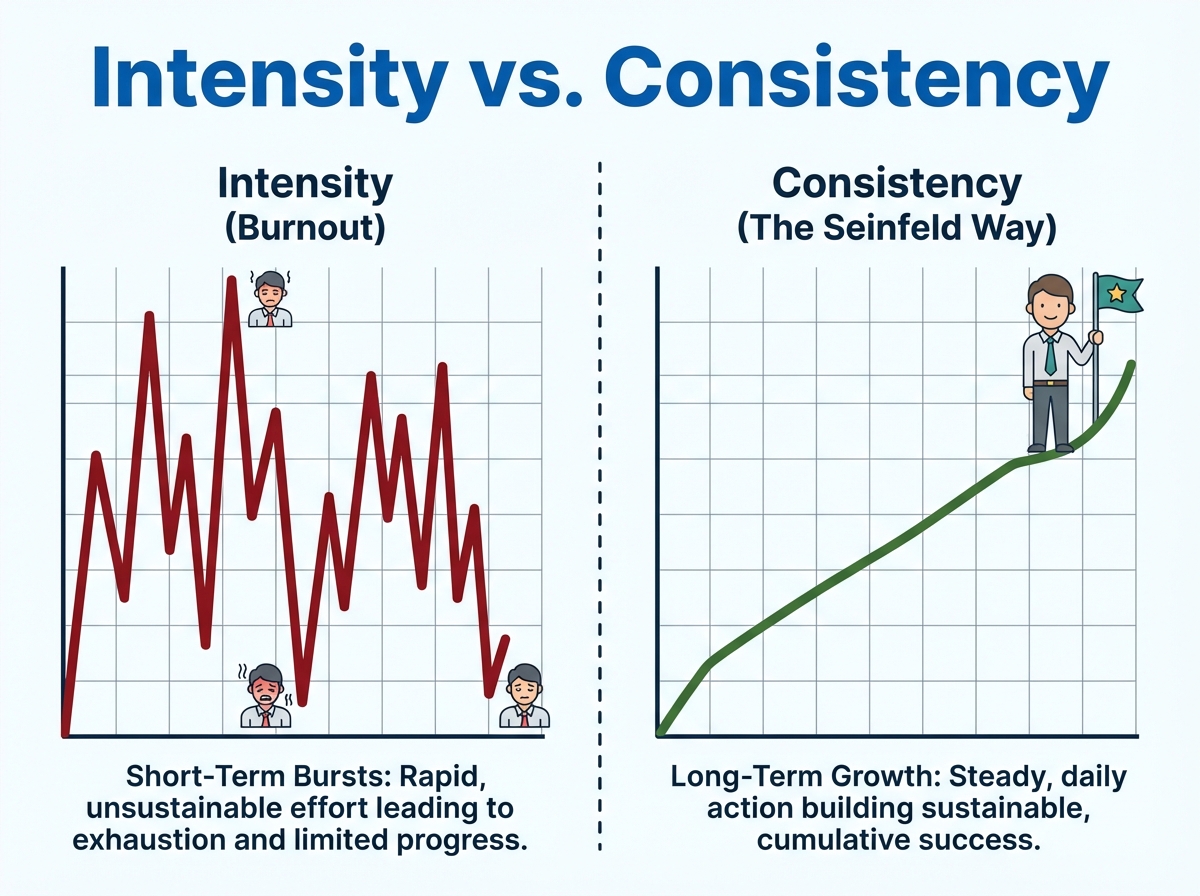
The most critical takeaway from Seinfeld’s approach is the prioritization of consistency over intensity. This is where most people fail.
When we get a burst of motivation (usually around New Year's), we rely on intensity. We vow to write for three hours a day, or hit the gym for ninety minutes. This is unsustainable. Life gets in the way, energy fades, and we burn out. When we miss a day because the target was too high, we feel like failures and quit entirely.
Seinfeld’s method implies a different approach: The bar for the daily action should be low enough that you can do it even on your worst day.
The latter produces a novel. The former produces a folder of unfinished drafts. The goal is to make the behavior automatic, not to set a world record every Tuesday.
Ready to start your own chain? Here is how to apply the Seinfeld strategy effectively without falling into common traps.
Don't try to start five different chains at once. Pick the one skill or habit that will have the highest impact on your goals. If you are a writer, it’s writing. If you are a coder, it’s committing code. If you are in sales, it’s outreach calls.
Set parameters for what earns an X. Be specific, but keep the barrier to entry low.
The requirement should be small enough that you have no excuse to skip it, even if you are tired or busy. You can always do more, but you must never do less.
While there are dozens of habit-tracking apps available, there is a visceral satisfaction in using a physical calendar and a marker. The act of physically marking the day engages different senses and reinforces the accomplishment. Put the calendar somewhere you cannot ignore, like above your desk or on your refrigerator.
While powerful, the 'Don't Break the Chain' method has risks. If you are too rigid, the chain can become a source of anxiety rather than motivation.
If your daily requirement is too high, you will eventually resent the chain. Remember, the goal is the habit, not the suffering. If you find yourself dreading the X, lower the daily requirement. The objective is to keep the momentum alive, not to exhaust yourself.
What happens if you get sick, have a family emergency, or simply forget? The chain breaks. For perfectionists, this can be devastating. They look at the broken chain, think "Well, I ruined it," and give up entirely.
The Solution: Adopt the "Never Miss Twice" rule. If you break the chain, your only priority is to start a new one immediately. One missed day is a stumble; two missed days is the start of a new, negative habit. Do not let a gap in the calendar define your success.
Seinfeld’s productivity isn't just about the calendar; it's about treating creativity as a system rather than magic. He is known for analyzing jokes down to the syllable, treating them like math equations or architectural structures.
This scientific approach to soft skills is crucial. By combining the emotional discipline of the Chain with the intellectual rigor of analyzing your work, you create a feedback loop of continuous improvement. You aren't just doing the same thing every day; you are refining your process daily.
Understanding the theory of "Don't Break the Chain" is easy; maintaining it when life gets chaotic is the hard part. This is where GPTnius bridges the gap between intention and action.
GPTnius offers AI Mentors trained on proprietary research analyzing the published works, philosophies, and proven methodologies of thought leaders, including high performers like Jerry Seinfeld and James Clear. Our mentors do not impersonate anyone. They synthesize researched frameworks, such as consistency systems and habit stacking, into personalized coaching conversations built around your specific goals.
Here is how a GPTnius AI Mentor can support your journey:
By turning abstract principles into a personalized conversation, GPTnius helps you move from reading about productivity to actually living it.
> 💡 Turn Consistency into Your Superpower > > Stop relying on fleeting motivation. Let a GPTnius AI Mentor guide you through building a bulletproof system for success using proven frameworks tailored to your life. > > Meet the AI mentors built from this research →
While the story originated from an interview with Brad Isaac, Seinfeld later clarified in a Reddit AMA that he didn't invent the specific calendar technique. However, the method perfectly illustrates the consistency and work ethic he is famous for.
Don't panic or give up. Adopt the 'Never Miss Twice' rule. Acknowledge the slip-up, and immediately focus on completing your task the next day to start a new streak. Consistency over the long term matters more than a perfect record.
Absolutely. The method is effective for any habit-building exercise, including fitness, learning a new language, coding, sales outreach, or meditation. It works by visualising consistency, regardless of the task.