Discover how journaling with AI transforms traditional reflection into dynamic personal growth. Learn actionable techniques to enhance emotional intelligence.
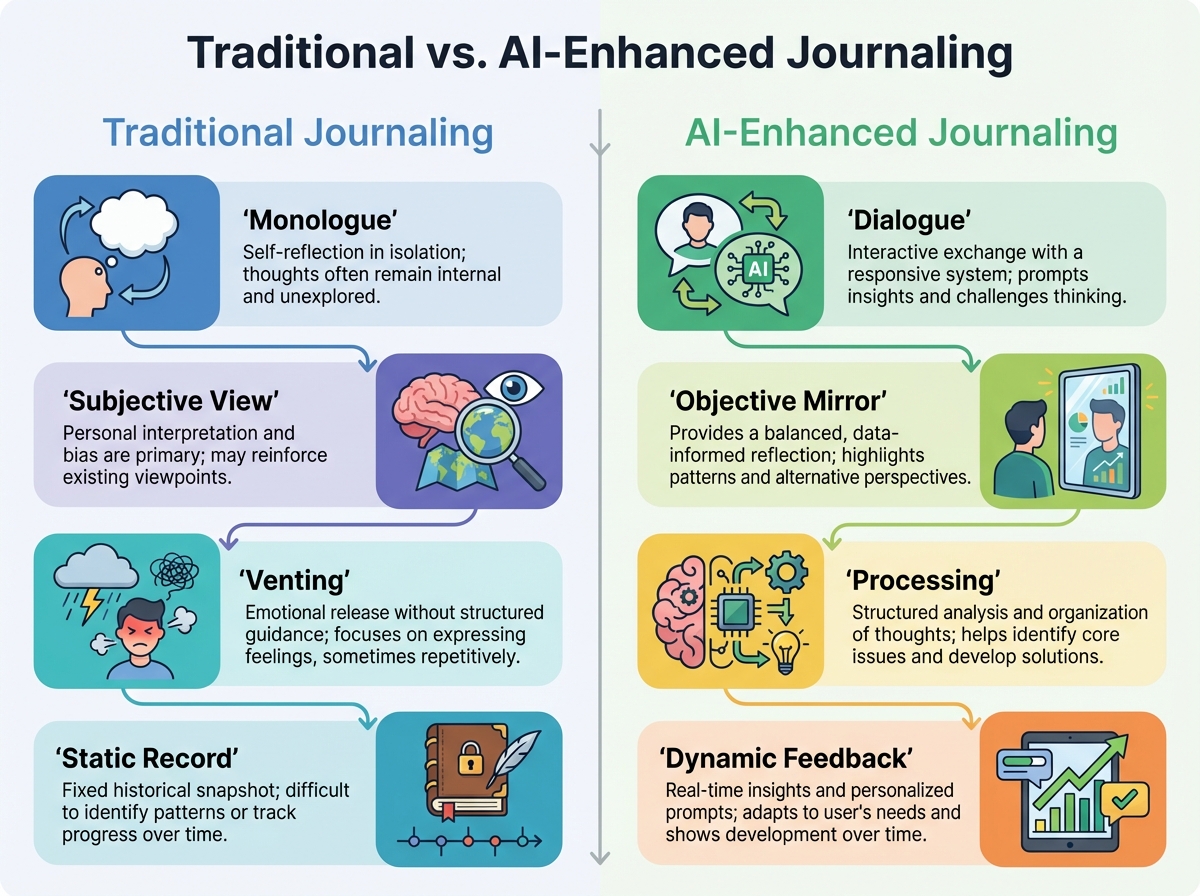
For centuries, journaling has been the bedrock of self-improvement. From Marcus Aurelius’s Meditations to the morning pages of modern creatives, the act of externalizing thoughts onto paper has proven essential for clarity. However, traditional journaling has always had one inherent limitation: it is a monologue. You write, you read, and you hope to gain insight from your own echo.
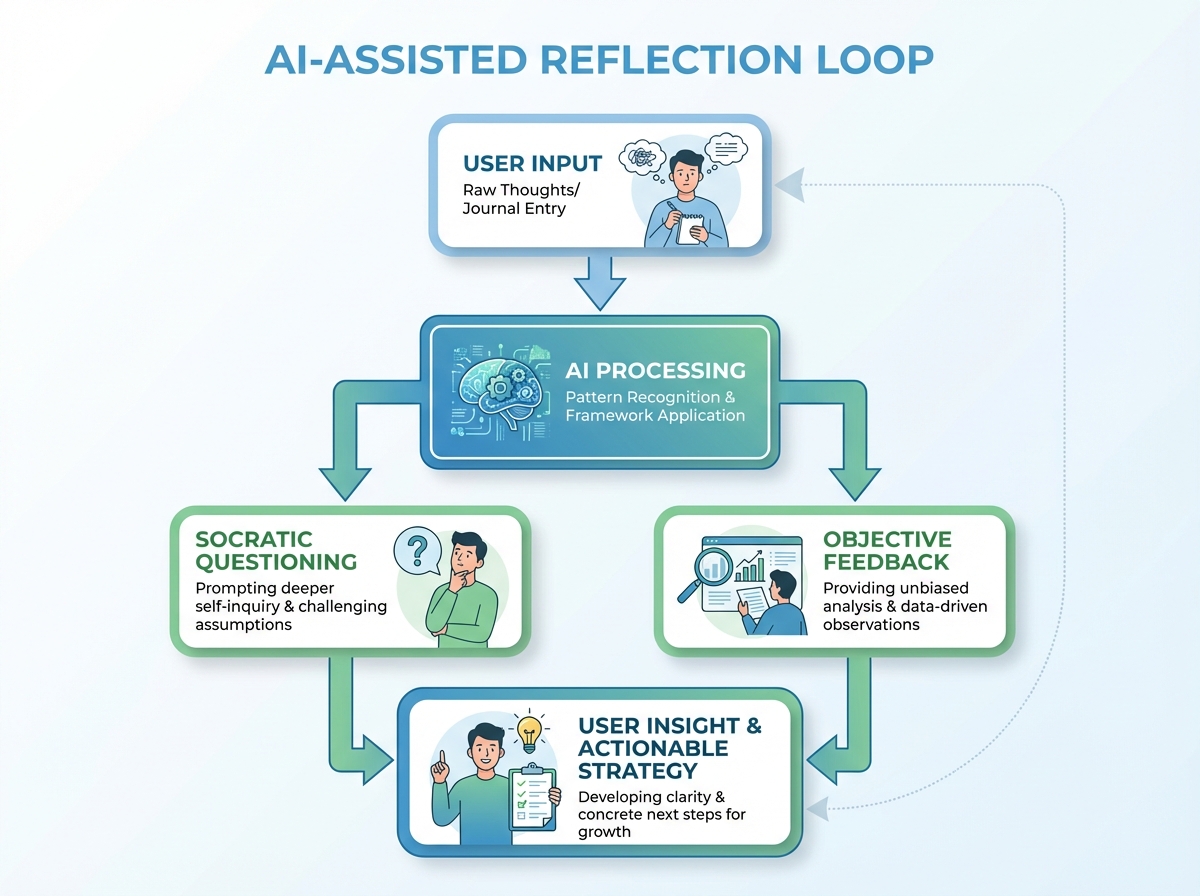
Journaling with AI shatters this limitation. It transforms the solitary act of writing into a reflective dialogue. By introducing artificial intelligence into your reflective practice, you are not replacing the human element; you are amplifying it. AI acts as a non-judgmental mirror, capable of spotting patterns, questioning biases, and suggesting frameworks that you might miss in the heat of the moment.
This is not about having an AI write for you. It is about using AI to think with you. In this guide, we will explore how to leverage AI learning to deepen your emotional intelligence, refine your decision-making, and accelerate your personal development journey.
To understand why journaling with AI is so effective, we must first look at the mechanics of human cognition. Our brains are efficient, but they are also prone to cognitive biases. We often loop on the same worries (rumination) or fail to see the root cause of our stress (blind spots).
When we journal traditionally, we sometimes reinforce negative neural pathways by venting without resolution. This is where the concept of Metacognition—thinking about your thinking—becomes crucial.
AI serves as an external metacognitive tool. When you input your journal entry into an AI trained on psychological frameworks or coaching models, it can parse the emotional data objectively. It separates the signal from the noise, helping you move from "venting" to "processing."
Emotional intelligence requires self-awareness, but true self-awareness is difficult when you are inside the jar trying to read the label. An AI mentor or tool provides a degree of emotional detachment that is impossible for the self to achieve alone. It does not get tired, it does not judge, and it does not carry the baggage of your past against you. It simply analyzes the text and offers a reflection based on logic and training.
> 💡 Turn Your Thoughts into Actionable Strategy > > Struggling to see the patterns in your daily reflections? GPTnius AI Mentors, trained on proprietary research of world-class psychological frameworks, can analyze your entries to provide objective feedback and strategic clarity. > > Meet the AI mentors built from this research →
Simply pasting a diary entry into a chat bot will yield generic results. To truly unlock the power of journaling with AI, you need to apply specific frameworks. Here are three powerful methods to structure your interaction.
The Socratic method involves asking disciplined questions to deconstruct beliefs. Instead of asking AI for answers, ask it to question you.
The Prompt Strategy: "I am going to paste my journal entry regarding a conflict I had at work. Do not offer advice yet. Instead, ask me three Socratic questions that will help me uncover the underlying assumptions I am making about my colleague's intentions."
The Outcome: This forces you to re-evaluate your narrative. You might realize you are projecting your own insecurities onto the situation, a key realization for emotional growth.
One of the greatest strengths of AI learning models is their ability to synthesize vast amounts of data. If you maintain a digital journal, AI can review weeks or months of entries to find correlations you missed.
The Prompt Strategy: "Here are my journal summaries for the last month. Please identify the three most common emotional triggers and the context in which they appear. Also, highlight any contradictions between my stated goals and my daily actions."
The Outcome: You might discover that your anxiety spikes specifically on Tuesday evenings, or that you claim to value health but rarely document healthy choices. This objective data is the fuel for behavioral change.
Lisa Feldman Barrett’s research suggests that emotional granularity—the ability to specifically name emotions beyond just "happy" or "sad"—is a key marker of emotional resilience. AI can help expand your emotional vocabulary.
The Prompt Strategy: "I feel 'bad' about this project failure. Based on the description I'm about to provide, help me identify the specific nuance of this emotion. Is it shame, guilt, frustration, or disillusionment? Explain the difference in this context."
Even with the best intentions, staring at a blank page can be paralyzing. AI can function as a dynamic prompt generator, tailored to your current mood or goals.
Instead of generic "What are you grateful for?" prompts, you can prime the AI with your current context.
Set up a session where the AI acts as a specific persona (e.g., a compassionate mentor or a rigorous logician). You write a sentence, and it responds with a probing question. This back-and-forth style keeps the writing flowing and digs deeper than a standard stream of consciousness.
When journaling with AI, privacy is paramount. Unlike a physical notebook locked in a drawer, digital interactions leave a footprint.
To make this a habit, you must reduce friction. Here is a suggested workflow for integrating AI into your personal development stack.
Once a week, feed your daily summaries into the AI to generate a "Weekly Personal Growth Report." Ask it to rate your progress on specific goals (e.g., "How well did I maintain my boundaries this week based on these entries?"). This turns subjective feelings into measurable progress.
While generic chatbots can assist with basic journaling, they lack the specialized training required for deep, strategic personal growth. This is where GPTnius distinguishes itself.
GPTnius offers AI Mentors trained on proprietary research analyzing the published works, philosophies, and proven methodologies of thought leaders, including thinkers like Charlie Munger and James Clear. Our mentors do not impersonate anyone. They synthesize researched frameworks, such as mental models and habit systems, into personalized coaching conversations built around your specific goals.
Instead of a blank text box, you get a guided coaching conversation. You can bring your journal entry to a GPTnius mentor, and they will synthesize the researched frameworks to help you:
By combining the intimacy of journaling with the structured wisdom of proven methodologies, GPTnius accelerates your journey toward emotional intelligence and mastery.
> 💡 Upgrade Your Inner Circle > > Stop journaling in a vacuum. Invite a GPTnius AI Mentor, trained on the methodologies of the world's greatest thinkers, to review your reflections and guide your growth. > > Meet the AI mentors built from this research →
Journaling with AI is not about automating your humanity; it is about upgrading your toolkit for self-discovery. By using AI as a reflective partner, you gain access to a level of objectivity and analytical power that transforms a simple diary entry into a catalyst for profound personal change. Whether you are seeking to improve your emotional intelligence, break negative habits, or simply understand yourself better, the combination of human introspection and machine intelligence offers a frontier of growth previously inaccessible. Start writing, start questioning, and let the dialogue begin.
Privacy depends on the platform used. It is recommended to anonymize personal details (names, addresses) before inputting entries and to use platforms that have clear data privacy policies regarding user data training.
No, AI cannot replace a human therapist. While it is a powerful tool for self-reflection and coaching, it lacks human empathy and clinical judgment. It should be used for personal growth and coaching, not for treating mental health disorders.
Effective prompts include Socratic questioning ("What evidence do I have for this belief?"), perspective-shifting ("How would a mentor view this situation?"), and emotional labeling ("Help me describe the nuance between frustration and anger in this context").