Unlock your cognitive potential with Deep Work. Learn actionable strategies to eliminate distraction, boost productivity, and master complex information quickly.
In an economy defined by rapid technological shifts and an overwhelming surplus of information, one skill stands out as the ultimate competitive advantage: the ability to focus. Yet, for most knowledge workers, true focus is a relic of the past. We spend our days in a blur of frantic activity—answering emails, checking Slack, and attending meetings—mistaking motion for progress.
This is the distraction economy. To thrive in it, you must master the art of Deep Work.
Drawing on concepts popularized by computer science professor and author Cal Newport, Deep Work is not merely a productivity hack; it is a rigorous philosophy for professional survival. It requires a fundamental shift in how we approach our time, our attention, and our cognitive resources. This comprehensive guide will explore the rules of focused success and provide actionable frameworks to help you reclaim your brain from the shallows.
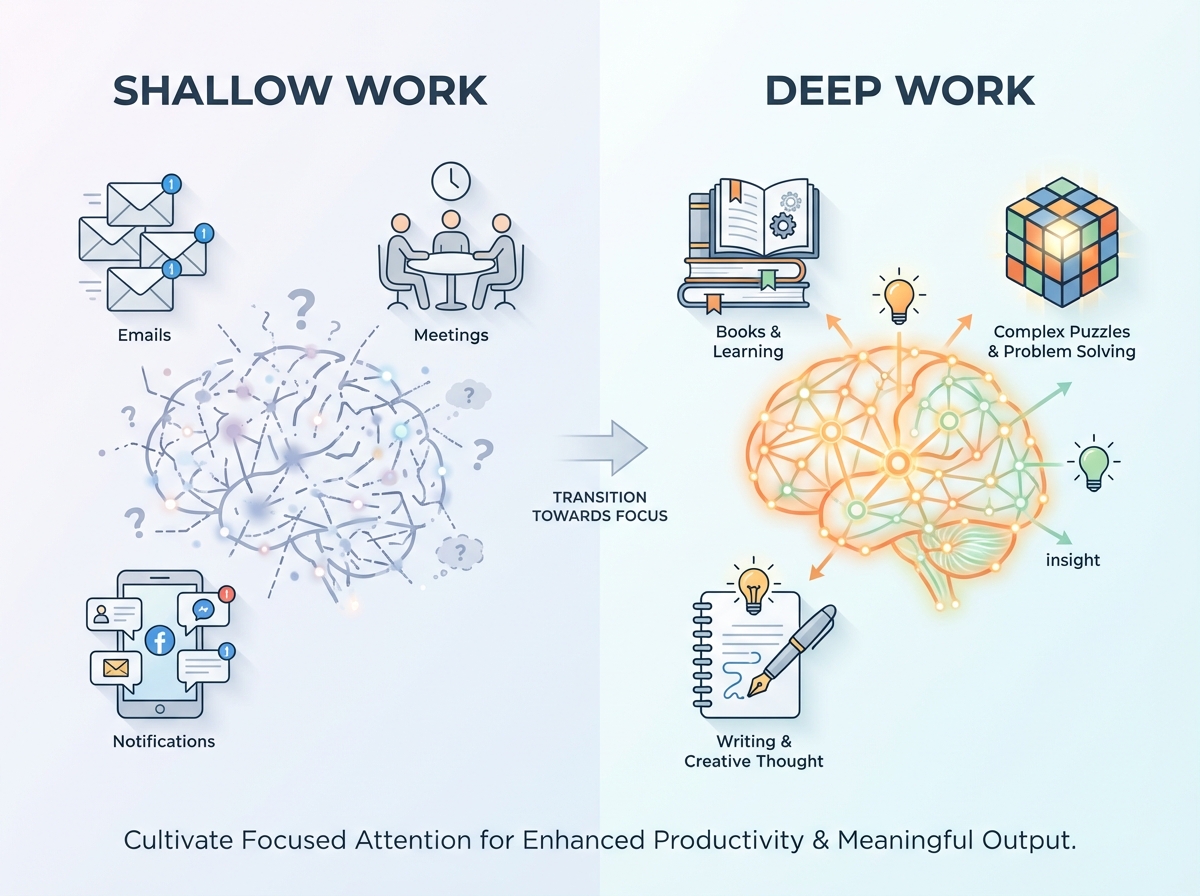
To understand why we are losing the battle for our attention, we must first distinguish between the two types of work that fill our days.
Definition: Professional activities performed in a state of distraction-free concentration that push your cognitive capabilities to their limit. These efforts create new value, improve your skill, and are hard to replicate.
Examples include writing code, developing a complex business strategy, writing a book, or mastering a new theorem. Deep Work optimizes your performance and produces the high-impact results that move the needle in your career.
Definition: Non-cognitively demanding, logistical-style tasks, often performed while distracted. These efforts tend to not create much new value in the world and are easy to replicate.
Examples include responding to routine emails, scheduling meetings, formatting data, and scrolling through social media feeds. While often necessary to keep the lights on, Shallow Work does not advance your long-term goals.
The danger lies in the fact that Shallow Work is easier. It provides immediate, tangible feedback (an empty inbox feels like an accomplishment), whereas Deep Work is taxing and often ambiguous. However, in the information age, the ability to perform Deep Work is becoming the currency of true value.
> 💡 Struggling to prioritize high-impact tasks? > > Transform your daily output by discussing your schedule with an AI Mentor trained on proprietary research into elite productivity frameworks. > > Meet the AI mentors built from this research →
Achieving a state of deep focus isn't about willpower; it's about systems. Based on the analysis of high-performers, there are four foundational rules designed to help you cultivate a deep work practice.
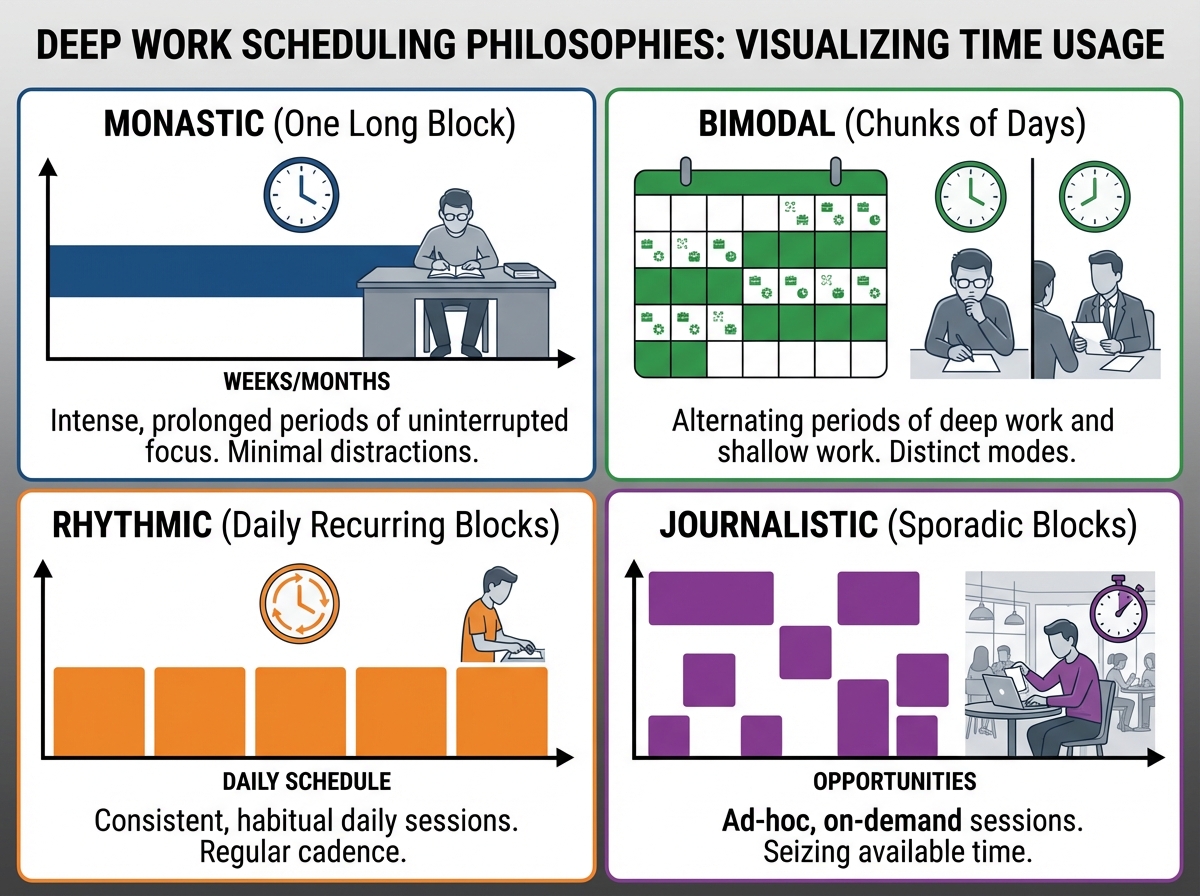
You cannot simply "decide" to focus in the middle of a chaotic open office. You must integrate deep work into your life using a specific philosophy that matches your professional reality. There are four main scheduling philosophies:
Here is a counterintuitive truth: You cannot achieve deep focus if you are addicted to distraction. If every moment of potential boredom (standing in line, waiting for a file to load) is filled with a quick glance at your smartphone, your brain has been rewired to crave novel stimuli.
To master deep work, you must train your ability to focus by weaning yourself off the constant drip of dopamine. This means scheduling breaks from focus to give in to distraction, rather than scheduling breaks from distraction to focus. By embracing boredom, you strengthen the mental muscle required to stick with difficult problems.
Social media platforms are engineered to be addictive. They are the enemies of depth. The argument often used to justify their use is the "Any-Benefit Mindset"—the idea that if a tool offers any benefit, it is worth using.
Instead, adopt the Craftsman Approach to Tool Selection: Identify the core factors that determine success and happiness in your professional and personal life. Adopt a tool only if its positive impacts on these factors substantially outweigh its negative impacts.
For many knowledge workers, the fragmented attention caused by social media far outweighs the minor connectivity benefits.
Shallow work expands to fill the time available for its completion. If you don't aggressively manage your administrative tasks, you will never find time for depth. Strategies to drain the shallows include:
Why is deep work so effective? The answer lies in the biology of the brain, specifically a substance called myelin.
Myelin is a layer of fatty tissue that grows around neurons, acting like an insulator that allows bio-electrical signals to travel faster and cleaner. Every time you focus intensely on a specific skill or concept, you trigger a specific circuit in your brain to fire repeatedly. This repetitive firing signals oligodendrocytes to wrap layers of myelin around the neurons in the circuits.
Conversely, when you multitask or switch contexts rapidly (a phenomenon known as "attention residue"), you fail to trigger this myelination process effectively. Deep work is the only way to physically restructure your brain to become better, faster, and more efficient at high-value skills.
Understanding the theory is one thing; executing it is another. Here are three practical rituals to help you start.
Incomplete tasks create "open loops" that occupy your attention even when you aren't working on them (the Zeigarnik effect). To combat this, end every workday with a formal shutdown ritual:
This signals your brain that work is done, allowing you to fully recharge so you can dive deep again the next morning.
Sometimes, a change in environment is necessary to signal the importance of the task. J.K. Rowling famously checked into a luxury hotel suite to finish the final Harry Potter book. You don't need to spend a fortune, but a "grand gesture"—like booking a conference room for a day, going to a library you've never visited, or buying an expensive notebook dedicated solely to one project—can psychologically prime you for serious work.
Named after Teddy Roosevelt, who had diverse interests and limited time, this technique involves estimating how long a task should take, and then drastically reducing that time. This forces you to work with blistering intensity, eliminating all potential for distraction because you literally do not have a second to spare.
Reading about Deep Work is inspiring, but implementing it requires discipline, accountability, and a system tailored to your unique psychology. This is where GPTnius bridges the gap between theory and practice.
GPTnius offers AI Mentors that have been trained on proprietary research analyzing the published works, philosophies, and proven methodologies of thought leaders in productivity and cognitive science. For example, you can engage with "The Architect," an AI Mentor designed to synthesize research on habit formation and focus frameworks.
Here is how a GPTnius AI Mentor can assist you:
By synthesizing these researched frameworks into personalized coaching conversations, GPTnius allows you to apply the principles of Deep Work directly to your daily challenges.
> 💡 Ready to reclaim your focus? > > Stop letting distractions dictate your career. Build a personalized Deep Work system today with an AI Mentor trained on the world's best productivity research. > > Meet the AI mentors built from this research →
In a world distracted by the trivial, the ability to go deep is a superpower. It is the difference between being busy and being productive, between maintaining the status quo and producing work that matters. By adopting the rules of Deep Work—protecting your attention, embracing boredom, and draining the shallows—you position yourself to thrive in the complex information economy.
The path to deep work is not easy. It requires saying no to the easy dopamine hits of social media and email. But the rewards, both in terms of professional success and personal satisfaction, are profound. The deep life is a good life.
Deep work refers to professional activities performed in a state of distraction-free concentration that push your cognitive capabilities to their limit, creating new value. Shallow work consists of non-cognitively demanding, logistical-style tasks, often performed while distracted, which do not create much new value.
Yes, though it is more difficult. The 'Rhythmic Philosophy' is often best for open offices, where you schedule specific blocks of time for focus. Using noise-canceling headphones or booking a private room (a 'Grand Gesture') can also help signal to colleagues that you are in a deep work state.
Research suggests that for most people, the upper limit for truly intense, deep work is about four hours per day. Beginners may only be able to sustain one hour before their mental energy depletes, but this capacity can be increased with practice.
The 4 Disciplines of Execution (4DX) is a framework often cited in conjunction with Deep Work to help execute goals. It involves: 1) Focusing on the Wildly Important, 2) Acting on Lead Measures (tracking hours spent in deep work), 3) Keeping a Compelling Scoreboard, and 4) Creating a Cadence of Accountability.