Discover actionable strategies for overcoming imposter syndrome using AI learning and emotional intelligence frameworks. Learn to silence your inner critic today.
It is the silent career killer that lurks in the corner offices of CEOs, the studios of award-winning artists, and the minds of brilliant engineers. Imposter Syndrome—the persistent inability to believe that one's success is deserved or has been legitimately achieved as a result of one's own efforts or skills—is a psychological phenomenon that transcends industry and experience levels. Despite external evidence of their competence, those exhibiting the syndrome remain convinced that they are frauds and do not deserve all they have achieved.
Traditionally, overcoming imposter syndrome has required years of therapy, mentorship, or sheer force of will. However, the intersection of Emotional Intelligence & Personal Growth and advanced technology has opened a new frontier. By leveraging AI learning and digital mentorship, individuals can now access objective, data-driven frameworks to dismantle self-doubt in real-time. This article explores how to utilize AI-guided strategies to rewrite your internal narrative and claim your accomplishments with confidence.
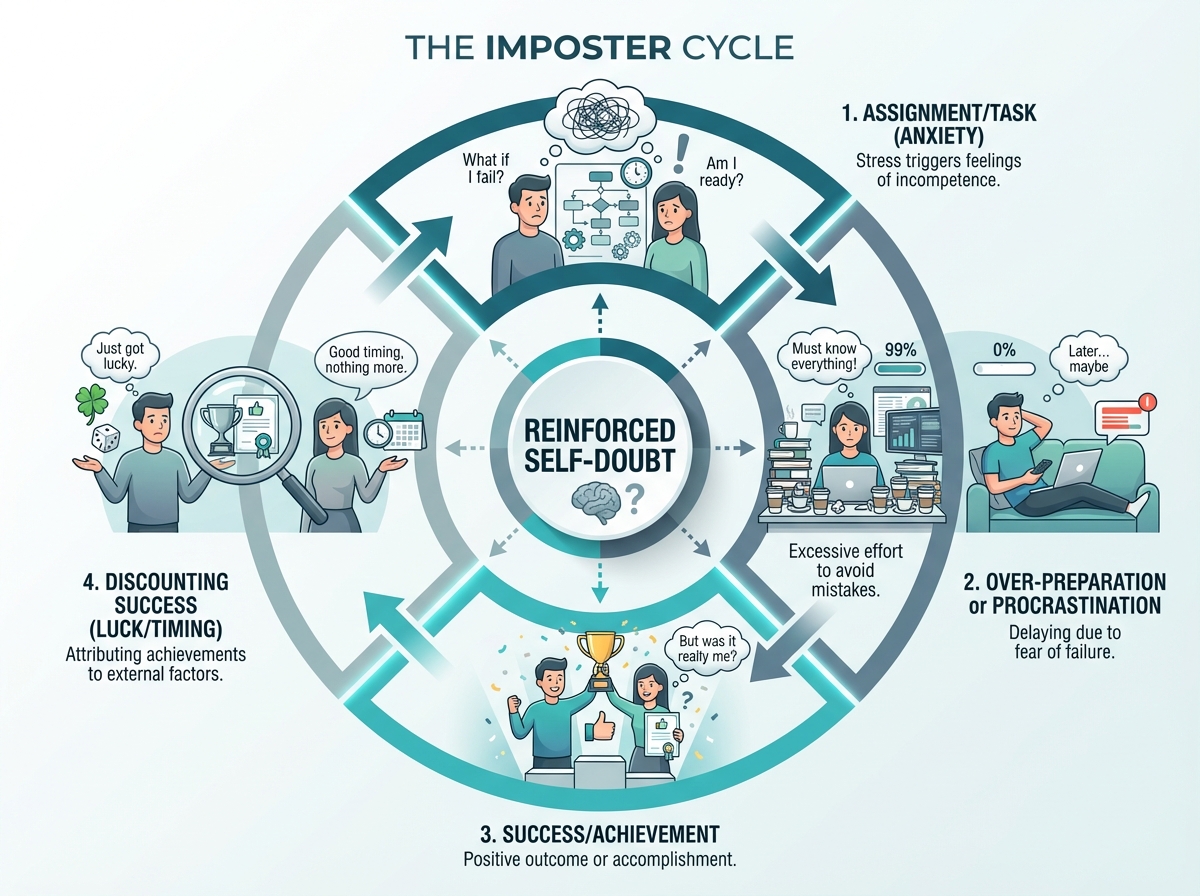
To dismantle the imposter phenomenon, one must first understand its mechanics. Psychologists often describe the "Imposter Cycle," a debilitating loop that begins with an achievement-related task. The individual experiences anxiety, leading to either over-preparation or procrastination followed by a frenzied effort. When the task is completed successfully, the relief is temporary. The "imposter" attributes the success to luck or hard work (masking perceived incompetence) rather than ability, reinforcing the belief that they are a fraud.
At the heart of this cycle are cognitive distortions—irrational thought patterns that perpetuate negative emotions. Common distortions include:
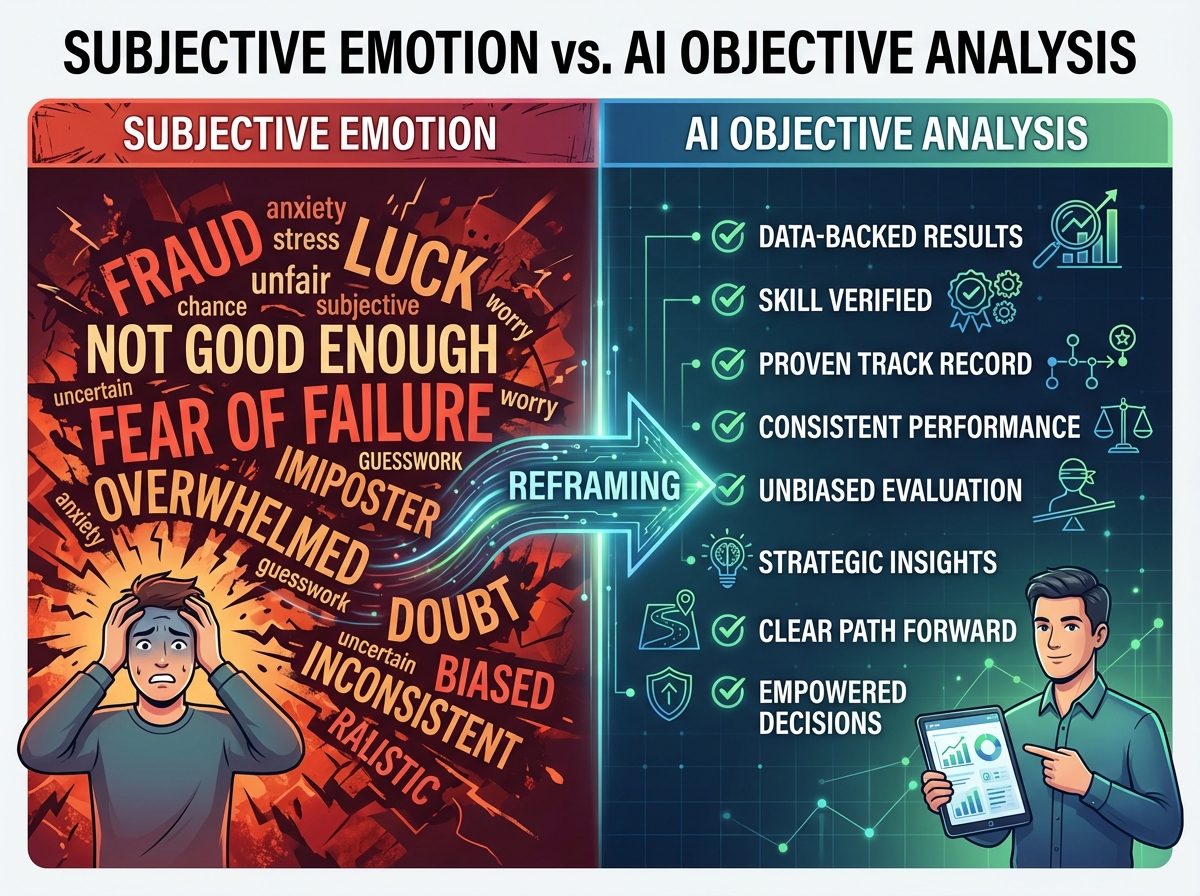
These distortions are subjective and deeply emotional. This is where Personal Development strategies often hit a wall; it is difficult to use a biased brain to fix a biased brain. This is precisely where AI enters the equation as a powerful, objective counter-balance.
> 💡 Break the Cycle of Self-Doubt > > Your internal narrative is often clouded by emotion, but an AI Mentor can help you analyze your thoughts objectively. By applying proven frameworks to your specific anxieties, you can identify cognitive distortions before they take root. > > Meet the AI mentors built from this research →
One of the most effective strategies for overcoming imposter syndrome is "reframing"—taking a negative thought and shifting the perspective to align with reality. While human mentors are invaluable, they can be biased or unavailable. AI mentors, however, offer a unique utility: radical objectivity combined with 24/7 availability.
When imposter syndrome strikes, it often relies on a lack of concrete evidence. An AI mentor can be used to facilitate a "Fact-Checking Protocol." By engaging in a structured dialogue, you can input your fears and ask the AI to challenge them based on logic and evidence.
The Strategy: When you feel like a fraud after a meeting, explain the situation to an AI mentor. Ask it to analyze your performance based only on the facts you provide, stripping away the emotional interpretation. Seeing your actions laid out without the overlay of anxiety often reveals that your performance was competent and effective.
Imposter syndrome thrives on amnesia; we forget our wins the moment we face a new challenge. Building a "Competence Evidence Bank" is a vital personal development habit.
The Strategy: Use an AI tool to maintain a running log of your achievements, positive feedback, and completed projects. However, don't just list them. Engage with the AI to analyze what skills were required to achieve them.
This process converts a fleeting moment of success into a permanent catalog of verified skills.
Beyond basic reframing, we can leverage AI to simulate high-pressure environments, effectively immunizing ourselves against the fear of being "found out."
Fear often stems from the unknown. "What if they ask me a question I can't answer?" is a common refrain of the imposter. AI mentors can act as sparring partners for your intellect.
Before a high-stakes presentation, use an AI mentor to roleplay the audience. Instruct the AI to ask difficult, probing questions regarding your topic. By practicing your responses in a safe, low-stakes digital environment, you build the neural pathways associated with confidence and competence. When the real moment arrives, your brain recognizes the pattern, reducing the "fight or flight" response that triggers imposter feelings.
A powerful psychological trick is to speak about yourself in the third person. It creates distance between the ego and the event. AI facilitates this naturally. By describing your situation to an AI as if it were happening to a colleague, you can solicit advice that you would give to someone else.
Often, we are much kinder and more logical when advising others than when judging ourselves. The AI acts as the medium for this externalization, forcing you to view your own capabilities through a lens of mentorship rather than judgment.
Emotional Intelligence (EQ) is the ability to understand and manage your own emotions and those of the people around you. It is the antidote to imposter syndrome. While AI is artificial, it can be a potent tool for developing human EQ.
By analyzing the language you use when describing your work, AI can identify patterns of self-deprecation or passive language. For example, if you constantly write "I think I might have..." or "Sorry to bother you, but...", an AI trained on assertive communication frameworks can flag these habits.
Correcting your language changes your psychology. As you begin to communicate with authority, you begin to feel the authority. This feedback loop—action changing belief—is central to behavioral psychology and is accelerated by the consistent feedback of an AI mentor.
Theory is useful, but application is transformative. GPTnius offers AI Mentors trained on proprietary research analyzing the published works, philosophies, and proven methodologies of thought leaders, including leading researchers on behavioral psychology and confidence. Our mentors do not impersonate anyone. They synthesize researched frameworks, such as inversion and other proven mental models, into personalized coaching conversations built around your specific goals. This unique approach allows you to combat imposter syndrome using the specific mental frameworks of the world's most successful minds.
Here is how GPTnius facilitates your growth:
Note: GPTnius AI Mentors are NOT endorsed by, affiliated with, or impersonating any real individuals. They are advanced tools designed to help you apply rigorous thinking to your personal growth.
> 💡 Build Unshakeable Confidence with Expert Frameworks > > Stop guessing how to fix your mindset. Use GPTnius to access AI Mentors trained on the proprietary research of world-class methodologies, helping you dismantle imposter syndrome with precision and logic. > > Meet the AI mentors built from this research →
Overcoming imposter syndrome is not about reaching a destination where you never feel doubt again; it is about building the tools to manage that doubt when it arises. By combining the psychological principles of Emotional Intelligence with the data-driven objectivity of AI Learning, you create a powerful support system.
The future of Personal Development is not just about looking inward, but about using intelligent tools to reflect our true value back to us. Whether through fact-checking your fears, simulating challenges, or engaging with the sophisticated frameworks provided by GPTnius, you have the power to rewrite the narrative. You are not an imposter; you are a work in progress, and with the right guidance, that progress can be limitless.
While AI is not a replacement for professional therapy, it is highly effective for coaching and cognitive reframing. AI mentors can provide objective, non-judgmental feedback and help users apply logic to emotional situations, which is key to dismantling the irrational thoughts associated with Imposter Syndrome.
GPTnius AI Mentors are trained on proprietary research analyzing the methodologies of specific thought leaders. Unlike standard chatbots that pull general information, GPTnius mentors synthesize these specific frameworks (like mental models or habit systems) to provide structured, personalized coaching conversations.
No, quite the opposite. Imposter Syndrome predominantly affects high-achieving individuals. It is a disconnect between actual competence and internal perception. The presence of these feelings often indicates that you are pushing your boundaries and growing professionally.