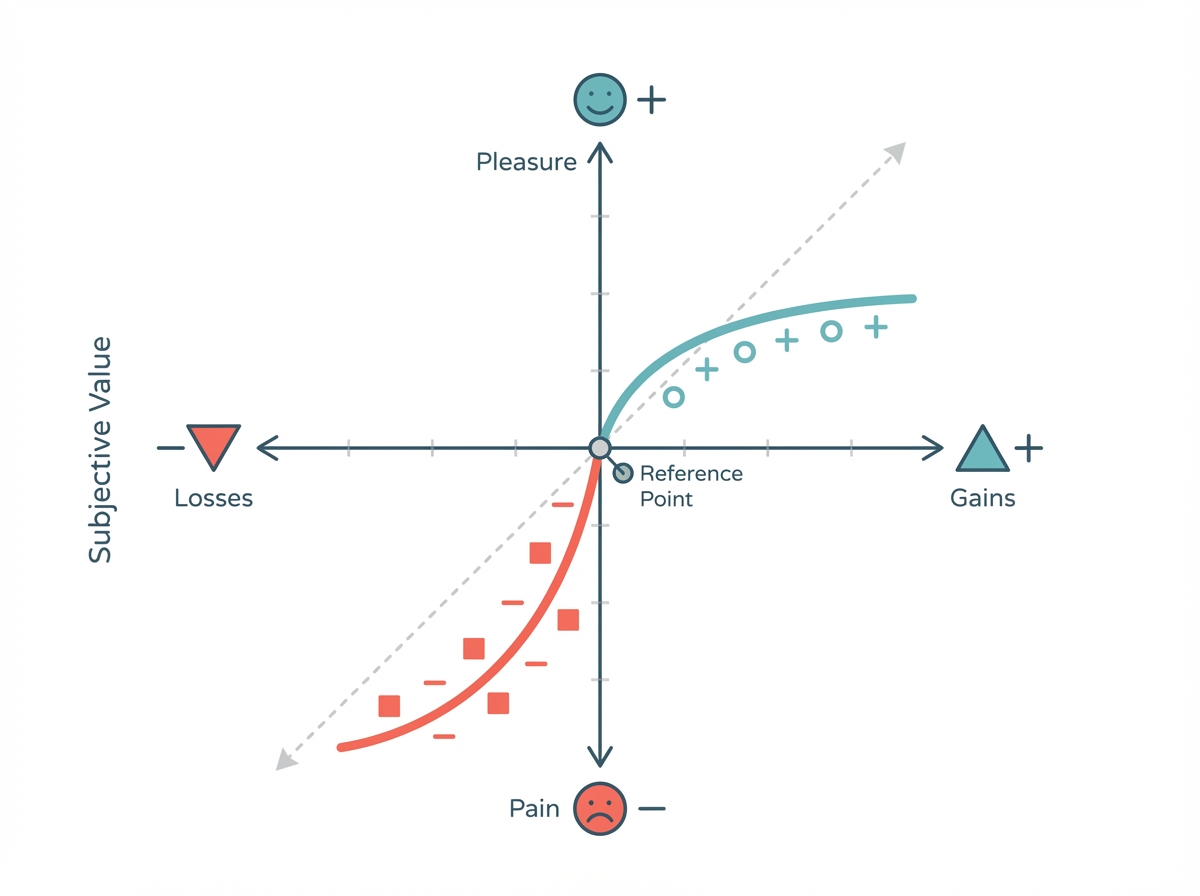
Prospect Theory explained: Discover why losses hurt more than gains and how this behavioral economics framework shapes investing, marketing, and decision-making.
Imagine a scenario: You are offered a coin toss. If it lands on heads, you win $150. If it lands on tails, you lose $100. The expected value of this gamble is positive—mathematically, you should take the bet every single time. Yet, most people instinctively reject it.
Why? Because the pain of losing $100 is psychologically more intense than the pleasure of winning $150.
For decades, economists operated under Expected Utility Theory, which assumes humans are rational actors ("Econs") who always maximize their wealth based on logical probability. In 1979, psychologists Daniel Kahneman and Amos Tversky shattered this assumption with Prospect Theory. Their research demonstrated that human decision-making is not driven by the final outcome of wealth, but by gains and losses relative to a reference point—and that we are biologically wired to fear loss far more than we desire gain.
This article provides a comprehensive Prospect Theory explained guide, breaking down the mechanics of loss aversion, the fourfold pattern of preferences, and actionable applications for prospect theory in marketing, investing, and negotiation.
---
To understand the revolution Kahneman caused, we must first look at what came before. Expected Utility Theory (EUT) suggests that people value assets based on the final state of wealth. Under EUT, receiving a $500 discount is the exact same utility as receiving a $500 bonus. Money is money.
Prospect Theory argues that humans process information differently. It introduces three critical cognitive features that define how we evaluate risk:
If you were to graph Prospect Theory, it wouldn't look like a straight line. It forms an asymmetrical S-curve. The curve for gains is concave (flattening out as amounts get higher), while the curve for losses is convex and much steeper. This steepness visually represents why a financial hit feels so visceral compared to a financial win.
> 💡 Stop Letting Hidden Biases Sabotage Your Decisions > > Understanding the theory is one thing; overcoming your brain's natural wiring is another. GPTnius AI Mentors can help you analyze your decision-making process against proven behavioral frameworks. > > Meet the AI mentors built from this research →
---
One of the most complex but fascinating aspects of Kahneman and Tversky’s work is the Fourfold Pattern of Preferences. This model explains why we sometimes buy insurance (risk-averse) and other times buy lottery tickets (risk-seeking), even when the math doesn't add up.
Human risk behavior flips depending on two factors: the probability of the event and whether the outcome is framed as a gain or a loss.
---
Prospect Theory isn't just academic; it dictates the flow of money in global markets, negotiation rooms, and retail stores. Here are prospect theory examples across different domains.
In the stock market, the reference point is usually the price at which you bought a stock.
This behavior—selling winners too early and riding losers too long—is known as the Disposition Effect, a direct result of loss aversion.
Marketers utilize framing effects to trigger loss aversion. Since avoiding pain is a stronger motivator than gaining pleasure, effective copy often highlights what the customer stands to lose rather than what they stand to gain.
Study after study shows that Example B drives more conversions. Similarly, "limited time offers" or "only 2 items left" trigger the fear of missing out (a form of loss), compelling immediate action.
In negotiations, the "reference point" is often the first number thrown out (the anchor). If you are selling a house, setting a high price shifts the buyer's reference point. Any reduction from that high price feels like a "gain" to the buyer, even if the final price is still above market value.
Conversely, if you frame a concession as a loss to yourself ("I'm taking a huge hit giving you this price"), the other party perceives it as more valuable than if you framed it as a simple discount.
---
A sub-component of Prospect Theory is the Endowment Effect. Once we own something, we value it more highly than we would if we didn't own it.
In a famous experiment, Kahneman handed coffee mugs to half a class. He asked the mug owners what they would sell it for, and the non-owners what they would pay for it. The sellers consistently demanded roughly twice as much as the buyers were willing to pay.
This happens because giving up the mug feels like a loss, while acquiring the mug is merely a gain. This explains why free trials are so effective in software and streaming services. Once you have the service (the endowment), cancelling it feels like a loss, making you more likely to start paying.
---
Reading about Prospect Theory is the first step, but applying it requires constant vigilance against your own cognitive biases. It is difficult to spot when you are falling into a "risk-seeking" trap during a business crisis or when you are succumbing to "loss aversion" in an investment portfolio.
This is where GPTnius bridges the gap between theory and practice.
GPTnius offers AI Mentors that have been trained on proprietary research analyzing the published works, philosophies, and proven methodologies of behavioral economics thought leaders. For example, you can engage with a mentor designed to help you deconstruct complex decisions.
Through guided coaching conversations, a GPTnius AI Mentor can help you:
Instead of relying on gut instinct—which Kahneman proved is often flawed—you can use GPTnius to stress-test your logic against the most rigorous mental models available.
> 💡 Master Your Psychology with AI Mentorship > > Don't let cognitive biases cost you money. Use GPTnius AI Mentors, trained on the research of top behavioral economists, to make clearer, more rational decisions today. > > Meet the AI mentors built from this research →
Daniel Kahneman’s Prospect Theory did more than win a Nobel Prize; it held a mirror up to human nature. It revealed that we are not cold, calculating logic machines, but emotional beings deeply influenced by context and the fear of loss.
Whether you are designing a marketing campaign, negotiating a salary, or managing a stock portfolio, understanding the asymmetry of gains and losses is a superpower. By recognizing the Fourfold Pattern of Preferences and the grip of loss aversion, you can step out of the trap of irrationality and make decisions that truly serve your long-term goals.
Prospect Theory posits that people make decisions based on the potential value of losses and gains rather than the final outcome, and that people evaluate these losses and gains using certain heuristics. The core finding is 'loss aversion,' meaning the pain of losing is psychologically about twice as powerful as the pleasure of gaining.
A common example is the 'Disposition Effect' in investing. Investors often sell stocks that have gone up too early (to secure a gain/avoid risk) but hold onto stocks that have gone down for too long (risk-seeking behavior to avoid realizing a loss), often resulting in lower overall returns.
Marketers use Prospect Theory by framing offers to highlight potential losses rather than gains. For example, limited-time offers trigger a fear of missing out (loss aversion). Additionally, free trials utilize the Endowment Effect; once a customer 'owns' the product during the trial, giving it up feels like a loss, increasing conversion rates.