Learn how the Lollapalooza Effect—a confluence of cognitive biases—drives irrational market behavior. Discover strategies to spot these patterns and make smarter decisions.
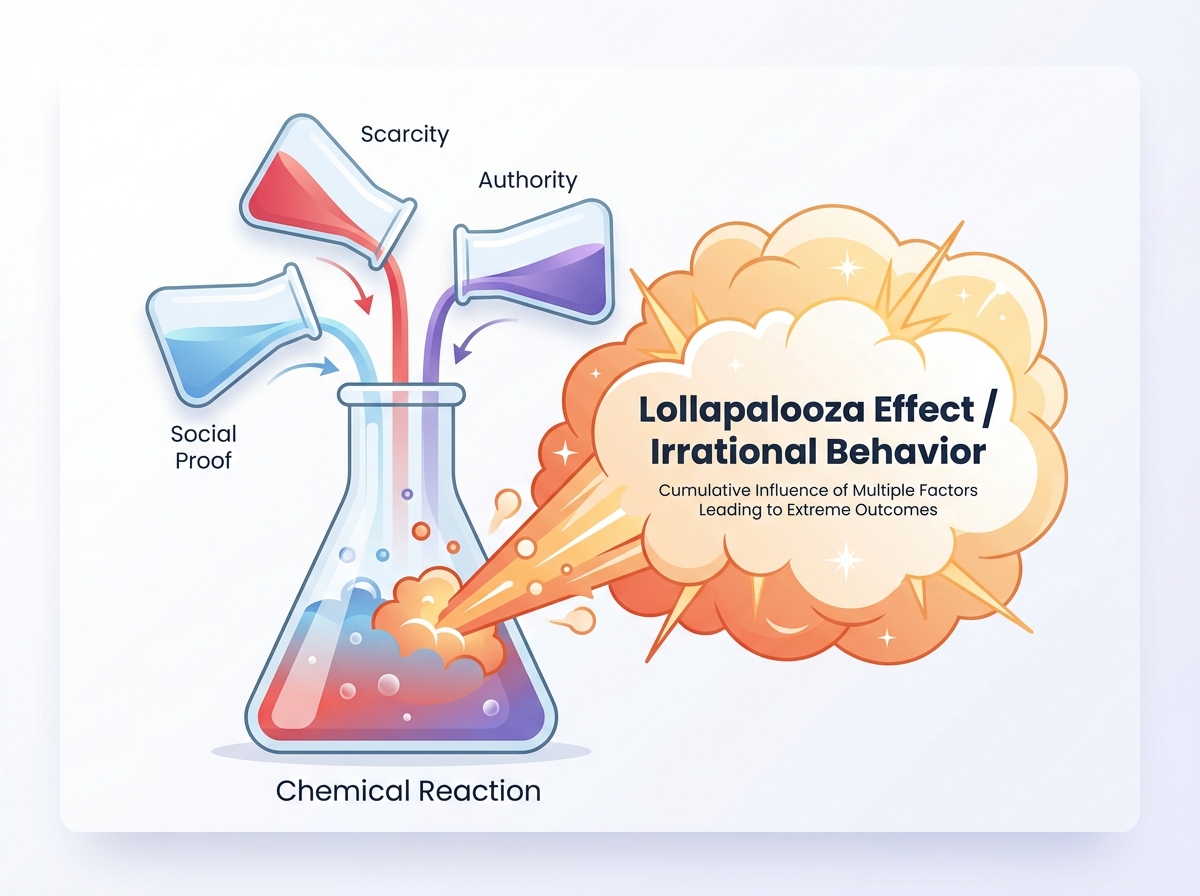
The Lollapalooza Effect is a term coined by Charlie Munger to describe the extreme outcomes that occur when multiple psychological biases converge on a single situation. Unlike a single error in judgment, a Lollapalooza is a "perfect storm" of cognitive dysfunction, where tendencies like Social Proof, Authority Bias, and Scarcity reinforce one another. This article breaks down the anatomy of these psychological compounds, explains how they drive market bubbles, and provides actionable frameworks—supported by GPTnius AI Mentors—to help you maintain rationality when the rest of the world is losing its head.
---
Have you ever looked back at a financial disaster, a corporate collapse, or a personal mistake and wondered, "What were they thinking?"
Usually, when we analyze bad decisions, we look for a single culprit. We might blame greed, or perhaps a lack of due diligence. However, in the world of high-stakes decision-making and investing, the most catastrophic errors rarely stem from a single cause. They are the result of a psychological chain reaction.
This phenomenon is known as the Lollapalooza Effect. It is the nuclear fusion of psychology: the explosive result of multiple cognitive biases acting in concert to drive behavior to an extreme.
Understanding this concept is essential for anyone navigating the complexities of the stock market, business strategy, or leadership. By recognizing how common cognitive biases cluster together, you can build a defense system against the irrationality that creates market bubbles and destroys wealth.
The term "Lollapalooza Effect" was popularized by Charlie Munger, the legendary vice chairman of Berkshire Hathaway, in his famous 1995 speech, The Psychology of Human Misjudgment. Munger, a lifelong student of psychology and multidisciplinary thinking, argued that academia often studies psychological tendencies in isolation. In the real world, however, these tendencies overlap.
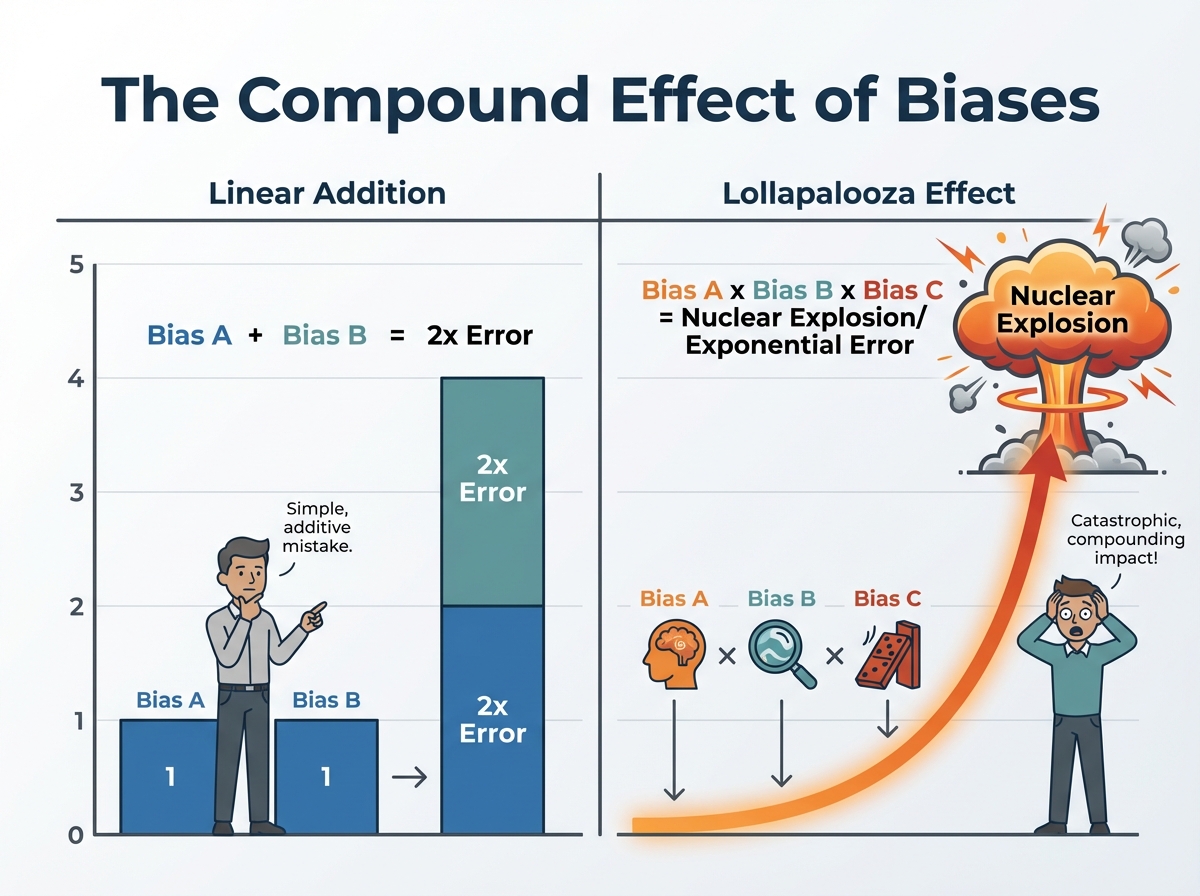
When two, three, or four psychological forces push a person in the same direction, the result isn't just additive (1 + 1 = 2); it is non-linear and multiplicative. The resulting behavior becomes incredibly powerful and difficult to reverse.
Think of the Lollapalooza Effect like a medical interaction. Taking one medication might have a mild side effect. Taking four different medications that all interact with the same receptor can cause a systemic shutdown.
In investing, if you are slightly influenced by what your neighbor is doing (Social Proof), you might buy a stock you shouldn't. But if you combine Social Proof with Authority Bias (a TV pundit recommends it), Scarcity (the IPO is limited), and Commitment/Consistency (you publicly stated you were going to buy it), your brain's ability to think critically effectively shuts down. You are swept away by the current.
> 💡 Master Your Mental Models > > Identifying a Lollapalooza event in real-time requires a deep understanding of mental models. GPTnius AI Mentors, trained on research analyzing frameworks like Charlie Munger's, can help you deconstruct complex situations to spot these bias clusters before you act. > > Meet the AI mentors built from this research →
Market bubbles are the quintessential examples of the Lollapalooza Effect in action. Whether it was the Dutch Tulip Mania of the 1630s, the Dotcom Bubble of the late 90s, or the Crypto crazes of the 2020s, the psychological DNA is remarkably similar.
Let’s dissect how psychological biases in investing combine to create a bubble:
Humans are evolutionarily wired to look to others for cues on how to behave, especially in uncertain environments. When stock prices rise, and "everyone" seems to be getting rich, the fear of standing alone outweighs the fear of losing money. This creates a feedback loop where rising prices attract more buyers, which further raises prices.
Fear Of Missing Out is a modern term for a primal anxiety. When an asset is perceived as scarce—"Only a few shares left at this price!" or "This is a once-in-a-lifetime opportunity!"—the brain panics. Scarcity bypasses logical valuation models and triggers an impulse to grab the resource before it vanishes.
During bubbles, "gurus" emerge. These figures—whether they are CEOs, analysts, or influencers—speak with absolute certainty. Because they appear successful (often due to luck rather than skill during a bull market), investors suspend their own judgment and outsource their thinking to the authority figure.
This is a Munger-specific term. It refers to the intense pain felt when something you possess (or almost possessed) is taken away. In a bubble, seeing a stock go up 20% after you decided not to buy it feels like money was stolen from your pocket. To stop the pain, you buy in at the top.
To identify a Lollapalooza, you must be able to identify the individual ingredients. Here are the specific cognitive biases examples that most frequently combine to cause bad decisions:
This tendency drives us to return favors. In sales, this is weaponized when a broker gives you "free" research or a "hot tip." You feel a subconscious obligation to buy from them. Combined with Liking/Loving Tendency (if the broker is charismatic), the sale is almost guaranteed, regardless of the investment's quality.
Once we make a choice or take a stand, we encounter personal and interpersonal pressures to behave consistently with that commitment. If you tell your spouse, "I think this company is the future," you will ignore all negative news about that company to avoid looking inconsistent or foolish. This leads to "holding the bag" on failing investments.
This is the tendency to search for, interpret, and recall information in a way that confirms one's preexisting beliefs. In a Lollapalooza scenario, Confirmation Bias acts as the shield that deflects reality. Even as the market crashes, the investor reads only the bullish forums that promise a rebound.
While psychological biases in investing are expensive, the Lollapalooza Effect creates havoc in other areas of life as well.
Charlie Munger often used the Tupperware party as a mild, non-financial example of this effect. Why do people buy plastic containers they don't need?
The result is a purchase decision completely divorced from the utility or price of the product.
Companies like Enron or Theranos were Lollapalooza outcomes. You had charismatic leaders (Authority), a culture of silence (Social Proof), huge financial incentives (Incentive Caused Bias), and a refusal to admit failure (Commitment/Consistency). Employees who might have been ethical individually were swept up in a collective delusion.
Knowing that these biases exist is not enough. As the physicist Richard Feynman said, "The first principle is that you must not fool yourself—and you are the easiest person to fool." Here are actionable strategies to mitigate the Lollapalooza Effect.
Pilots use checklists because memory and judgment fail under stress. Investors need the same. Before making a significant decision, run it through a checklist of biases:
This is a classic problem-solving technique. Instead of asking, "How do I make money on this deal?" ask, "How could I lose money on this deal?" By inverting the problem, you force your brain to look for risks that your optimism is hiding.
Actively hunt for the "bear case." If you believe a stock will go up, find the smartest person who believes it will go down and listen to their arguments. If you cannot dismantle their argument with facts, you do not have a right to hold your opinion.
The Lollapalooza Effect relies on emotional momentum. Implement a "cooling-off period." If you want to make a trade, force yourself to wait 24 hours. If the logic holds after the dopamine rush of the idea fades, it is more likely to be a sound decision.
Recognizing a Lollapalooza Effect in your own thinking is incredibly difficult because your brain is the one playing the trick on you. You need an external, objective sounding board.
GPTnius offers AI Mentors trained on proprietary research analyzing the published works, philosophies, and proven methodologies of thought leaders, including thinkers like Charlie Munger. Our mentors do not impersonate anyone. They synthesize researched frameworks, such as mental models and rationality checklists, into personalized coaching conversations built around your specific goals. This allows the AI to:
By debating your decisions with a GPTnius AI Mentor, you simulate the experience of consulting with a wise, unbiased partner who is immune to the emotional contagions of the market.
> 💡 Break the Cycle of Bad Decisions > > Don't let a Lollapalooza of biases wipe out your hard-earned progress. Use GPTnius to stress-test your ideas against the world's best mental frameworks before you commit. > > Meet the AI mentors built from this research →
The Lollapalooza Effect is a formidable adversary. It is the reason smart people do foolish things and why markets cycle between euphoria and despair. You cannot eliminate your cognitive biases—they are hardwired into your biology. However, by understanding how they combine and compound, you can recognize the warning signs of a psychological storm.
Through the use of checklists, inversion, and objective feedback loops like those provided by GPTnius, you can navigate the fog of irrationality with a clear head. In a world addicted to hype, rationality is the ultimate competitive advantage.
The Lollapalooza Effect is a concept introduced by Charlie Munger describing a situation where multiple cognitive biases act together at the same time, leading to extreme and often irrational outcomes or decisions.
Common biases include Social Proof (following the herd), Authority Bias (blindly trusting experts), FOMO (fear of missing out/scarcity), and Confirmation Bias (ignoring negative information about an investment).
You can mitigate biases by using checklists, applying the 'Inversion' mental model (looking at how a plan could fail), seeking disconfirming evidence, and using a cooling-off period before major decisions.