Master systems thinking by creating 'digital twins' of your decision-making processes. Learn to map complex feedback loops and leverage AI to predict outcomes.
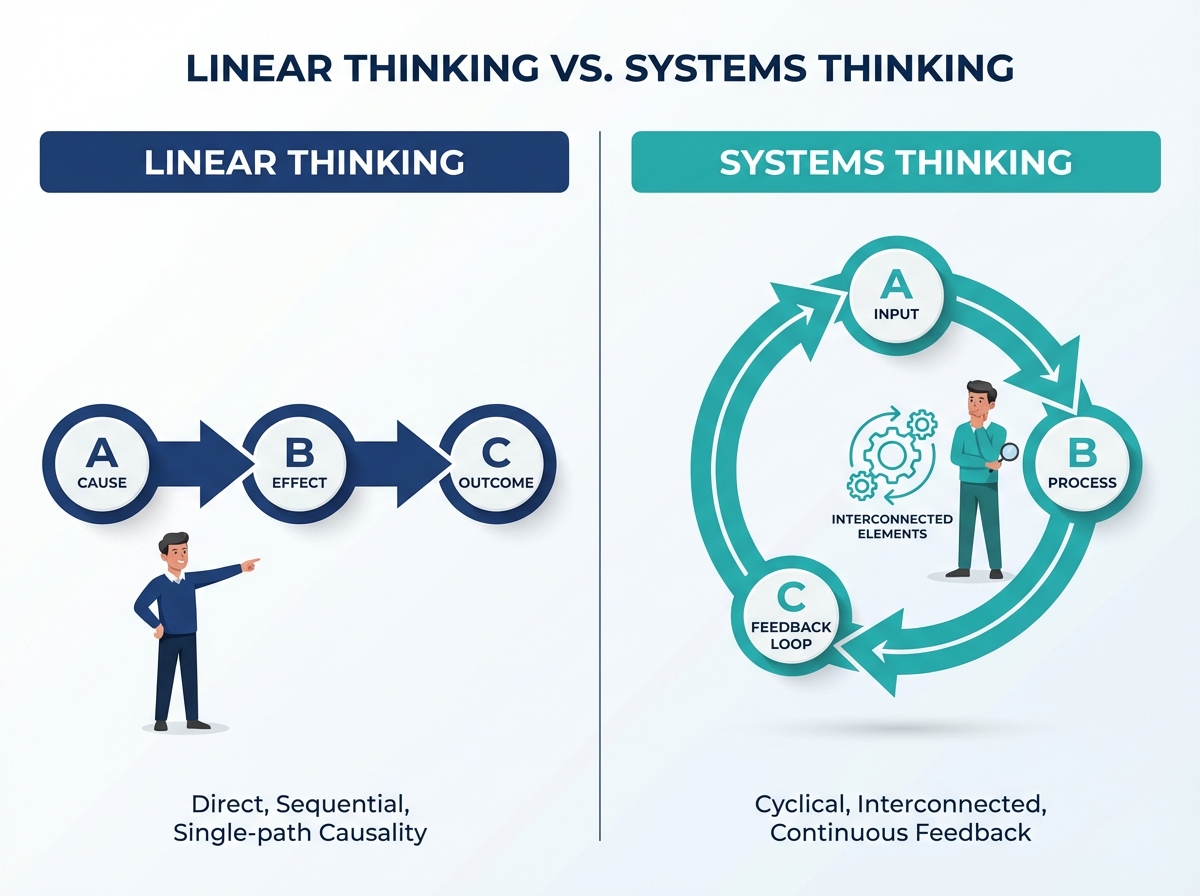
Most of us are taught to think in straight lines: Problem A leads to Solution B. If sales are down, increase marketing. If you are tired, drink coffee. This linear approach, often called "event-oriented thinking," works well for simple, isolated mechanical problems. However, reality rarely operates in a vacuum.
We live in a web of interconnected systems where a single action ripples outward, creating secondary and tertiary effects that often circle back to influence the original problem. This is the realm of Systems Thinking—a discipline that views the world not as a collection of isolated parts, but as a cohesive web of relationships.
In the age of AI, we can take this cognitive framework a step further. Borrowing a concept from advanced engineering, we can create "Digital Twins" of our decision-making landscapes. Just as NASA simulates a spacecraft's performance before launch, you can model complex loops in your business or personal life to foresee consequences before they occur.
To build a model of a complex system, you must first understand the building blocks that govern it. Systems thinking relies on a few fundamental components that, when combined, create the intricate behaviors we see in economics, biology, and organizational psychology.
At the heart of any system are stocks and flows.
Understanding the delay between a change in flow and the visible result in the stock is crucial. Often, we panic because we don't see an immediate change in the stock, leading us to overcorrect.
Systems are driven by feedback loops—the mechanism through which a system regulates itself or spirals out of control. There are two primary types:
> 💡 Master Your Mental Models > > Struggling to identify the hidden loops in your current strategy? GPTnius AI Mentors utilize research on mental models to help you deconstruct complex problems. > > Meet the AI mentors built from this research →
A Digital Twin is traditionally a virtual replica of a physical object—like a jet engine or a wind turbine—used to run simulations. In the context of decision-making and personal development, a "Decision Twin" is an externalized model of your situation.
Why externalize it? Because the human brain, while powerful, has limited working memory. We struggle to calculate the interaction of more than three or four variables simultaneously. By mapping your problem into a structured model, you move the processing load from your brain to a framework that can be analyzed objectively.
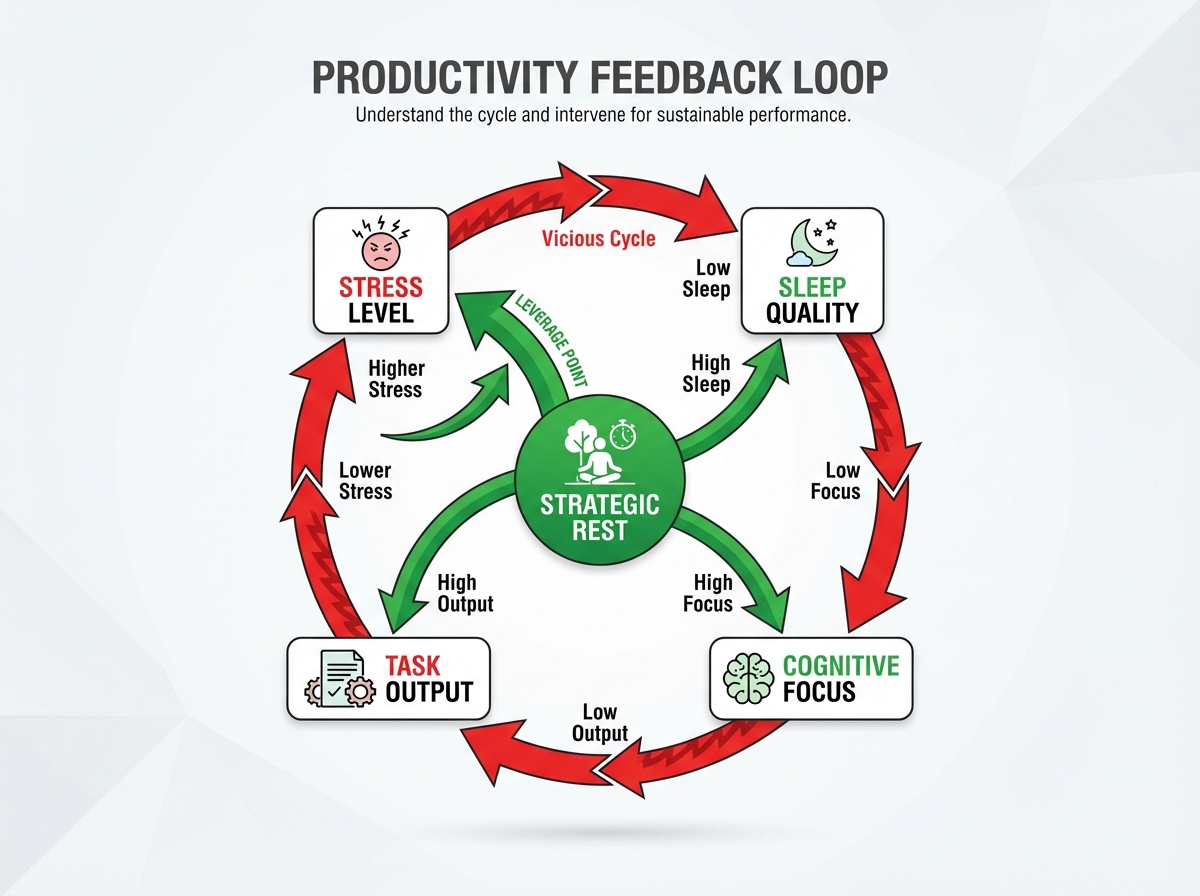
Start by listing the key variables in your system. If you are modeling "Personal Productivity," your variables might include:
Draw lines connecting these variables. Does an increase in Stress Levels lead to a decrease in Sleep? Does a decrease in Sleep lead to a decrease in Cognitive Load capacity?
This mapping process usually reveals that what you thought was a simple problem is actually a Reinforcing Loop of burnout. By visualizing it, you transform a vague feeling of overwhelm into a solvable engineering problem.
Once you have a model (a crude Digital Twin of your reality), you can begin scenario planning. This is where systems thinking becomes a superpower for decision-making.
Instead of asking, "What should I do next?" you ask, "If I intervene at this specific point in the system, how will the feedback loops respond?"
Donella Meadows, a pioneer in systems thinking, famously wrote about "Leverage Points"—places in a system where a small shift in one thing can produce big changes in everything.
In our productivity example, you might try to intervene by "working harder" (increasing flow to Task Completion). However, your model shows this increases Stress, which lowers Sleep, which eventually crashes Task Completion. The model reveals that "working harder" is a low-leverage intervention.
A high-leverage intervention might be changing the rules of the system—perhaps implementing a strict "no work after 6 PM" policy. This acts as a Balancing Loop on Stress, eventually stabilizing the system and allowing for sustainable Task Completion.
Even with a solid understanding of systems, it is easy to fall into cognitive traps.
In a complex system, cause and effect are often separated by time and space. If you implement a new marketing strategy today, the sales might not spike for three months. If you ignore the delay, you might abandon a working strategy too early or double down on a failing one because the negative consequences haven't hit yet.
We make decisions based on the information we have, which is never complete. A Digital Twin is only as good as the variables you include. If you model a business strategy but leave out "Competitor Reaction" or "Market Sentiment," your simulation will yield false confidence.
Constructing a robust system model requires more than just intuition; it requires access to proven frameworks and the ability to stress-test your logic. This is where GPTnius bridges the gap between theory and application.
GPTnius offers AI Mentors trained on proprietary research analyzing the published works, philosophies, and proven methodologies of thought leaders, including thinkers like Charlie Munger. Our mentors do not impersonate anyone. They synthesize researched frameworks, such as mental models and systems thinking, into personalized coaching conversations built around your specific goals.
Through guided discussions, the AI Mentor helps you:
> 💡 Build Your Strategic Digital Twin > > Stop guessing. Use the GPTnius AI Mentors to apply proven systems thinking frameworks to your unique challenges and simulate the outcomes before you act. > > Meet the AI mentors built from this research →
Systems thinking is the antidote to the chaos of modern complexity. By moving away from linear cause-and-effect and embracing the circular nature of feedback loops, you gain a clearer view of reality. Creating a "Digital Twin" of your decisions allows you to test, iterate, and optimize without the risk of real-world failure. Whether you are managing a team, planning a career pivot, or optimizing your health, the ability to model the system is the first step toward mastering it.
A mental model is an internal cognitive framework used to understand the world. A digital twin, in this context, is an externalized, structured simulation of that model (often assisted by AI or software) that allows you to test variables and see potential outcomes objectively.
Feedback loops determine the long-term consequences of a decision. Reinforcing loops can lead to exponential growth or spiral into disaster, while balancing loops help maintain stability. Understanding which loop is active helps you predict whether an intervention will succeed or backfire.
Yes. Personal habits are classic systems composed of triggers, actions, and rewards (loops). By mapping these loops, you can identify the leverage points—such as changing the environment (stock) or altering the reward (flow)—to permanently change behavior.