Unlock true remote work mastery by shifting from synchronous overload to asynchronous efficiency. Learn how to leverage AI to streamline communication and boost productivity.
Many remote teams suffer from 'Zoom fatigue' because they replicate office habits digitally. Remote Work Mastery requires a shift to asynchronous collaboration—working independently and communicating via documentation rather than instant messaging. This article details how to use AI tools to structure your thoughts, automate documentation, and refine your communication style to thrive in a distributed environment.
---
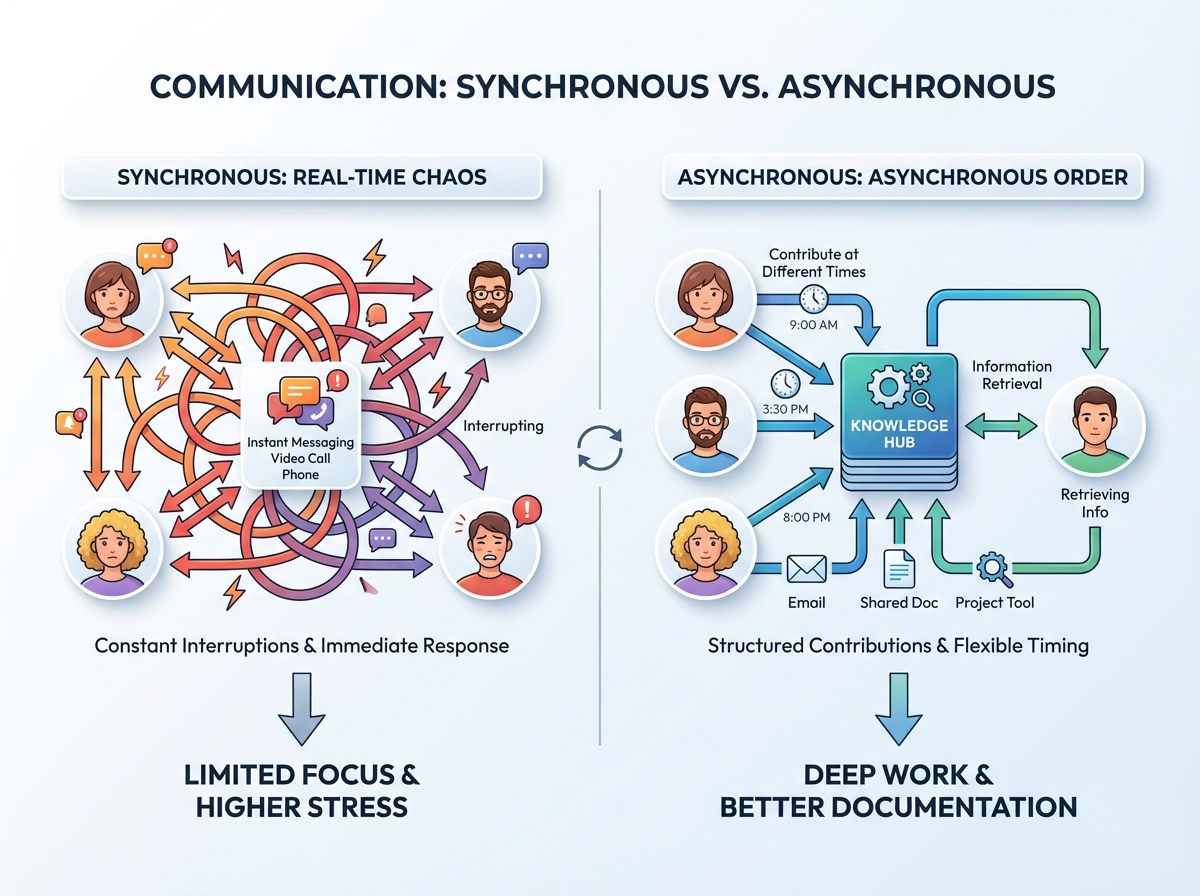
Since the global shift to distributed teams, a paradox has emerged. While we have saved time on commutes, many professionals report working longer hours with less output. The culprit is not the location of the work, but the methodology of the work. We have unwittingly ported the 'shoulder-tap' culture of the physical office into our digital spaces.
Slack pings have replaced tap-on-the-shoulder interruptions. Back-to-back video calls have replaced conference room gatherings. This is synchronous working in a remote wrapper, and it is the enemy of Remote Work Mastery.
True productivity in a distributed environment relies on asynchronous collaboration. This is the practice of moving projects forward without requiring others to be online at the same time. It respects the recipient's time and attention span, allowing for what researchers call 'Deep Work'—cognitive activities performed in a state of distraction-free concentration.
However, shifting to an asynchronous model requires a high degree of clarity, discipline, and documentation. This is where Artificial Intelligence becomes not just a tool, but a catalyst for cultural change.
To master remote work, one must understand that communication does not equal connection, and activity does not equal productivity. Asynchronous collaboration rests on three pillars:
The biggest barrier to asynchronous adoption is the effort required to write well. It takes more energy to write a comprehensive project brief than to jump on a 15-minute call to 'talk it through.' This is where AI significantly lowers the barrier to entry.
By utilizing AI as a synthesis engine and editorial assistant, you can produce high-quality, asynchronous artifacts (memos, briefs, updates) in a fraction of the time it takes to write them from scratch.
> 💡 Master the Art of Written Leadership > > Shifting to asynchronous work requires clear, persuasive writing—a skill that can be difficult to master alone. GPTnius AI Mentors, trained on proprietary research analyzing the frameworks of world-class communicators and strategists, can help you refine your written voice and structure your arguments for maximum impact. > > Meet the AI mentors built from this research →
AI is the great equalizer for remote teams. It bridges the gap between the messy, unstructured thoughts in our heads and the polished documentation required for effective async work. Here is how to apply AI to specific remote work challenges.
In a synchronous office, you might hand off a task by walking over to a colleague's desk. In an asynchronous environment, a poor handoff creates a delay loop (the recipient opens the task, doesn't understand it, asks a question, and waits 4 hours for your reply).
The AI Application: Use AI to audit your task instructions before you send them. Paste your draft instructions into an LLM and ask: "Act as a junior developer who has no context on this project. Read this task description and tell me what questions you would have. What is missing?"
The AI will identify gaps in your logic, missing links, or ambiguous deadlines, allowing you to fix the handoff before it causes a delay.
One of the biggest anxieties of remote work is Fear Of Missing Out (FOMO) on critical information buried in Slack threads or missed meetings. This drives people to stay online when they should be resting.
The AI Application: Instead of reading every message, use AI summarization tools to digest long threads or meeting transcripts. The goal is to extract the Decisions Made and Action Items.
This allows you to stay informed without dedicating hours to monitoring communication channels.
Text lacks nuance. A direct message that sounds efficient to you might sound curt or angry to a colleague in a different time zone. This 'emotional friction' often leads to unnecessary video calls just to 'smooth things over.'
The AI Application: Before sending a sensitive update or feedback, run it through an AI filter for tone analysis.
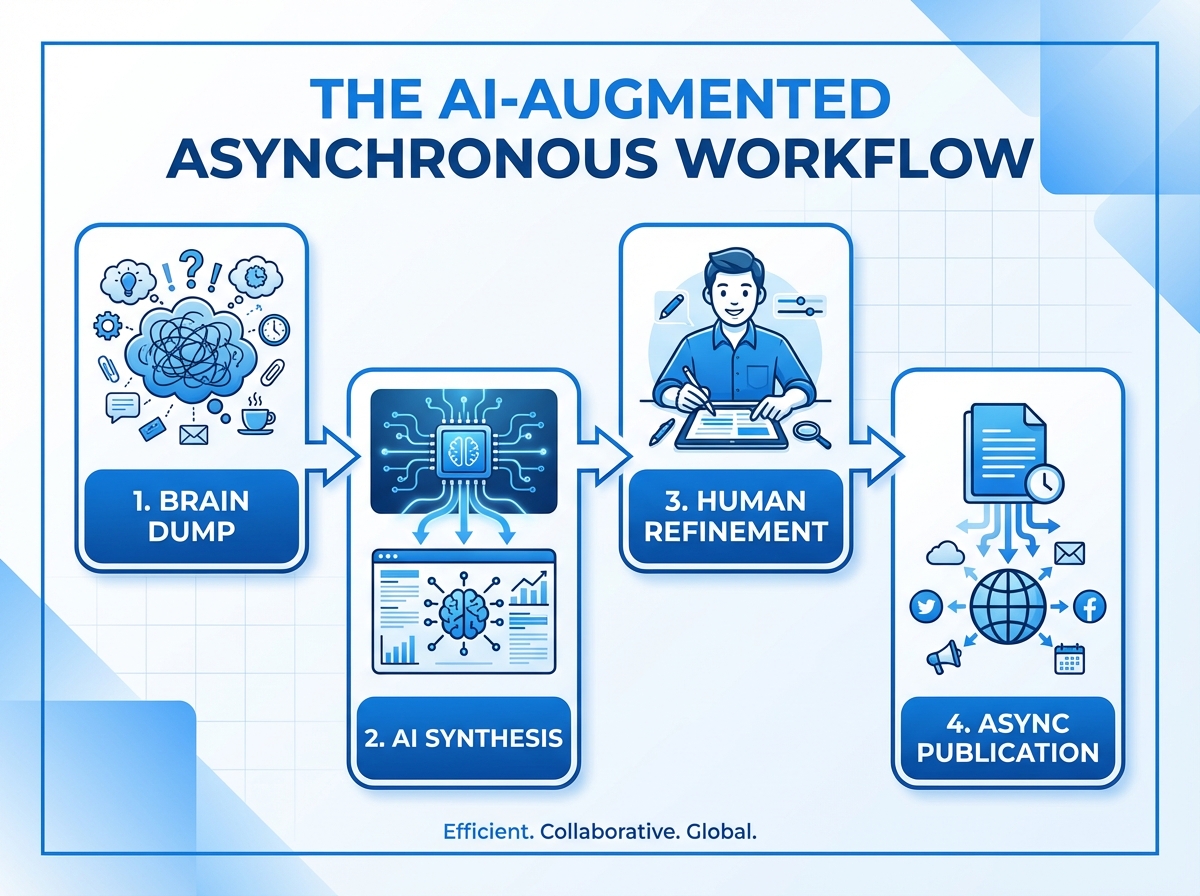
Implementing these tools requires a structured workflow. You cannot simply throw AI at a chaotic process and expect order. You must design the process first.
In a synchronous world, we often 'think out loud' in meetings. In an async world, we must 'think, then publish.'
This cycle ensures that what you share with your team is high-signal and low-noise, respecting their time and attention.
Remote work can feel isolating. When you remove meetings, you remove the social glue of the company. However, asynchronous does not mean anti-social.
Use synchronous time strictly for bonding and complex problem solving. If a topic requires emotional nuance or rapid-fire brainstorming, a meeting is appropriate. If it is a status update, it should be an email or a dashboard.
AI can help here by suggesting agendas for these synchronous moments. By offloading the boring updates to async text, your live meetings can be dedicated to human connection and creative collaboration.
Transitioning to an asynchronous, AI-enhanced workflow is a significant behavioral change. It requires discipline, strategic thinking, and the ability to view your own work habits objectively. This is where GPTnius provides a distinct advantage.
GPTnius offers AI Mentors that have been trained on proprietary research analyzing the published works, philosophies, and proven methodologies of thought leaders in productivity, management, and strategy.
For example, you can engage with "The Architect", a mentor profile that draws from research on mental models and habit formation systems. Here is how a GPTnius mentor can assist in your Remote Work Mastery:
These AI Mentors do not just chat; they synthesize researched frameworks to provide personalized coaching conversations, helping you apply abstract principles to your specific career challenges.
> 💡 Build Your Personal Board of Mentors > > You don't have to navigate the transition to asynchronous work alone. Access AI Mentors trained on the research of top productivity experts to guide your strategy, review your communications, and optimize your workflow. > > Meet the AI mentors built from this research →
Remote Work Mastery is not about finding the perfect webcam angle or the best noise-canceling headphones. It is about fundamentally restructuring how you collaborate. By embracing asynchronous communication and leveraging AI to handle the heavy lifting of synthesis and structure, you can escape the trap of the 'always-on' culture.
The future of work belongs to those who can produce high-quality output without constant supervision and who can communicate complex ideas clearly across time zones. With the right mindset and the right AI tools, that future is yours to command.
Asynchronous collaboration is a work method where communication and tasks do not happen in real-time. Team members contribute to projects on their own schedules, relying on documentation and written updates rather than instant meetings.
AI improves remote productivity by automating the drafting of documents, summarizing long communication threads, clarifying task instructions to prevent back-and-forth, and analyzing the emotional tone of written text.
While often used interchangeably, 'remote work' implies working away from a central office, sometimes still adhering to office hours. 'Distributed work' implies a decentralized structure where team members are spread across time zones and workflows are designed to be asynchronous by default.