Master the art of emotional recovery with the Rising Strong framework. Learn how to navigate the Reckoning, Rumble, and Revolution to bounce back from failure.
In the arena of life—whether it is the boardroom, a creative endeavor, or our personal relationships—falling is not a possibility; it is a certainty. If you are brave enough often enough, you will fall. The cultural narrative of success often glosses over the messy middle, skipping straight from the catastrophic failure to the triumphant return. However, true resilience isn't just about getting back up; it is about how we get back up and what we learn while we are on the ground.
This process is often referred to as "Rising Strong," a concept popularized by research into vulnerability and shame, most notably in the works of Dr. Brené Brown. The core philosophy suggests that the gold isn't in the success, but in the recovery. It is in the ability to process emotion, challenge our internal narratives, and rewrite the ending of our stories.
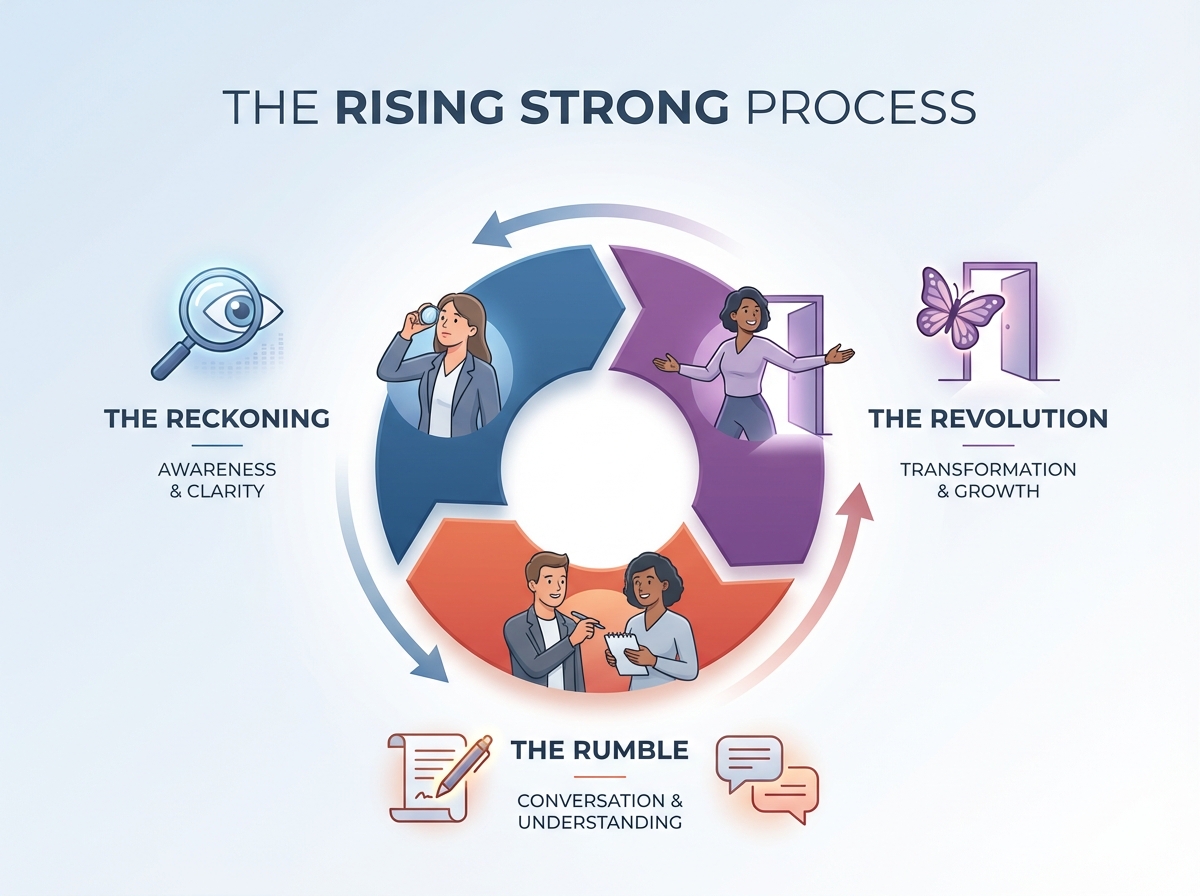
Emotional recovery is a skill, not a trait. It is a teachable, learnable practice that involves three distinct phases: The Reckoning, The Rumble, and The Revolution. By mastering these stages, we move from a state of reactive survival to proactive growth, transforming how we lead, love, and parent.
The first step in bouncing back from failure is the Reckoning. This phase is defined by a simple yet difficult act: recognizing that we are emotionally hooked. It is the moment we realize that something has happened—a snub in a meeting, a failed project launch, a difficult conversation—and our body is reacting before our mind has caught up.
Most of us are trained to suppress emotion in professional settings. We try to "push through" or "stay rational." However, the Reckoning requires us to do the opposite. It asks us to pay attention to our physiology. Are your palms sweating? Is your heart racing? Do you feel a knot in your stomach? These are data points.
In the Reckoning, we don't need to know exactly what is wrong or why we are feeling it yet. We simply need to acknowledge the shift. It is the difference between lashing out at a colleague because you're angry and pausing to say, "I'm feeling a strong emotional reaction right now, and I need to figure out what it is."
The tool of choice in the Reckoning is curiosity. Judgment shuts down learning ("I'm so stupid for feeling this way"), whereas curiosity opens the door to insight ("That's interesting—why did that comment make me feel so defensive?").
Integrating this into your life means adopting a "curiosity mindset" regarding your own feelings. Instead of numbing the discomfort with distractions (doom-scrolling, overworking, substance use), you lean into it. You ask, "What is the story I am walking into right now?"
> 💡 Master Your Emotional Triggers > > Struggling to identify why certain situations leave you emotionally hooked? GPTnius AI Mentors can help you unpack your reactions using proven emotional intelligence frameworks. > > Meet the AI mentors built from this research →
Once we have recognized that we are in the grip of an emotion, we move to the second, and often the most difficult phase: The Rumble. This is where we get honest about the stories we are making up.
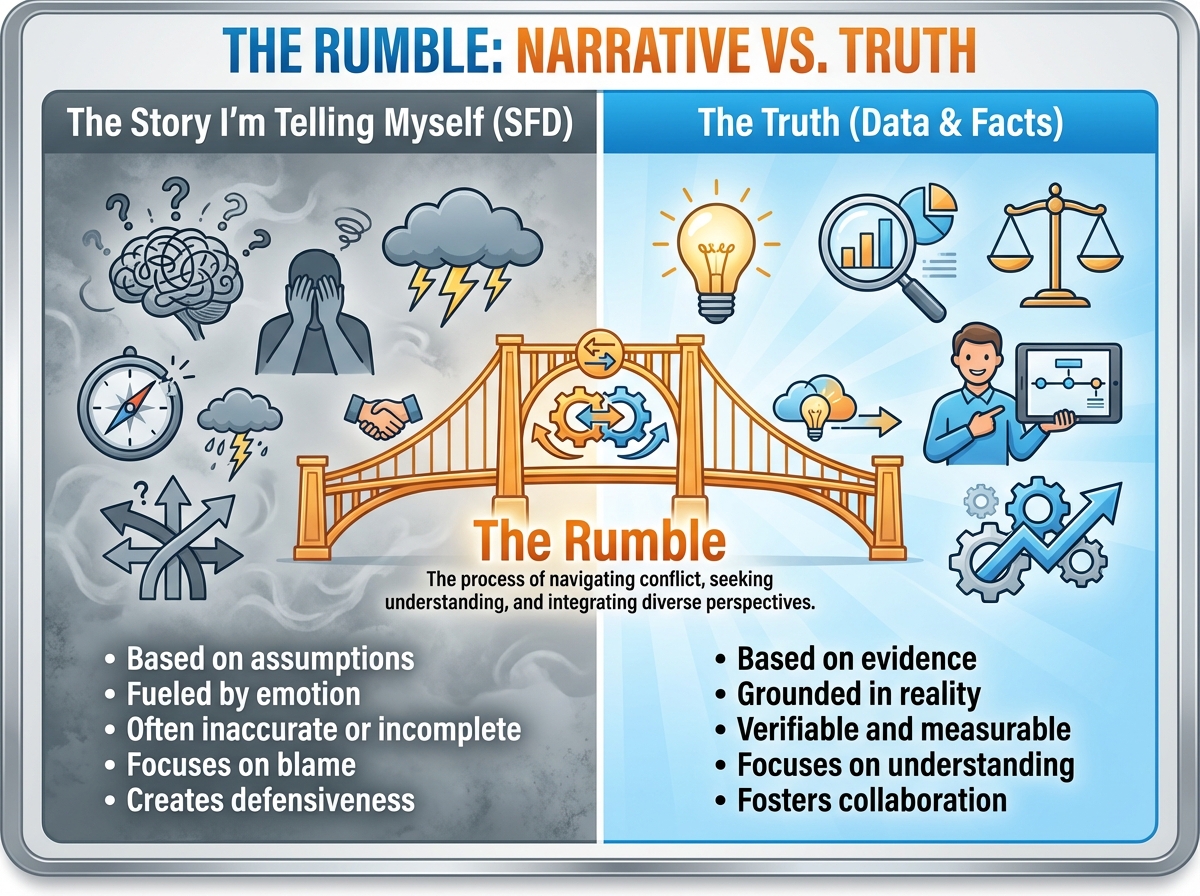
In the absence of data, the human brain creates stories to make sense of ambiguity. If a colleague doesn't reply to an email, our brain rarely concludes, "They must be busy." Instead, it often jumps to, "They hate my idea," or "I'm about to get fired."
Research into narrative psychology refers to this as the "Shitty First Draft" (SFD). The SFD is the fear-based, insecure, and often irrational story we tell ourselves to explain our pain.
Examples of SFDs:
To "rumble" is to challenge these drafts. It involves a process of rigorous honesty where we look for the delta between what we think happened and what actually happened. It requires asking tough questions:
The Rumble is uncomfortable because it often exposes our own insecurities. It forces us to admit that we might be wrong, or that we are projecting our own fears onto others. However, this is the crucible of emotional recovery. You cannot bounce back if you are solving the wrong problem.
The goal of the Rumble is to move from the SFD to a truthful narrative. This usually involves a conversation—either with yourself or with the person involved. It sounds like: "The story I'm telling myself is that you didn't support my proposal because you don't respect my work. Is that true?"
By vocalizing the narrative, you strip it of its power and invite the truth into the room. This transforms conflict into connection and confusion into clarity.
The final stage is The Revolution. This is not just about fixing the immediate issue; it is about a fundamental shift in how we engage with the world. When we successfully navigate the Reckoning and the Rumble, we don't just solve a problem—we evolve.
The Revolution happens when the insight gained from the Rumble becomes a practice. If you realized during your Rumble that your SFD was driven by a deep fear of rejection, the Revolution is the conscious decision to build self-worth independent of external validation.
If the Rumble revealed that you have poor boundaries at work, the Revolution is the systemic implementation of clearer limits. It is the shift from "I survived this conflict" to "I am now a person who navigates conflict with clarity and courage."
Rising strong is a process of integration. We take the broken pieces of our failure—the mistakes, the misunderstandings, the hurt—and we integrate them into our identity. We stop hiding our failures and start using them as assets.
A leader who has risen strong doesn't hide their past errors; they use them to mentor others. A partner who has risen strong doesn't pretend they never get jealous; they use their awareness to communicate better. The Revolution is the death of perfectionism and the birth of authentic confidence.
How do we apply these high-level concepts to our Tuesday afternoon? Here is a step-by-step approach to applying the framework when you hit a wall.
When you feel the physical surge of emotion (Reckoning), force a pause. Do not send the email. Do not make the snide comment. Breathe for six seconds. This engages the parasympathetic nervous system and allows your prefrontal cortex (the thinking brain) to come back online.
Get it out of your head. Write: "The story I am telling myself is..." and let it be petty, immature, and raw. You cannot fix a story you refuse to acknowledge. Seeing it on paper often highlights how ridiculous or fear-based it is.
Look at your written SFD like a detective. Circle the facts (observable data). Underline the assumptions. If you have 10% facts and 90% assumptions, you are not ready to react. You need to rumble.
Go to the source. Use the phrase: "I'm trying to make sense of what happened, and the story I'm making up is [X]. Can you help me understand?" This vulnerability disarms defensiveness and invites collaboration.
Understanding the theory of "Rising Strong" is one thing; applying it in the heat of the moment is another. This is where GPTnius becomes an invaluable tool for your personal and professional growth.
GPTnius offers AI Mentors that have been trained on proprietary research analyzing the published works, philosophies, and proven methodologies of thought leaders in resilience and emotional intelligence. For example, you can engage with "The Architect," a mentor persona that synthesizes research on mental models and habit formation to help you restructure your emotional responses.
Here is how GPTnius supports your journey:
By combining your lived experience with the synthesized wisdom of the world's best methodologies, GPTnius helps you turn theory into daily practice.
> 💡 Rewrite Your Narrative with AI Support > > Don't let a "Shitty First Draft" ruin your relationships or career. Use GPTnius to rumble with your stories and find the truth faster. > > Meet the AI mentors built from this research →
Rising strong is not a one-time event; it is a lifestyle. It is the commitment to never let a failure define us, but rather to let the learning from that failure refine us. By recognizing our emotions in the Reckoning, challenging our narratives in the Rumble, and changing our lives in the Revolution, we build an unshakeable foundation of resilience.
The process is messy, and it requires courage. But the reward is a life lived with greater authenticity, deeper connection, and the quiet confidence that comes from knowing that no matter how hard you fall, you have the tools to get back up.
The three stages are The Reckoning (recognizing emotional triggers), The Rumble (challenging the stories we tell ourselves), and The Revolution (changing our behavior based on new insights).
A Shitty First Draft is the initial, often fear-based and inaccurate story our brain creates to make sense of a difficult situation or lack of information.
You can improve recovery time by practicing the 'Reckoning' phase: recognizing physical signs of emotion early, pausing before reacting, and getting curious about your feelings rather than suppressing them.