Master shame resilience with this comprehensive guide to Brené Brown's 4-step method. Learn to recognize triggers, overcome shame, and build authentic connection.
Shame is a universal emotion that leads to disconnection, but it can be managed through Shame Resilience Theory. This guide explores Brené Brown's 4-step method—recognizing triggers, practicing critical awareness, reaching out, and speaking shame—to help you move from isolation to empathy and empowerment.
---
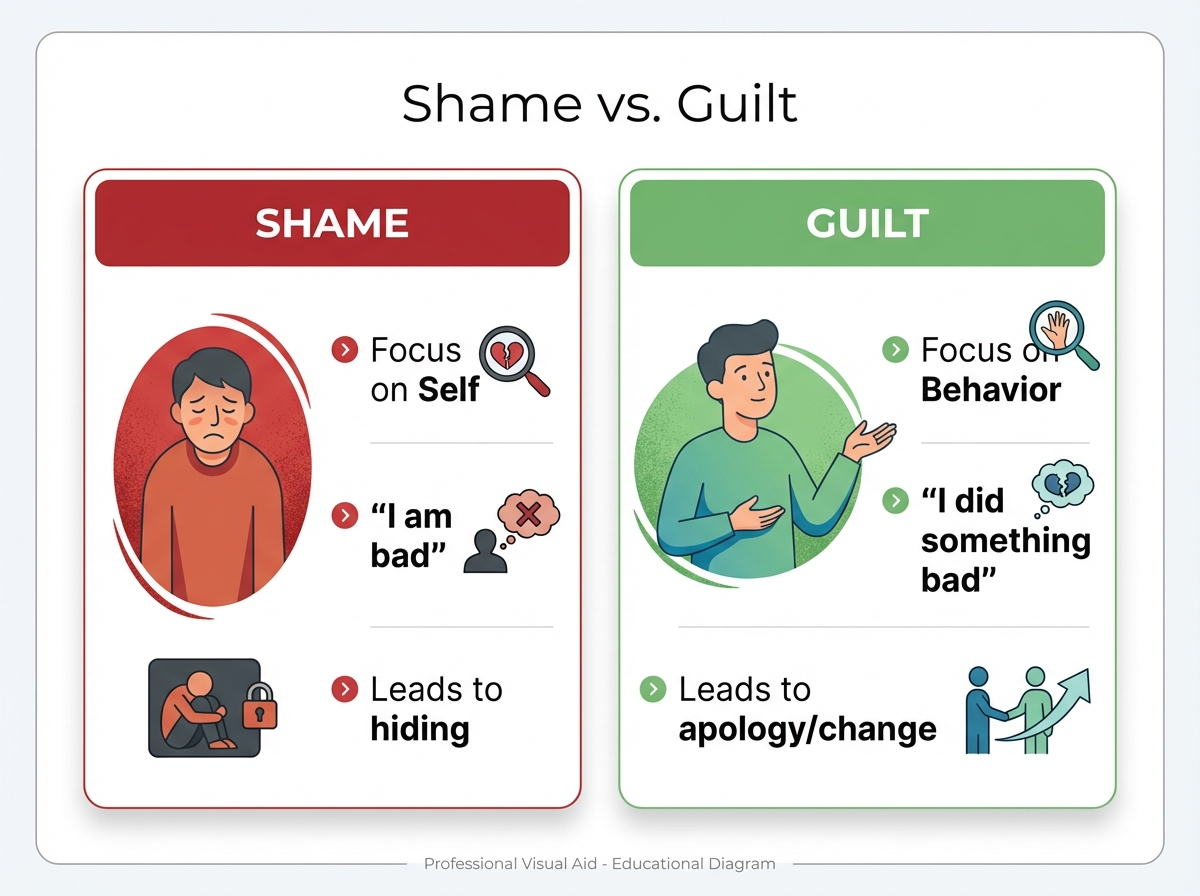
Shame is often described as the master emotion. It is the intensely painful feeling or experience of believing that we are flawed and therefore unworthy of love and belonging. Unlike guilt, which says "I did something bad," shame says "I am bad."
In a world driven by perfectionism and curated social media lives, feelings of inadequacy are rampant. However, research by Dr. Brené Brown suggests that while we cannot eliminate shame from our lives, we can build resilience to it. Shame resilience is not about immunity; it is about the ability to recognize shame when we experience it and move through it in a constructive way that allows us to maintain our authenticity and grow from the experience.
This article provides a deep dive into Brené Brown's Shame Resilience Theory (SRT), offering a practical, step-by-step guide to help you identify triggers, practice critical awareness, and foster the empathy required to heal.
At its core, Shame Resilience Theory posits that shame derives its power from being unspeakable. That which creates the most shame is often the thing we are most afraid to discuss. When we bury these feelings, they metastasize, leading to disengagement, addiction, aggression, or depression.
Resilience is born from the antidote to shame: Empathy.
If we can share our story with someone who responds with empathy and understanding, shame cannot survive. The goal of building shame resilience is to move from a place of shame (isolation, fear, judgment) to a place of empathy (connection, courage, compassion).
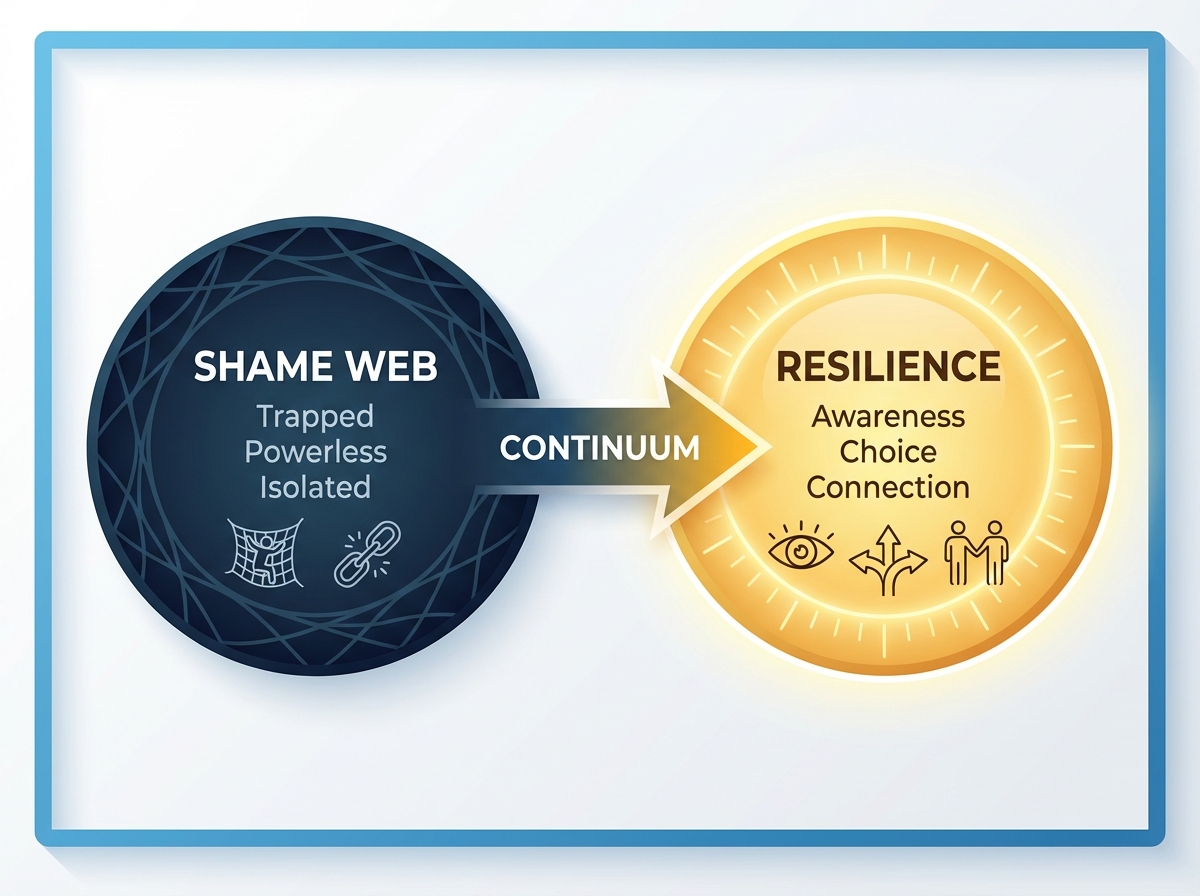
Brown describes resilience as a continuum. On one end, we are trapped in the "Shame Web," characterized by:
On the other end is Shame Resilience, characterized by:
To move from the Shame Web to Resilience, Brown identifies four specific elements. Mastering these steps allows us to deconstruct the shame experience and regain our footing.
The first step in any emotional regulation strategy is awareness. You cannot heal what you do not acknowledge. Shame is a visceral emotion; it often manifests physically before we can articulate it cognitively.
Recognizing Physical Signs: How do you know when you are in shame? For many, it involves a physical reaction:
identifying Triggers: Shame triggers are the specific topics or areas where we feel most vulnerable to judgment. These are often tied to societal expectations or personal insecurities. Common categories include:
To build resilience, you must map your triggers. When you feel that physical wash of heat, pause and ask: What just happened? What expectation do I feel I failed to meet?
> 💡 Master Your Emotional Triggers > > Identifying the root cause of your shame requires deep self-reflection and a safe space to explore your vulnerabilities. GPTnius AI Mentors, trained on research into emotional intelligence and resilience frameworks, can help you decode these triggers through guided, non-judgmental coaching. > > Meet the AI mentors built from this research →
Once you have identified that you are in shame and what triggered it, the next step is to reality-check the situation. Shame relies on the belief that we are alone in our struggle and that the expectations placed upon us are reasonable and attainable. Critical awareness challenges these assumptions.
This involves "zooming out" to look at the bigger picture. It asks the question: Is this shame coming from me, or is it coming from an impossible societal expectation?
The "Gremlins" of Shame: Brown often refers to the negative self-talk as "gremlins." These are the voices that whisper, "You're not good enough," or "Who do you think you are?"
How to Practice Critical Awareness:
Shame thrives in secrecy. It convinces us that if we tell anyone what we have done or how we feel, they will reject us. This leads to isolation, which only deepens the shame. To break the cycle, we must do the exact opposite of what shame dictates: we must reach out.
The Importance of the Right Listener: Reaching out does not mean broadcasting your shame to the world. It means sharing your story with someone who has earned the right to hear it. You need a friend, partner, or mentor who can respond with empathy rather than judgment.
Connecting with others reminds us that we are not alone, instantly dissolving the "isolation" component of the Shame Web.
The final step is the act of articulation. Speaking shame means putting words to the feeling. It is the difference between feeling a vague sense of unworthiness and saying, "I am feeling shame right now because I felt ignored in that meeting, and my story is that I am not smart enough to be here."
When we speak shame, we move it from the limbic system (emotional brain) to the prefrontal cortex (rational brain). Language gives us handle bars on the emotion.
To effectively apply Brené Brown's shame resilience theory, it is vital to distinguish shame from its cousins: guilt, humiliation, and embarrassment. Mixing these up can lead to ineffective coping mechanisms.
Building resilience is like building a muscle; it requires repetition. Here are actionable ways to integrate these concepts into daily life.
Imagine your shame as a tangible object in a box. When you feel triggered, visualize taking the lid off, looking at the object, and describing it. Is it heavy? What color is it? This externalization helps separate the emotion from your identity.
When you feel the "not good enough" narrative taking over, write down the specific expectation you feel you are failing. Then, write three reasons why that expectation is unrealistic or why your worth is not tied to it.
Speak to yourself as you would to someone you love. If a friend came to you with your struggle, would you say, "You're an idiot for feeling that"? Unlikely. You would offer comfort. Extend that same courtesy to yourself.
Understanding the theory of shame resilience is one thing; practicing it in the heat of the moment is another. This is where GPTnius can bridge the gap between knowledge and application.
GPTnius offers AI Mentors that have been trained on proprietary research analyzing the published works, philosophies, and proven methodologies of thought leaders in emotional intelligence and psychology.
Here is how an AI Mentor can assist you in building shame resilience:
By synthesizing these researched frameworks into personalized coaching conversations, GPTnius allows you to apply proven principles to your specific challenges in real-time.
> 💡 Build Resilience with Expert Frameworks > > Don't let shame dictate your life. Use GPTnius to access AI Mentors trained on the world's best resilience and mental health research, helping you practice self-compassion and break the cycle of negative self-talk. > > Meet the AI mentors built from this research →
Shame is a powerful force, but it loses its grip when exposed to the light of empathy and awareness. By applying the four steps of shame resilience—recognizing triggers, practicing critical awareness, reaching out, and speaking shame—you can transform your relationship with vulnerability. Remember, resilience is not about never falling; it is about the courage to get back up, own your story, and move forward with authenticity.
The primary difference lies in the focus of the emotion. Guilt is behavior-focused, meaning 'I did something bad,' which can motivate positive change. Shame is self-focused, meaning 'I am bad,' which creates feelings of unworthiness and leads to disconnection.
According to Shame Resilience Theory, you cannot completely eliminate shame as it is a primitive human emotion. However, you can build resilience to it, meaning you can recognize it faster, process it more effectively, and recover from it without losing your sense of self-worth.
'Speaking shame' refers to the act of verbally acknowledging and naming the feeling of shame and the story you are telling yourself. Articulating the emotion moves it from a hidden, destructive state to a manageable one, allowing for empathy and connection to dissolve the shame.