Discover why 'follow your passion' is flawed advice. Learn how the craftsman mindset and career capital build a career so good they can't ignore you.
For decades, the prevailing wisdom dispensed at graduation ceremonies and in career self-help books has been simple: "Follow your passion." The logic suggests that if you identify what you love doing first, and then find a job that matches it, you will never work a day in your life. It sounds romantic, inspiring, and intuitive.
It is also, according to a growing body of research on workplace satisfaction, fundamentally flawed advice.
This concept, often referred to as the "Passion Hypothesis," puts the cart before the horse. It assumes that passion is a pre-existing entity waiting to be discovered, rather than a side effect of mastery. When we look at the careers of truly successful and fulfilled individuals, we rarely find people who started with a burning passion. Instead, we find people who committed to becoming undeniably good at something, and found passion as a reward for their excellence.
To build a career that is truly remarkable—one that is "so good they can't ignore you"—we must shift our focus from what the world can offer us, to what we can offer the world. This article explores the mechanics of career capital, the power of the craftsman mindset, and how skill development trumps abstract passion every time.
The core problem with the Passion Hypothesis is that it makes you hyper-aware of what you don't like about your job. When you believe that the "perfect" job exists and is waiting for you, every minor annoyance in your current role feels like evidence that you are on the wrong path. This leads to chronic job-hopping and anxiety.
The antidote to this is the Craftsman Mindset.
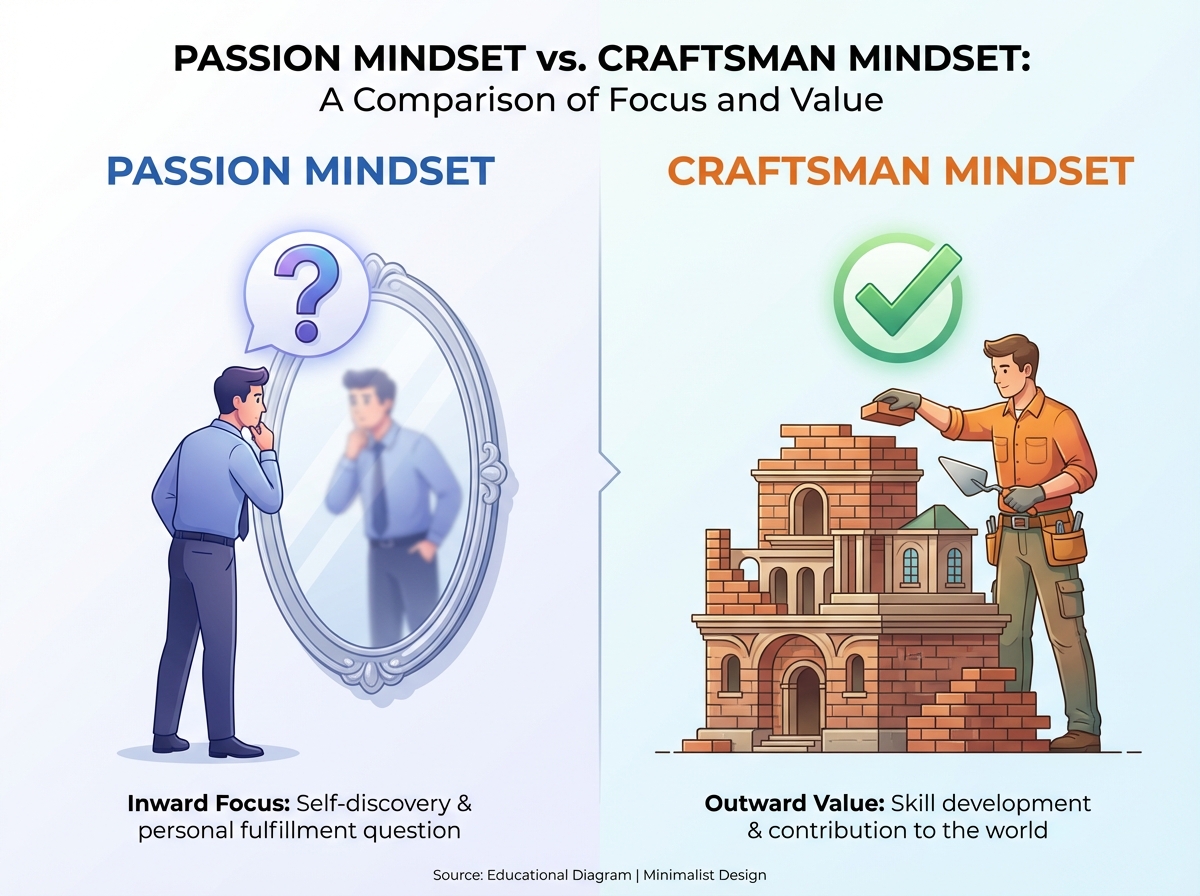
While the Passion Mindset asks, "What can the world offer me?", the Craftsman Mindset asks, "What can I offer the world?"
This shift in perspective is subtle but revolutionary. The Passion Mindset is ego-centric; it focuses on the value the job provides to you. The Craftsman Mindset is value-centric; it focuses on the quality of output you provide to the marketplace. Adopting the Craftsman Mindset liberates you from the anxiety of wondering if you are in the "right" job. Instead, it compels you to put your head down and focus on the quality of your work.
Nobody owes you a great career. You have to earn it. And the currency you use to earn it is the quality of your skills.
> 💡 Stop Searching, Start Building > > Shifting from a passion mindset to a craftsman mindset requires a fundamental change in how you view your daily work. GPTnius AI Mentors, trained on research into the mental models of top performers, can help you identify high-leverage skills to focus on today. > > Meet the AI mentors built from this research →
If the Craftsman Mindset is the philosophy, Career Capital is the asset you are accumulating.
Basic economic theory applies to the job market: things that are rare and valuable are in short supply. If you want a job that features creativity, impact, and control (the traits that make a job "great"), you need to offer something rare and valuable in return. You cannot buy a Ferrari with pocket lint; similarly, you cannot "buy" a dream job with entry-level skills.
Career Capital is the store of rare and valuable skills you have built up over time. The more capital you have, the more leverage you have to dictate the terms of your working life.
Many people want great jobs, but few are willing to put in the years of "deliberate practice" required to build the capital necessary to acquire them. This creates a disconnect. People feel entitled to fulfilling work without having developed the skills that make them valuable enough to demand it.
When you focus on skill development, you are essentially making deposits into your Career Capital account. Eventually, you will have enough capital to "cash in" for the traits that truly generate passion: autonomy, competence, and relatedness.
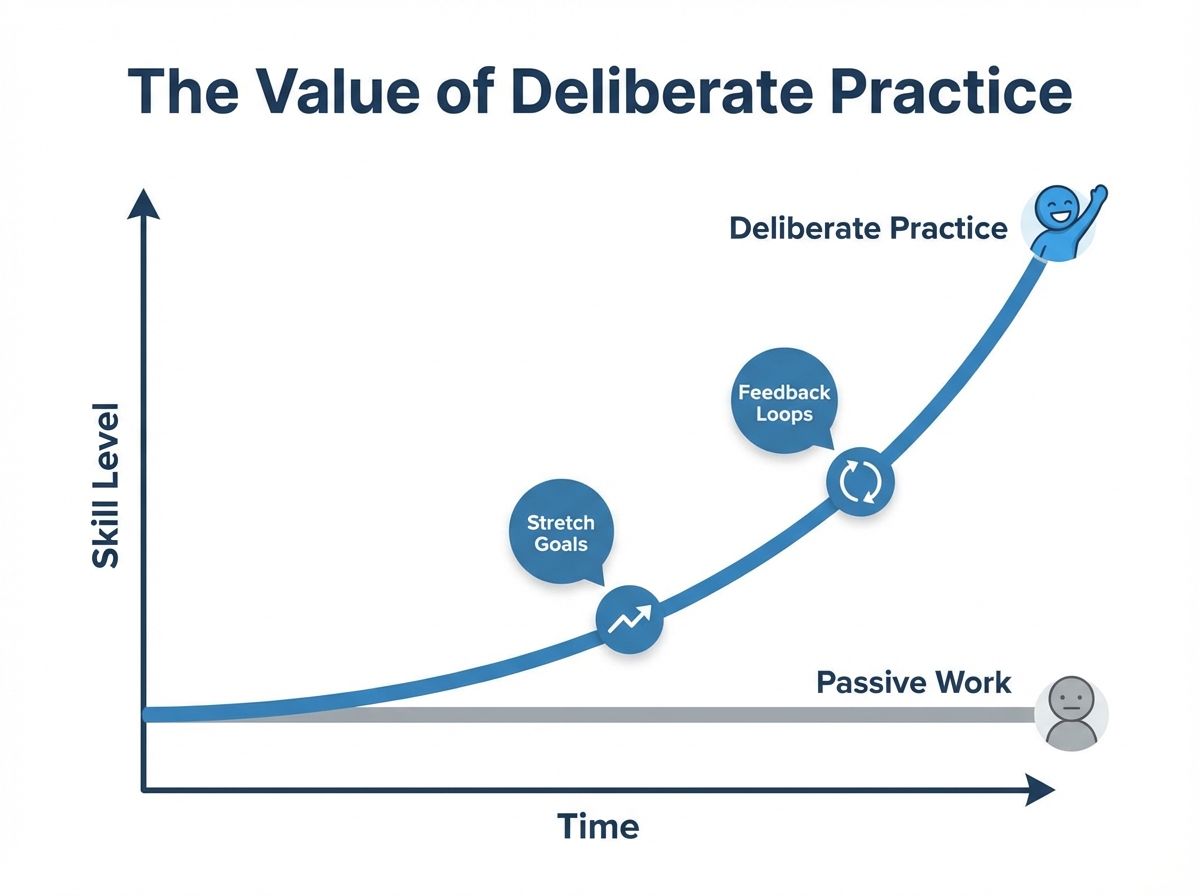
How do you acquire Career Capital? It isn't just about showing up and logging hours. It requires Deliberate Practice.
Most knowledge workers hit a performance plateau. Once they are "good enough" to not get fired, they stop improving. They might work hard, but they aren't getting better. This is the difference between ten years of experience and one year of experience repeated ten times.
Deliberate practice involves:
By consistently pushing your cognitive capabilities, you separate yourself from the herd. You become the only person who can do what you do—or at least, one of the very few who can do it well.
Once you have become so good they can't ignore you, what do you do with that leverage? You use it to acquire two main attributes: Control and Mission.
A common mistake is demanding control (flexible hours, remote work, autonomy on projects) before you have the capital to pay for it. If you demand autonomy without being valuable, you will simply be ignored or replaced. However, once you have the skills, control becomes the most powerful predictor of happiness.
Passion often evolves into a "mission"—a unifying goal for your career. But here is the catch: you usually can't find a mission until you are already an expert in your field. Great missions are found in the "adjacent possible"—the cutting edge of a field that is only visible to those who have mastered the basics.
Trying to launch a mission-driven career without deep expertise often leads to generic, ineffective efforts. Building Career Capital gives you the vision to see where the industry needs to go and the ability to take it there.
Understanding the theory of Career Capital is one thing; applying it to your daily professional life is another. This is where GPTnius bridges the gap.
GPTnius offers AI Mentors trained on proprietary research analyzing the published works, philosophies, and proven methodologies of thought leaders, including leading thinkers on skill acquisition and career strategy. Our mentors do not impersonate anyone. They synthesize researched frameworks, such as career capital and deliberate practice, into personalized coaching conversations built around your specific goals.
Here is how GPTnius helps you become "So Good They Can't Ignore You":
Users can apply these proven principles to their own challenges through personalized, guided discussions that evolve as their career grows.
> 💡 Build Your Career Capital Strategy > > Don't guess which skills will make you indispensable. Use GPTnius to create a personalized roadmap for skill acquisition based on proven frameworks of mastery. > > Meet the AI mentors built from this research →
Passion is not a spark you find; it is a fire you build. By abandoning the passion hypothesis and embracing the craftsman mindset, you free yourself from the anxiety of the "perfect choice." Instead, you commit to the process of becoming undeniably good.
Build your skills. Accumulate career capital. Engage in deliberate practice. When you do this, you won't just find a job you love—you will build a career that offers the control, mission, and financial viability that makes work truly meaningful. Be so good they can't ignore you, and the passion will follow.
The passion mindset focuses on what the world can offer you (leading to dissatisfaction), while the craftsman mindset focuses on what you can offer the world through the quality of your work (leading to mastery and fulfillment).
Career Capital refers to the rare and valuable skills you accumulate over time. It is the 'currency' you use to 'buy' a great career that includes autonomy, creativity, and impact.
Research suggests that pre-existing passion is rare. Telling people to follow it often leads to anxiety and job-hopping. Passion is usually a side effect of mastery, not a prerequisite for it.