Master accelerated learning by combining the psychology of the Forgetting Curve with modern Spaced Repetition Algorithms and AI-driven mentorship.
Imagine spending hours reading a seminal book on strategy, attending a high-stakes workshop, or studying a new programming language. You feel enlightened. You feel prepared. Yet, one week later, you struggle to recall the core arguments. A month later, the knowledge has evaporated, leaving only a vague impression that you once knew something important.
This is not a failure of intelligence; it is a feature of biology. The human brain is designed to filter out non-essential information to prevent cognitive overload. However, in the information age, this filter often works against us, discarding the very insights we are trying to master.
For decades, polymaths and memory champions have utilized a technique called Spaced Repetition to hack this biological limit. Today, Artificial Intelligence has supercharged this concept, moving it from manual index cards to dynamic, predictive algorithms that adapt to your unique learning velocity.
This article explores the science of the Forgetting Curve, the mathematics behind Spaced Repetition Algorithms, and how you can leverage AI to transform your mind from a leaky bucket into a steel vault.
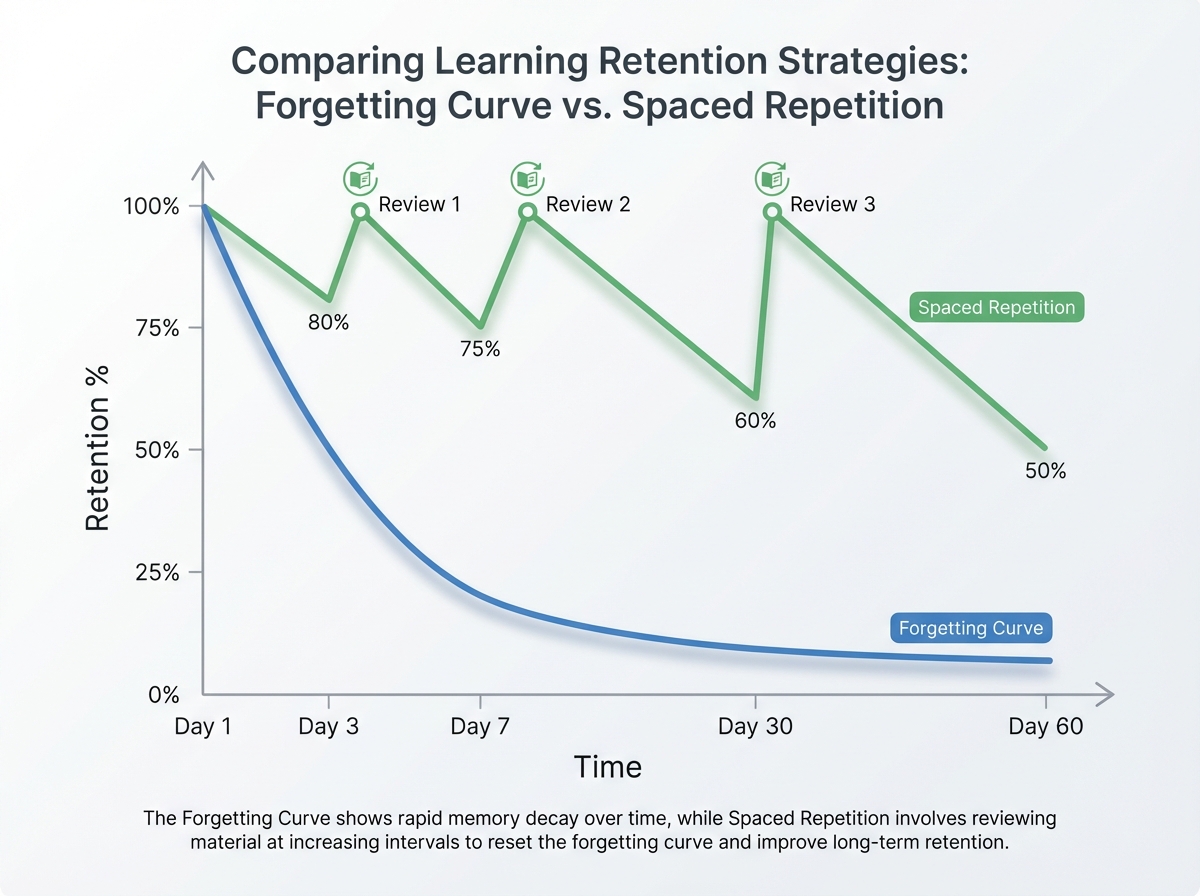
In the late 19th century, German psychologist Hermann Ebbinghaus conducted a rigorous self-experiment. He memorized lists of nonsense syllables and tested his recall at various intervals. His findings, plotted on a graph, became known as the Forgetting Curve.
The results were stark:
Without active intervention, the brain aggressively prunes neural pathways it deems unnecessary. The curve is exponential; the steepest drop happens immediately after learning. To counter this, you cannot simply review information randomly. You must interrupt the curve.
Spaced Repetition is the practice of reviewing information at gradually increasing intervals. Instead of cramming (which stores information in short-term memory), you review material just as you are about to forget it.
Every time you successfully recall a memory on the verge of fading, the neural pathway is reinforced, and the forgetting curve flattens. The next review can be scheduled further into the future.
> 💡 Stop Forgetting, Start Mastering > > The science shows that retention requires active reinforcement. GPTnius AI Mentors use proprietary research to guide you through iterative learning, ensuring core principles stick. > > Meet the AI mentors built from this research →
To understand how AI is changing learning, we must look at how spaced repetition algorithms have evolved from physical boxes to neural networks.
In the 1970s, Sebastian Leitner proposed a system using physical flashcards and shoeboxes.
If you got a card right, it moved to the next box. If you got it wrong, it went all the way back to Box 1. While effective, it was rigid and manual.
Developed by Piotr Woźniak (creator of SuperMemo), the SM-2 algorithm became the backbone of popular software like Anki. It introduced a mathematical variable called the Ease Factor.
When you review a card, you grade yourself (e.g., Again, Hard, Good, Easy). The algorithm calculates the next interval based on:
This allowed for millions of items to be tracked individually, optimizing efficiency far beyond the Leitner boxes.
Recent advancements have led to the Free Spaced Repetition Scheduler (FSRS) and other machine-learning-based approaches. Unlike SM-2, which relies on static formulas, modern AI algorithms utilize:
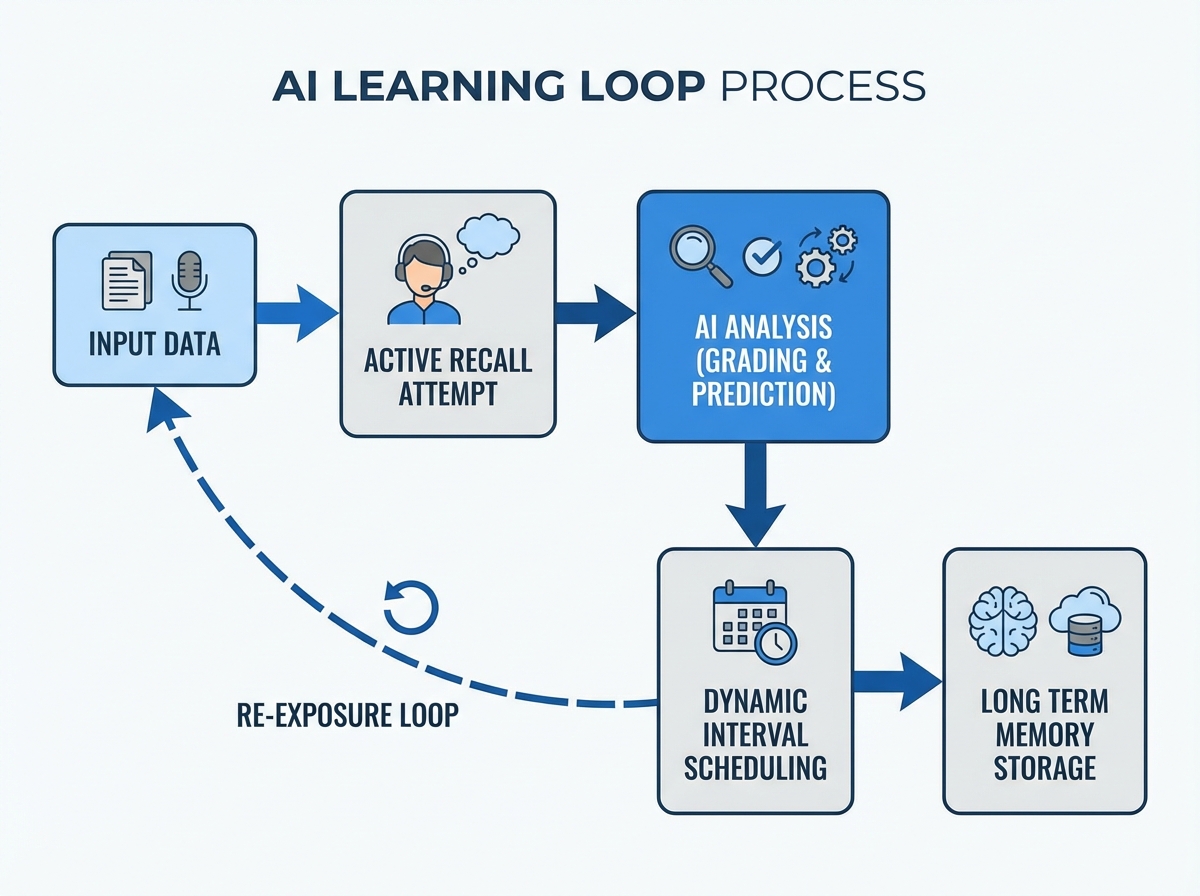
AI analyzes your entire history to predict your "forgetting index" with uncanny accuracy, adjusting the schedule dynamically. If you are tired and performing poorly, the AI adapts. If you are in a flow state, it pushes you further.
The traditional view of Spaced Repetition is limited to flashcards—vocabulary, dates, and definitions. However, for high-level learners and professionals, the goal is not to memorize trivia, but to internalize Mental Models and Frameworks.
AI allows for Semantic Spaced Repetition. This is where the concept is revisited not through a static card, but through varied contexts.
Instead of seeing the same card ("Define Opportunity Cost"), an AI learning system might present the concept differently over time:
This prevents "pattern matching" (where you memorize the shape of the answer) and ensures deep semantic understanding. This is vital for learning complex skills like coding, strategic management, or medical diagnosis.
To beat the forgetting curve today, you need a system that integrates consumption with retention.
When reading or listening to podcasts, do not trust your brain to hold the data. Highlight key insights. Modern tools can sync your Kindle highlights or web clippings directly into a database.
Use AI to help synthesize raw notes into questions. You can paste a complex article into an LLM and ask it to: "Generate 5 active recall questions based on the core arguments of this text, focusing on the 'why' and 'how' rather than just facts."
Dedicate 15–20 minutes daily to clearing your review queue. Consistency matters more than intensity. Missing a day disrupts the algorithm's optimization.
While flashcard apps are excellent for raw data, they lack the nuance required for leadership, strategy, and personal development. This is where GPTnius bridges the gap between memorization and wisdom.
GPTnius offers AI Mentors that have been trained on proprietary research analyzing the published works, philosophies, and proven methodologies of thought leaders. These mentors do not just lecture; they engage in conversational spaced repetition.
Here is how GPTnius applies these algorithms to your growth:
> 💡 Internalize the Wisdom of the Greats > > Don't let valuable insights fade away. Engage with AI Mentors trained on the world's best frameworks to actively reinforce your learning through personalized coaching. > > Meet the AI mentors built from this research →
The Forgetting Curve is a formidable adversary, but it is not invincible. By understanding the mechanics of memory and leveraging Spaced Repetition Algorithms, you can choose what you keep. Whether you use a simple flashcard app or an advanced AI coaching platform like GPTnius, the key is the same: consistent, active retrieval spaced over time.
In a world overflowing with information, the superpower is not just accessing knowledge—it is retaining it.
While SM-2 (used in Anki) is the industry standard for stability, the newer FSRS (Free Spaced Repetition Scheduler) is considered state-of-the-art as it uses machine learning to adapt more precisely to individual retention rates.
Absolutely. Spaced repetition is highly effective for learning complex concepts, coding syntax, legal precedents, and medical diagnosis. The key is to formulate 'why' and 'how' questions rather than simple fact-based questions.
AI can generate questions for you, grade your answers based on nuance rather than exact keyword matching, and dynamically adjust the review schedule based on your fatigue levels and learning velocity.