Discover the psychology behind the 6 human needs. Learn how certainty, variety, significance, connection, growth, and contribution shape your life and motivation.
Why does a billionaire continue to work 18-hour days long after their financial future is secure? Why would someone risk their life to save a stranger? Conversely, why do people stay in abusive relationships or succumb to addiction?
On the surface, these behaviors seem unrelated or even contradictory. However, at their core, they are all fueled by the same fundamental drivers. In the realm of peak performance and human psychology, these drivers are known as the 6 Human Needs.
This framework, popularized by strategists and thought leaders like Tony Robbins, suggests that regardless of culture, age, or socioeconomic status, every human being is wired with the same six psychological needs. While we all have them, we prioritize them differently. The way you rank these needs—and the vehicles you use to meet them—determines your happiness, your success, and your ultimate destiny.
Understanding these needs is not just an academic exercise; it is a master key to self-awareness. Once you identify which needs are steering your ship, you can stop reacting to life and start designing it.
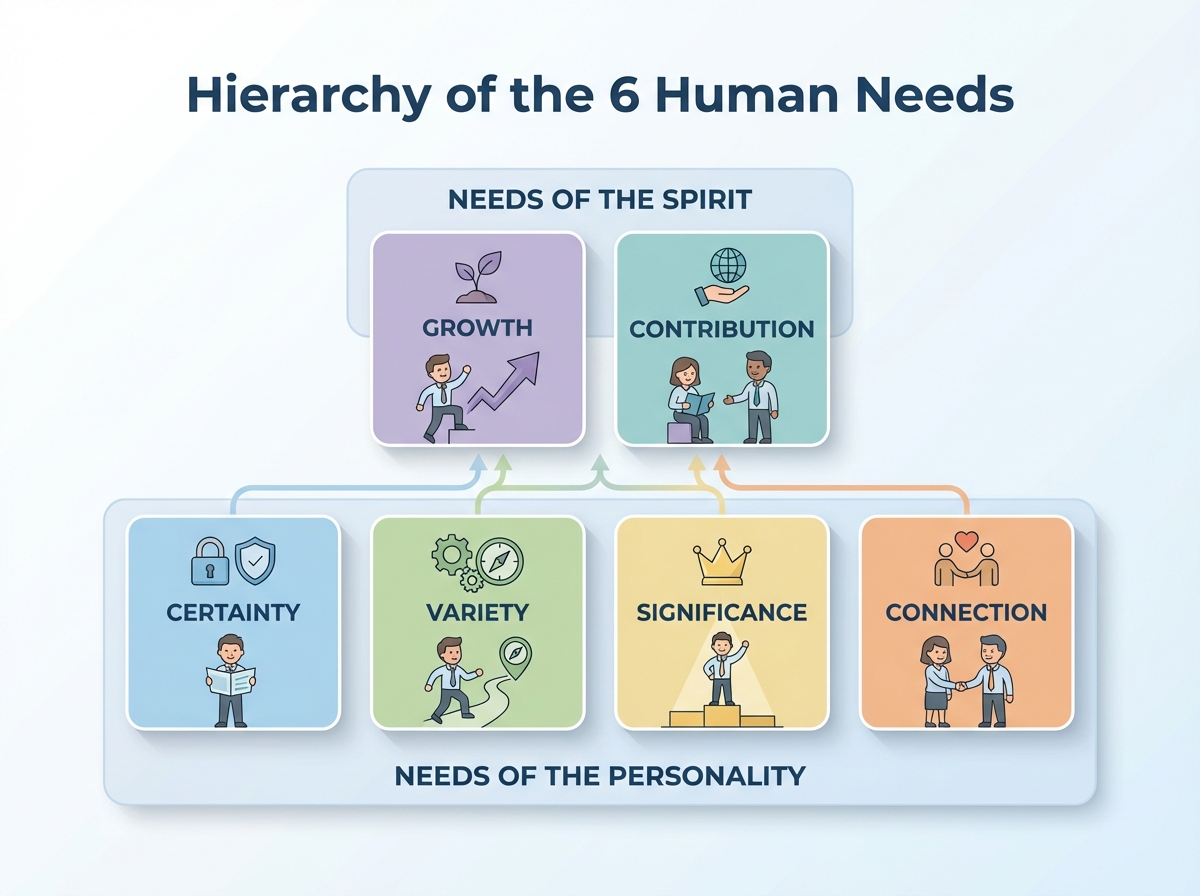
The first four needs are classified as the "Needs of the Personality." These are the fundamental requirements for human survival and psychological well-being. Everyone finds a way to meet these needs, whether through constructive, neutral, or destructive means.
The first human need is Certainty. This is the need for safety, stability, and predictability. It is the biological imperative to avoid pain and gain pleasure. We need to know that the roof will hold, that food will be on the table, and that our partner won't leave us tomorrow.
Without a baseline of certainty, we cannot function; we would be in a constant state of panic. People meet this need in various ways:
However, there is a catch. If you have 100% certainty—if you know exactly what will happen every moment of every day—you will eventually feel bored and unfulfilled.
To combat the boredom of total predictability, we have a second need: Uncertainty, or Variety. This is the need for the unknown, for change, for new stimuli. It is the spice of life. We crave surprise, challenges, and adventure.
This creates a natural paradox within the human psyche: We want stability (Certainty), but we also want excitement (Variety). Balancing these opposing forces is a constant negotiation.
The third need is Significance. This is the deep-seated desire to feel unique, important, special, and needed. Every person wants their life to have meaning and to be recognized by others.
Significance is a powerful driver—often more powerful than the desire for survival. People will die for a cause (significance) that they believe is greater than their life (certainty).
The fourth need is Love and Connection. As social creatures, we are desperate to bond with others. While many strive for love, it can be terrifying because it requires vulnerability. Therefore, many settle for connection, which is the "lite" version of love.
> 💡 Master Your Internal Drivers > > Struggling to balance the need for stability with the desire for growth? GPTnius AI Mentors can analyze your decision-making patterns and help you align your habits with your core needs. > > Meet the AI mentors built from this research →
The first four needs are essential for survival, but meeting them does not guarantee happiness. You can have certainty, variety, significance, and connection and still feel empty. True fulfillment comes from the final two needs: the "Needs of the Spirit."
Everything in the universe is either growing or dying; there is no plateau. Growth is the need for emotional, intellectual, and spiritual expansion. It is the drive to become more than we are today.
We are most alive when we are stretching our capabilities. The satisfaction of a goal achieved is fleeting, but the person you become in the pursuit of that goal provides lasting fulfillment.
The final need is Contribution. This is the need to give beyond oneself, to serve others, and to leave a legacy. Life is not about "me"; it is about "we."
When we focus entirely on ourselves, our problems seem massive. When we focus on contribution, our perspective shifts. Contribution regulates the other needs—it gives us certainty (we are good people), variety (solving others' problems), significance (we are helping), connection (bonding with those we help), and growth.
Most people have two "top needs" that drive 80% of their decisions. If your top need is Certainty, you will live a very different life than someone whose top need is Variety.
Problems arise when our top needs conflict with our goals. For example, if your goal is to build a startup (which requires embracing massive uncertainty), but your number one driver is Certainty, you will self-sabotage. You will procrastinate, over-plan, and refuse to launch until everything is "perfect"—which it never will be.
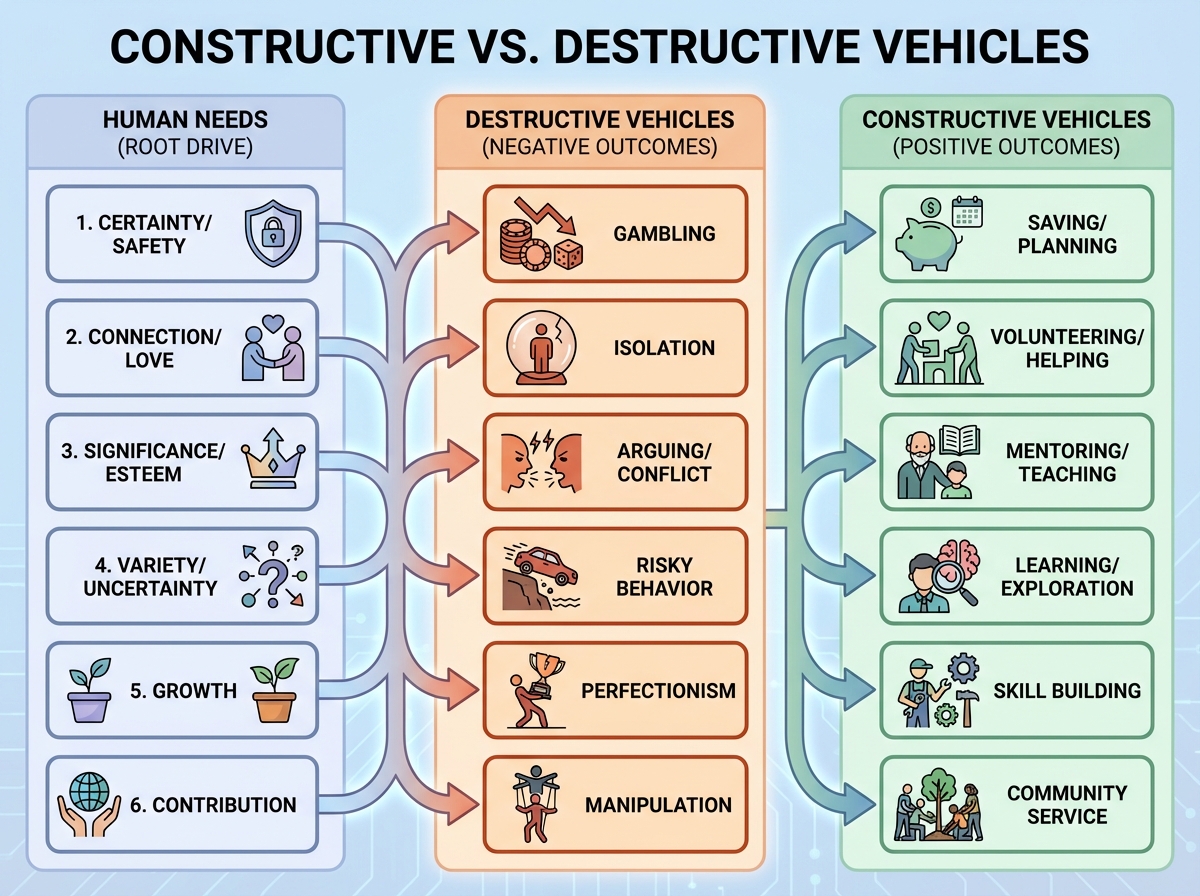
The most critical aspect of this psychology is understanding the "vehicle" you use to meet your needs. A vehicle is simply the method or habit you use to satisfy a driver.
Consider three different people who all have a high need for Significance:
All three achieved significance. They all felt "important" or "noticed" in the moment. But the quality of their lives is vastly different.
The Trap of Addiction: Addictions are difficult to break because they often meet four or more needs simultaneously. Smoking, for example:
When a vehicle meets 3+ needs, it becomes an addiction. To break it, you cannot just stop the behavior; you must replace it with a new vehicle that meets those same needs in a healthier way.
Understanding the 6 Human Needs intellectually is the first step, but applying this framework to your daily life requires consistent analysis and feedback. This is where GPTnius bridges the gap between theory and practice.
GPTnius offers AI Mentors trained on proprietary research analyzing the published works, philosophies, and proven methodologies of thought leaders in peak performance and psychology. Specifically, the "Architect" and "Strategist" mentors can help you:
> 💡 Discover Your Primary Drivers > > Are you driven by significance or contribution? Certainty or variety? Unlock the insights of the world's best psychological frameworks with your own personal AI Mentor. > > Meet the AI mentors built from this research →
The 6 Human Needs are the operating system of your psychology. They are always running in the background, influencing how you spend your money, how you treat your partner, and how you view your career.
We do not have a choice about having these needs, but we do have a choice in how we meet them. By becoming conscious of your drivers, you can shift from seeking significance to seeking contribution, and from demanding certainty to embracing growth. This shift is the difference between a life of pleasure and a life of fulfillment.
The six human needs are Certainty, Uncertainty/Variety, Significance, Love/Connection, Growth, and Contribution. The first four are needs of the personality, while the last two are needs of the spirit.
To find your top need, look at where you spend your money, time, and energy. Ask yourself: When I am most stressed, what do I crave? Do I crave control (Certainty) or attention (Significance)? Analyzing your 'vehicles' or habits usually reveals your primary drivers.
Yes, your top needs often shift as you move through different stages of life. A young adult might prioritize Variety and Significance, while a parent might prioritize Certainty and Connection. However, intentional personal development can also help you consciously shift your drivers.