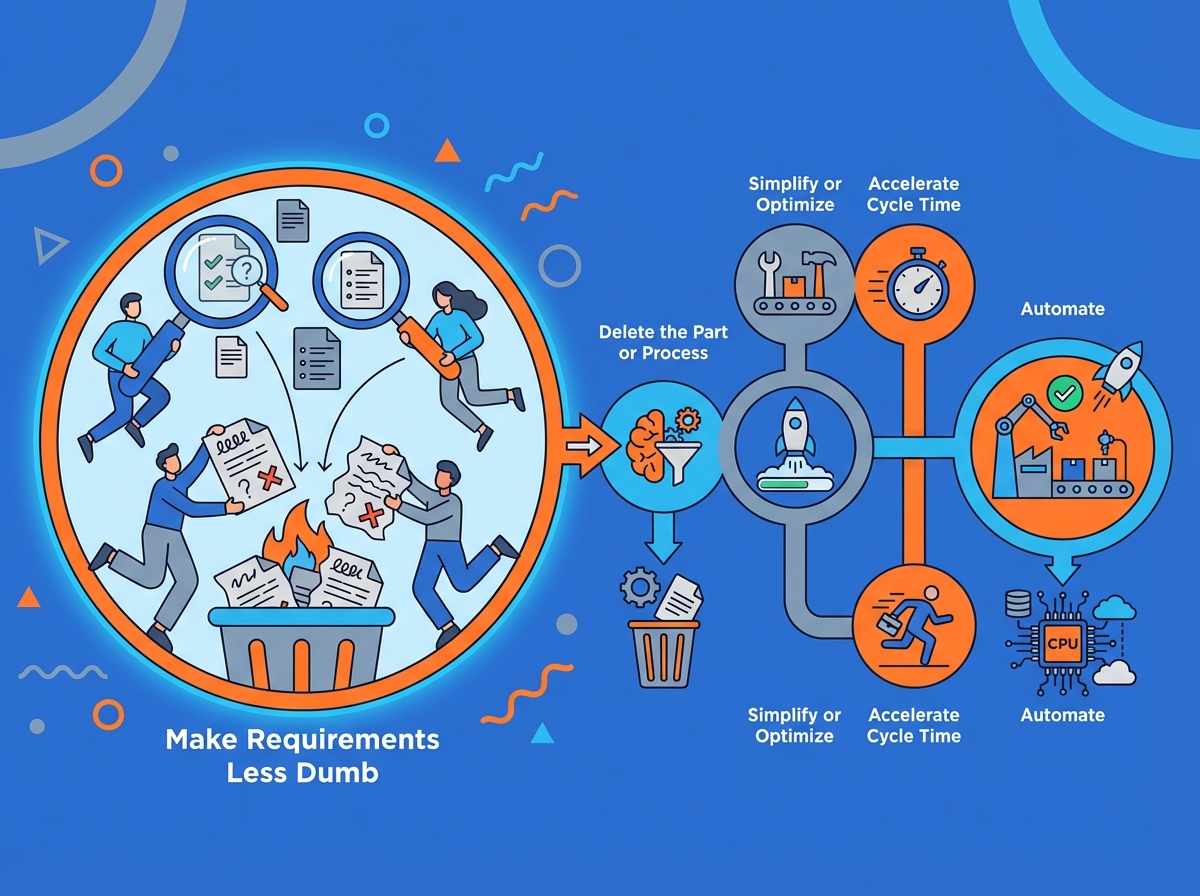
Master process optimization with the Elon Musk Algorithm. Learn the 5-step framework used at Tesla and SpaceX to streamline business processes and boost efficiency.
The 'Elon Musk Algorithm' is a rigorous 5-step methodology for process optimization that prioritizes deleting requirements over automation. By questioning every constraint and removing unnecessary steps before accelerating, businesses can achieve radical efficiency and innovation.
---
In the world of high-stakes manufacturing and engineering, efficiency isn't just a metric—it is a matter of survival. Whether it is ramping up production for the Tesla Model 3 or building the Starship at SpaceX, Elon Musk has relied on a specific mental framework to navigate 'production hell' and achieve what many deemed impossible.
This framework, often referred to simply as "The Algorithm," is a five-step process designed to strip away bureaucracy, reduce costs, and dramatically speed up execution. While it was born on the factory floor, its principles are universal. From software development to marketing operations, the Algorithm offers a blueprint for how to streamline business processes and stop wasting time on things that shouldn't exist in the first place.
Most organizations struggle with efficiency because they try to optimize the wrong things. They automate broken processes or accelerate workflows that are fundamentally flawed. This guide provides a comprehensive breakdown of the Algorithm, showing you how to apply these principles to your own work to achieve radical simplification.
Before diving into the five steps, it is crucial to understand the philosophy behind them. In most corporate environments, the default behavior is to add: add more features, add more meetings, add more safety steps, and add more people. This is often done to mitigate risk or respond to a specific failure.
Over time, these additions calcify into "requirements." A smart engineer or manager joins the company, sees a requirement, and assumes there is a good reason for it. They then spend their time optimizing that requirement—making it cheaper or faster—without ever asking if it should exist at all.
Musk’s philosophy posits that the most common error in process engineering is optimizing a thing that should not exist.
If you spend months building a machine to automate a specific part of an assembly line, and it turns out that part wasn't actually necessary for the final product, you haven't just wasted time; you have cemented inefficiency into your system. The Algorithm is designed to prevent this by forcing a specific order of operations.
> 💡 Stop Optimizing Things That Shouldn't Exist > > Are you unsure which of your current business processes are actually necessary? GPTnius AI Mentors, trained on proprietary research into proven mental models, can help you challenge your assumptions and identify bottlenecks. > > Meet the AI mentors built from this research →
The first step is to question every requirement. No matter who gave you the requirement—whether it was a legal department, a safety engineer, or the CEO—you must treat it as a recommendation, not a law.
Musk famously notes that requirements from smart people are the most dangerous because you are less likely to question them. You assume they know something you don't. In reality, everyone is wrong some of the time.
To apply this to process optimization:
This is the most radical and difficult step for most managers: Delete the part or process.
The corporate instinct is to keep things "just in case." We keep a step in the workflow because we might need it one day. The Algorithm flips this logic: delete it now, and put it back later if you are forced to.
Musk suggests that if you are not forced to add back at least 10% of what you deleted, you are not deleting enough. This sounds counterintuitive. Doesn't adding things back mean you made a mistake? No. It means you successfully found the absolute boundary of what is necessary. If you never have to add anything back, it means you played it too safe and left inefficiency in the system.
Only after you have rigorously questioned requirements and deleted everything possible should you move to simplify and optimize.
A common mistake is to simplify a process that you should have deleted (Step 2). This is effectively polishing garbage. Once you are sure a step is necessary, your goal is to make it as simple as possible.
At Tesla, this often involved looking at the underbody of the car. They realized they were welding hundreds of separate parts together. By investing in massive casting machines (Giga Press), they simplified the process by casting the entire rear underbody as a single piece. They didn't just weld faster; they changed the geometry of the problem.
Now that you have a simplified process that is strictly necessary, you can focus on speed. Accelerate cycle time.
Speed is the ultimate weapon in business. Faster iteration cycles mean faster learning. However, Musk warns: Don't go faster until you have worked on the first three steps.
If you accelerate a broken process, you are just digging your own grave faster. If you automate a process that should be deleted, you are accelerating waste.
To improve efficiency at work during this stage:
The final step is automate. Note that this is step five, not step one.
We live in an era obsessed with automation, AI, and robotics. It is tempting to look at a manual process and immediately say, "Let's build a bot for that." The Algorithm dictates that you should only automate after you have questioned, deleted, simplified, and accelerated.
Musk learned this the hard way during the Model 3 ramp-up. Tesla tried to automate the placement of fiberglass mats on battery packs. The robots were slow and clumsy. The "fluff" of the fiberglass destroyed the machines. They spent millions trying to fix the robots.
Eventually, they went back to Step 1 (Question Requirements). They asked the battery safety team: "What are these mats for?" The answer was sound dampening. They then asked the engineering team sound dampening was needed. The answer? "The battery pack is glued to the floor; it doesn't vibrate."
The requirement was dumb. The part wasn't needed. They deleted the part. The robots were scrapped. They had spent months automating a process that should have been deleted.
While the Algorithm uses manufacturing language, it is perfectly suited to knowledge work and general business management. Here is how to streamline business processes in an office setting:
Applying the Elon Musk Algorithm requires a shift in mindset. It demands the confidence to question authority and the strategic foresight to risk deletion. This is where GPTnius can be your strategic partner.
GPTnius offers AI Mentors that have been trained on proprietary research analyzing the published works, philosophies, and proven methodologies of thought leaders. For example, our "The Architect" mentor draws from research on frameworks like mental models and systems engineering, combined with proven coaching models.
Here is how you can use GPTnius to apply the Algorithm:
By engaging in guided discussions, you can turn the theoretical steps of the Algorithm into a practical roadmap for your specific challenges.
> 💡 Master the Art of Radical Simplification > > Don't let bureaucracy slow you down. Get personalized coaching on how to apply the 5-step Algorithm to your specific business challenges using AI Mentors trained on proven frameworks. > > Meet the AI mentors built from this research →
The Elon Musk Algorithm is not about cutting corners; it is about cutting waste. It is a recognition that complexity is the enemy of execution. By rigorously questioning requirements, deleting the unnecessary, simplifying the essential, accelerating the cycle, and finally automating, you can transform the efficiency of any team or project.
Start small. Pick one process this week. Ask who set the requirements. Try to delete a step. If you aren't forced to add it back, you've just made your business faster and leaner.
The 5 steps are: 1. Question the requirements (make them less dumb), 2. Delete the part or process, 3. Simplify and optimize, 4. Accelerate cycle time, and 5. Automate.
Automating a process that shouldn't exist is a waste of resources. By deleting first, you ensure you are only investing time and technology into steps that are strictly necessary for the final value.
Musk suggests that if you are not forced to add back at least 10% of what you deleted, you didn't delete enough. This implies you should push the boundaries of removal to find the absolute limit of necessity.
Yes. In software, 'parts' are features or code blocks. The algorithm encourages deleting unnecessary features and simplifying code logic before optimizing for speed or writing automated tests.