The traditional entry-level job is disappearing. Learn how to use AI simulation to bridge the experience gap, build a portfolio, and fast-track your career development.
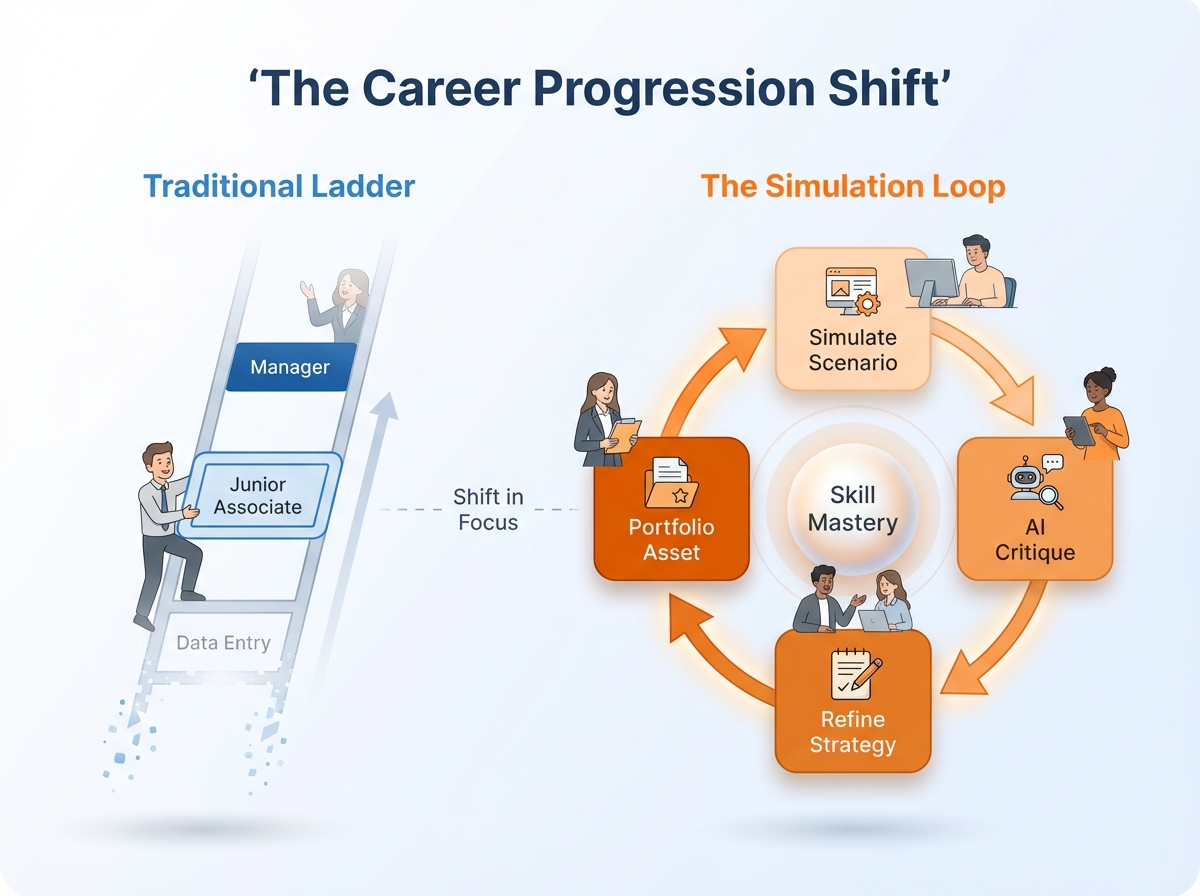
For decades, the career path for students and graduates was linear and predictable. You graduated, secured an entry-level position involving low-stakes, repetitive tasks (data entry, basic research, drafting emails), and slowly absorbed the nuances of your industry through osmosis. You were paid little because you knew little, but the company invested in your potential.
That ladder has been pulled up.
Generative AI and automation have effectively mastered the "grunt work" that defined the first two years of a professional career. Companies no longer need a junior associate to summarize meeting notes or a junior developer to write boilerplate code; software does it instantly and often more accurately. While this boosts productivity for seniors, it creates a crisis for juniors: The End of Entry-Level.
If the bottom rung of the ladder is gone, how do you start climbing? The answer lies not in finding a job to gain experience, but in simulating the job to prove competence. This guide explores how to leverage AI tools and mentorship platforms to create a "Flight Simulator" for your career, allowing you to gain years of perceived experience in months.
To understand the solution, we must first diagnose the problem. The labor market is undergoing a structural shift known as "skill polarization."
This creates a daunting gap between the university curriculum (theory) and the workforce reality (high-level execution). However, the same technology causing this disruption offers the solution.
> 💡 Bridge the Gap Between Theory and Practice > > Don't wait for a job offer to start learning professional strategy. Our AI Mentors, trained on research into the world's best business minds, can guide you through complex problem-solving frameworks today. > > Meet the AI mentors built from this research →
Pilots do not learn how to handle engine failure with real passengers on board. They use flight simulators—highly realistic virtual environments that replicate the pressure, mechanics, and consequences of flying without the fatal risks.
Knowledge workers must now adopt the same approach. You can use AI to build a "Career Simulator."
Instead of asking an AI for answers, ask it to be your antagonist or client. If you are a student studying negotiation, do not just read about BATNA (Best Alternative to a Negotiated Agreement). Prompt an AI to act as a stubborn procurement officer and negotiate a deal in real-time.
The Simulation Prompt: "Act as a skeptical venture capitalist. I am going to pitch you a business idea. Critique my logic, ask difficult questions about my unit economics, and do not let me off the hook easily. After 5 turns, pause and give me feedback on my persuasion skills."
To prove experience, you must show you can handle the messy reality of a project, not just the happy path. Create "Shadow Projects"—unpaid, simulated initiatives that mirror real-world complexity.
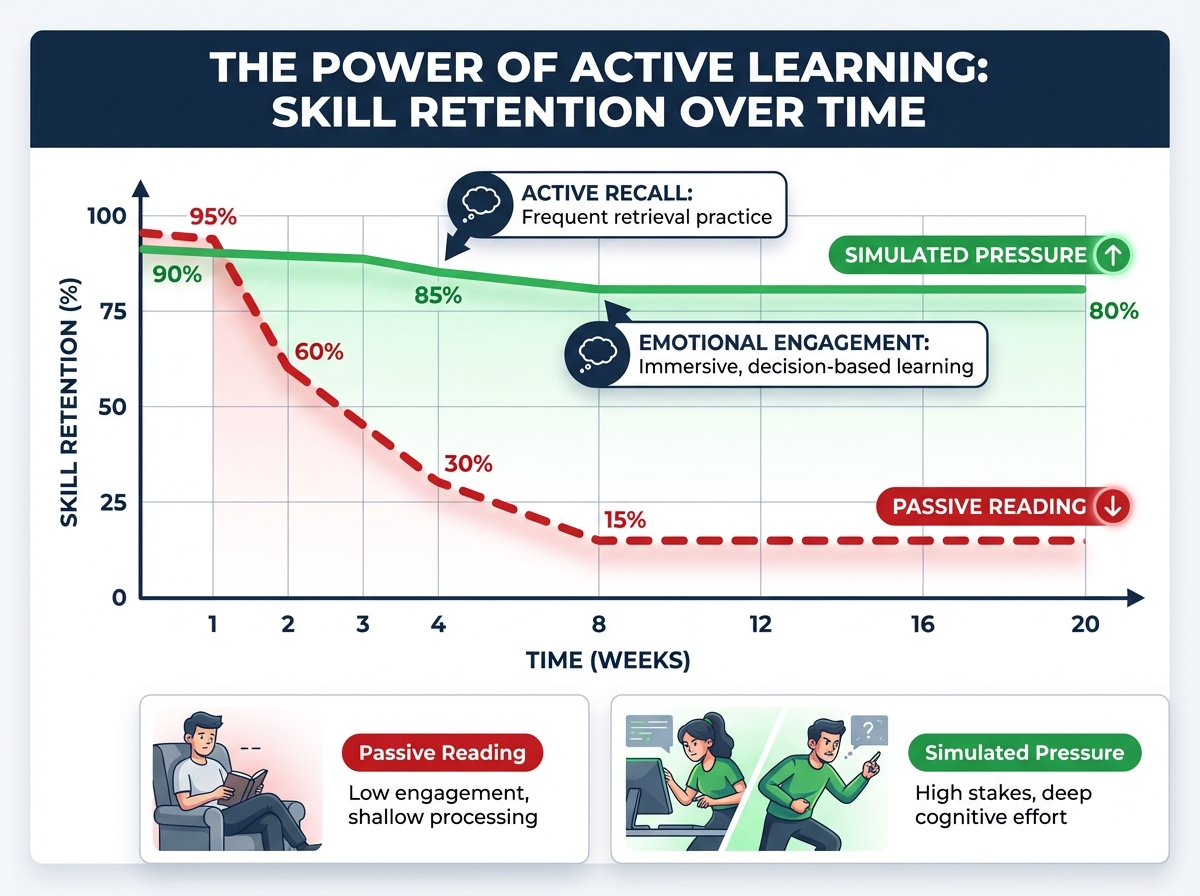
Simulation is only effective if it mimics the friction of the real world. If the practice is too easy, the "experience" gained is worthless. This is where the concept of Desirable Difficulty comes into play.
In a traditional job, you might wait weeks for a performance review. In a simulated environment, feedback is instant. However, you must structure the feedback to be actionable.
When using AI tools for simulation, use the "Do, Critique, Refine" loop:
This rapid iteration cycle allows you to compress a year's worth of improvement into a week of focused practice.
For students, the "End of Entry-Level" mindset applies to exams as well. Rote memorization is losing value. Exams are shifting toward synthesis and application.
Use AI to generate "Synthesis Questions." instead of asking "What year was the French Revolution?" ask the AI to: "Create an exam question that requires me to compare the economic causes of the French Revolution with the 2008 Financial Crisis, highlighting three distinct parallels."
By simulating the hardest possible version of the test, the actual exam becomes manageable.
The ultimate output of simulation is a portfolio. In the past, portfolios were for artists. Now, every knowledge worker needs one.
When you complete a Shadow Project or a complex simulation, document it. Write a case study: "How I used First Principles Thinking to solve a simulated supply chain bottleneck." Employers are less interested in where you worked and more interested in how you think.
By showing a portfolio of complex problems you have solved—even if they were simulated—you demonstrate that you have moved beyond the entry-level mindset.
While generic AI tools can generate text, true professional growth requires mentorship based on proven frameworks. This is where GPTnius distinguishes itself.
GPTnius offers AI Mentors trained on proprietary research analyzing the published works, philosophies, and proven methodologies of thought leaders, including thinkers like Charlie Munger. Our mentors do not impersonate anyone. They synthesize researched frameworks, such as mental models and inversion, into personalized coaching conversations built around your specific goals.
By practicing with mentors grounded in the best methodologies, you aren't just simulating work; you are simulating excellence.
> 💡 Master the Mental Models of Leaders > > Stop practicing in a vacuum. Use GPTnius AI Mentors to roleplay high-stakes scenarios and get feedback based on the world's most effective thinking frameworks. > > Meet the AI mentors built from this research →
It means that the basic, repetitive jobs often used to train new graduates are being automated by AI. Students now need to demonstrate higher-level problem-solving skills and practical experience before getting their first job.
You can use AI to simulate realistic work scenarios. Ask AI to act as a client, a boss, or a critic, and run through projects—like coding a feature, designing a marketing campaign, or negotiating a contract—to build a portfolio of 'synthetic' experience.
Yes, if it is documented well. Employers value the ability to solve problems. A portfolio showing how you tackled complex, simulated challenges demonstrates initiative and competence often missing in traditional resumes.