Unlock your potential with The Growth Mindset in 2025. Explore neuroscience-backed strategies, neuroplasticity, and AI learning to adapt and thrive.
In 2025, the growth mindset has evolved from a psychological concept to a biological imperative driven by neuroplasticity. This article explores how to leverage brain science and AI tools to accelerate learning, overcome the 'fixed' nature of anxiety, and strategically rewire your neural pathways for resilience.
---
For decades, the concept of the "Growth Mindset"—the belief that abilities can be developed through dedication and hard work—has been a cornerstone of personal development. However, as we navigate 2025, the landscape has shifted dramatically. We are no longer just competing with our peers; we are co-evolving with artificial intelligence. In this era of rapid technological acceleration, a growth mindset is no longer just a "nice-to-have" soft skill; it is a critical survival mechanism rooted in Neuroplasticity & Brain Health.
The static definition of intelligence is obsolete. The question is no longer "How smart are you?" but rather "How quickly can your brain reconfigure itself to absorb new information?" This guide moves beyond the basics of positive thinking to provide deep, neuroscience-backed strategies for rewiring your brain. We will explore how to harness the biological mechanisms of learning to thrive alongside AI, rather than fearing it.
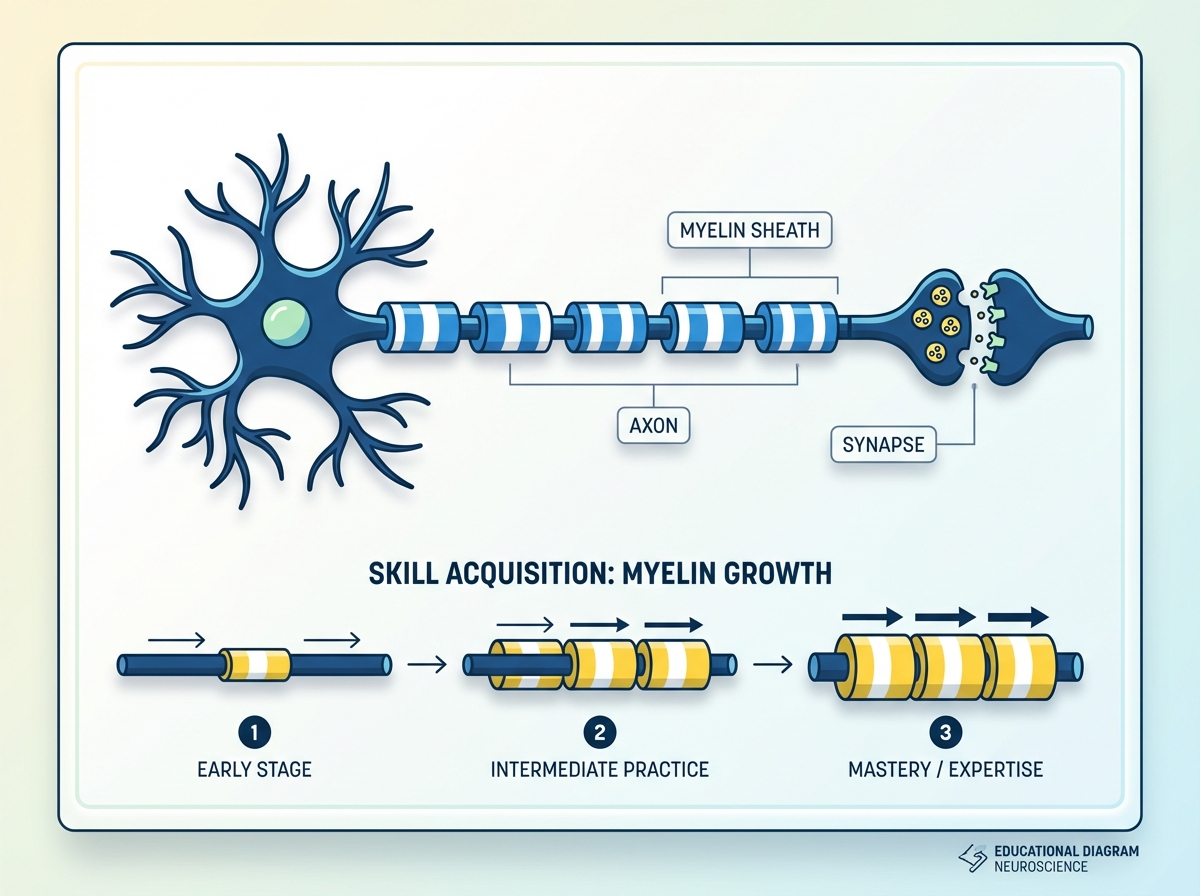
To truly adopt a growth mindset in 2025, one must understand the hardware: the human brain. The feeling of "growth" is actually the physical process of neuroplasticity in action. When you struggle with a new concept, your brain is not failing; it is signaling the release of neurochemicals required to build new neural pathways.
Every time you engage in intense focus to learn a new skill, two things happen:
A "Fixed Mindset" essentially halts this process. By avoiding challenges, you deny your brain the stimulus it needs to myelinate new circuits. In 2025, understanding this biological reality changes the narrative. You aren't "bad at math" or "bad at prompting AI"; you simply haven't built the myelin sheath for those circuits yet.
Research in neurobiology highlights the importance of the chemical environment of the brain during learning:
Actionable Strategy: To hack this cycle, engage in bouts of intense focus (triggering epinephrine and acetylcholine) followed by deep rest (Sleep/NSDR), which is when the actual rewiring takes place.
> 💡 Rewire Your Brain with Strategic Guidance > > Understanding neuroplasticity is the first step; applying it requires consistent feedback. GPTnius AI Mentors, trained on research analyzing the frameworks of cognitive experts, can help you identify the specific mental models needed to trigger this growth. > > Meet the AI mentors built from this research →
One of the greatest threats to The Growth Mindset in 2025 is the psychological pressure exerted by AI. The rapid advancement of Large Language Models (LLMs) can trigger a profound Fixed Mindset response: "The machine is faster than me, so why bother trying?"
This is a cognitive distortion. In the context of AI Learning, the goal isn't to out-compute the AI; it's to out-adapt it. Neuroscience tells us that anxiety inhibits the prefrontal cortex—the area responsible for executive function and learning. When you view AI as a threat, you biologically handicap your ability to learn how to use it.
Instead of viewing intelligence as a finite resource (zero-sum game between human and machine), view AI as a tool for "Cognitive Extension." Just as a telescope extends your vision, AI extends your reasoning.
To remain competitive, you need to be an active operator of your own brain's development. Here are three research-backed protocols to accelerate learning.
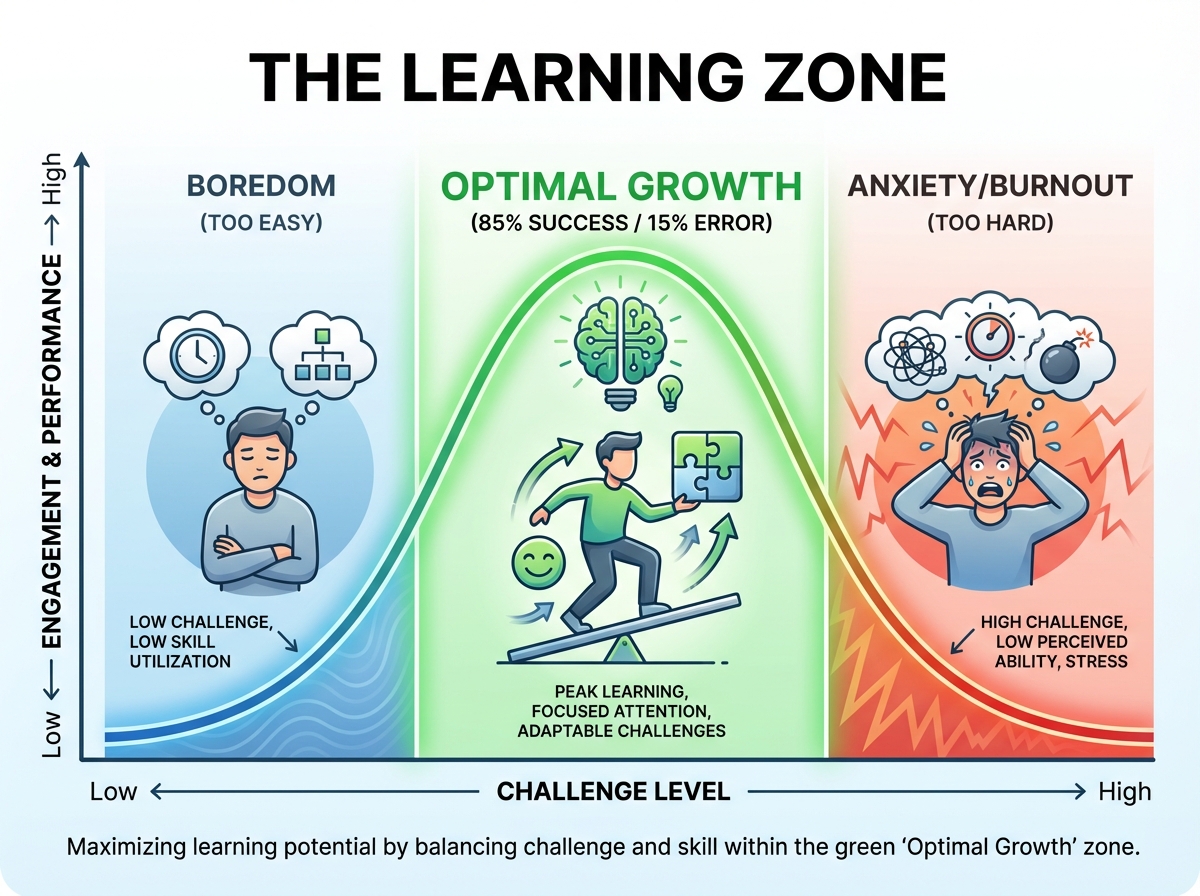
Research suggests that the "sweet spot" for learning is when you are succeeding about 85% of the time and failing 15% of the time. If you are succeeding 100% of the time, you are not learning; you are executing known patterns. If you are failing 50% of the time, the frustration (cortisol) may cause you to quit.
Application: When learning a new software or skill, intentionally push the difficulty until you start making errors. Those errors are not signs of incompetence; they are the alert signal your brain needs to trigger acetylcholine release, marking the error for correction.
In an age of instant answers, we often bypass the "struggle" phase of learning. However, the struggle is the learning. When you ask an AI for an answer immediately, you bypass the neural agitation required to encode the memory.
The Protocol:
James Clear’s research on habit formation (a framework analyzed by GPTnius mentors) suggests that long-term change is driven by identity, not outcomes. Neuroscientifically, this shifts the dopamine reward system.
Instead of getting a dopamine hit only when you finish a project (outcome), you train your brain to release dopamine when you engage in the behavior of a learner (identity). You reward yourself for the act of studying, not just the grade. This creates a sustainable loop of Personal Development.
Metacognition is "thinking about thinking." It is the highest form of learning. While AI can provide facts, its true power in 2025 lies in acting as a Socratic tutor.
The Feynman Technique involves explaining a concept in simple terms to identify gaps in your understanding. You can now simulate this with AI.
Prompt Strategy: "I am going to explain the concept of neuroplasticity to you. Please listen, and then point out any logical fallacies, gaps in my reasoning, or analogies that could be improved."
This forces your brain to retrieve and structure information (active recall), which is far more effective for myelination than passively reading a textbook.
Applying neuroscience-backed growth strategies requires more than just reading an article; it requires an interactive feedback loop. This is where GPTnius bridges the gap between theory and practice.
GPTnius offers AI Mentors trained on proprietary research analyzing the published works, philosophies, and proven methodologies of thought leaders, including leading researchers on mindset and neuroplasticity. Our mentors do not impersonate anyone. They synthesize researched frameworks, such as cognitive reframing and growth mindset strategies, into personalized coaching conversations built around your specific goals. Here is how this assists with the Growth Mindset:
By engaging in guided discussions with these AI Mentors, you move from passive consumption of self-help content to active application of proven principles.
> 💡 Master Your Mindset with AI Mentorship > > Don't let 2025 leave you behind. Leverage AI Mentors trained on the world's best problem-solving frameworks to build a resilient, adaptable brain. > > Meet the AI mentors built from this research →
The Growth Mindset in 2025 is about integrating the biological reality of neuroplasticity with the technological leverage of AI. It requires a shift from viewing intelligence as a fixed asset to viewing it as a dynamic process of circuit building. By embracing errors, managing your neurochemistry, and utilizing tools like GPTnius to guide your development, you can ensure that your brain remains your most valuable asset in an automated world. The future belongs to the adaptable.
In 2025, the distinction focuses on adaptability to technology. A Fixed Mindset views AI as a replacement for human intelligence, leading to anxiety and stagnation. A Growth Mindset views AI as a tool for cognitive extension, leveraging neuroplasticity to learn how to orchestrate AI tools effectively.
Neuroplasticity in adults is triggered by focus and alertness (releasing epinephrine and acetylcholine) which marks neurons for change, followed by deep rest or sleep, during which the actual rewiring and strengthening of connections occurs.
Yes. AI tools can be used to facilitate 'active recall' and the 'Feynman Technique,' acting as tutors that identify gaps in your knowledge. Furthermore, platforms like GPTnius offer mentors trained on research regarding habit formation and mental models to coach you through psychological barriers.