Discover the psychology behind building confidence through micro-achievements. Learn actionable strategies to break down goals and master self-efficacy.
We often look at successful leaders, elite athletes, or prolific creators and imagine they possess an innate, unshakeable reserve of self-assurance. We assume they wake up ready to conquer mountains. However, this perspective reverses the actual psychological mechanism at play. Confidence is rarely the cause of high achievement; it is usually the result.
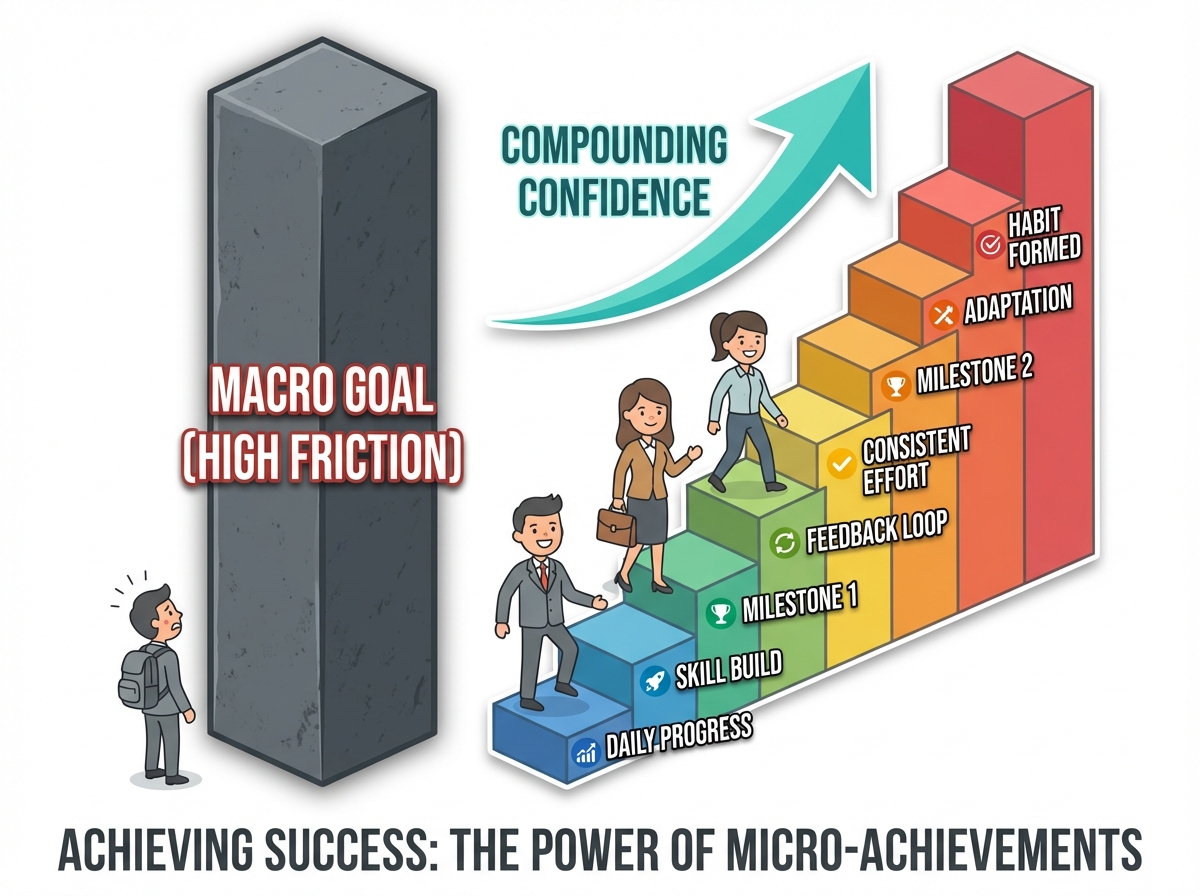
When we set ambitious goals—launching a startup, writing a novel, or transforming our physical health—the sheer magnitude of the task can be paralyzing. The gap between where we are and where we want to be creates a psychological friction known as the "intention-action gap." The larger the gap, the more likely we are to succumb to procrastination or impostor syndrome.
The solution lies in a counter-intuitive approach: thinking smaller. Building confidence through micro-achievements is a strategy rooted in behavioral psychology that focuses on the accumulation of tiny, undeniable victories. By shifting your focus from the summit to the single step directly in front of you, you can hack your brain’s reward system, silence your inner critic, and build a fortress of self-efficacy that stands the test of time.
To understand why micro-achievements work, we must look at the neuroscience of motivation. The human brain is wired to conserve energy and avoid failure. When faced with a massive, vague objective (e.g., "Get fit"), the brain’s amygdala (the fear center) may trigger a stress response, interpreting the unknown effort required as a threat.
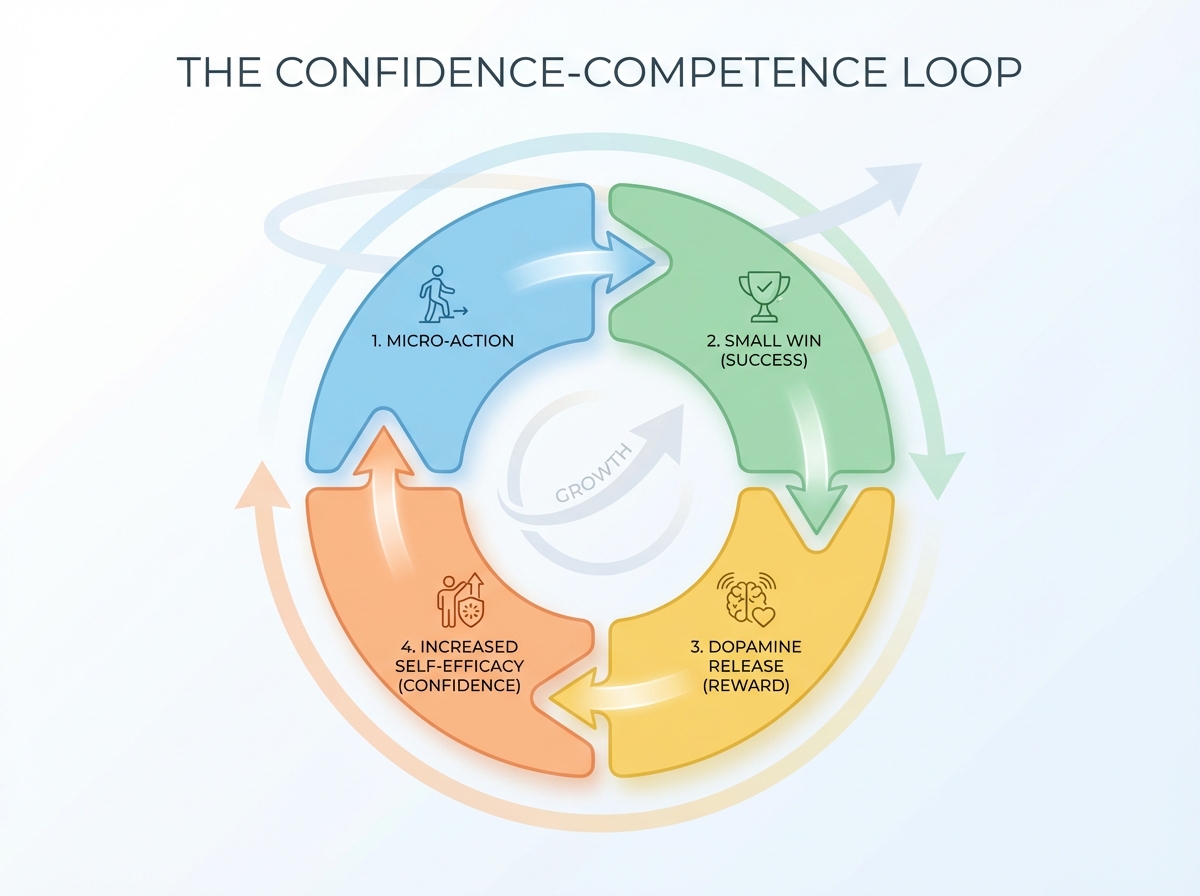
However, when a goal is shrunk to a micro-level (e.g., "Put on running shoes"), the threat response is bypassed. More importantly, completing that task triggers a release of dopamine. Dopamine is not just a pleasure chemical; it is a learning chemical. It reinforces the neural pathway that says, "I did what I said I was going to do."
Harvard Business School professor Teresa Amabile and psychologist Steven Kramer conducted extensive research into what motivates people. Their findings, dubbed The Progress Principle, suggest that of all the things that can boost emotions, motivation, and perception during a workday, the single most important is making progress in meaningful work.
Crucially, this progress does not need to be monumental. Minor milestones, when recognized, provide the same psychological fuel as major breakthroughs. This creates a positive feedback loop:
> 💡 Stop Dreaming, Start Doing > > The gap between your big goals and your current reality can be paralyzed by overthinking. GPTnius AI Mentors help you break that paralysis by turning abstract ambitions into concrete, daily steps based on proven frameworks. > > Meet the AI mentors built from this research →
Building confidence through micro-achievements requires a strategic approach to goal decomposition. It is not enough to simply "do less"; you must do the right small things that align with a larger trajectory.
Most people set goals at a "project" level. A project is a collection of tasks. You cannot "do" a project; you can only do the tasks that comprise it. To harness micro-achievements, you must break projects down until the first step requires almost zero resistance.
By lowering the barrier to entry, you eliminate the friction of starting. Once you have written three bullet points, the laws of physics—specifically inertia—take over. An object in motion tends to stay in motion. You are far more likely to write a paragraph after writing three bullets than you are to write a paragraph from a standing start.
James Clear, author of Atomic Habits, argues that every action you take is a vote for the type of person you wish to become. Micro-achievements are effectively casting votes for a new identity.
If you want to be a runner, running a marathon is a massive vote. But putting on your running shoes every single morning is a series of hundreds of small votes. Over time, the sheer volume of these micro-achievements convinces your subconscious mind: "I am the kind of person who runs." This identity shift is far more durable than the fleeting motivation of a New Year's resolution.
The biggest enemy of micro-achievements is the ego. High achievers often feel that small steps are beneath them. We tell ourselves, "Writing 50 words is pathetic; I should be writing 1,000." or "Walking for 10 minutes doesn't count; I need to do an hour of HIIT."
This is the "Not Enough" trap. It stems from a misunderstanding of compound interest. Just as finances compound over time, so do habits and confidence.
When you rely on massive achievements for confidence, failure is devastating. If you fail to run the marathon, your confidence collapses. However, when your confidence is built on micro-achievements, a single missed step is insignificant.
Because the stakes of micro-tasks are low, the fear of failure diminishes. If you fail to write your three bullet points today, it doesn't shatter your identity. You simply try again in an hour. This resilience is a key component of emotional intelligence and personal growth. It allows you to view setbacks not as a judgment on your character, but as data points to adjust your system.
To begin building confidence through micro-achievements, you need a system to capture and execute these small wins. Here are three frameworks to integrate into your daily life.
Derived from productivity methodology, this rule states: If a task takes less than two minutes, do it immediately. If a new habit takes effort, scale it down until it takes less than two minutes to do.
To-do lists are often sources of anxiety—reminders of what you haven't done. A "Done" list is a record of your micro-achievements. At the end of the day, write down the small wins you accumulated.
Reviewing this list provides visual proof of your competence, reinforcing the confidence loop.
Jerry Seinfeld famously used a calendar to track his writing. Every day he wrote a joke, he put a red X on that day. His goal was simply: "Don't break the chain."
The visual chain serves as a micro-achievement in itself. Adding the X is the reward. This externalizes your progress, making your confidence visible rather than abstract.
Understanding the theory of micro-achievements is the first step; applying it consistently is where the challenge lies. This is where GPTnius bridges the gap between knowledge and action.
GPTnius offers AI Mentors trained on proprietary research analyzing the published works, philosophies, and proven methodologies of thought leaders, including leading researchers on habit formation and motivation. Our mentors do not impersonate anyone. They synthesize researched frameworks, such as the progress principle and atomic habit systems, into personalized coaching conversations built around your specific goals. When you feel overwhelmed by a large goal, your mentor can help you:
By interacting with an AI Mentor trained on these specific methodologies, you aren't just reading about confidence; you are actively practicing the cognitive restructuring required to build it.
> 💡 Build Your Confidence Stack Today > > Don't let the magnitude of your goals stop you from starting. Let a GPTnius AI Mentor guide you in defining, tracking, and celebrating the micro-achievements that lead to massive success. > > Meet the AI mentors built from this research →
Confidence is not a lightning bolt that strikes from the sky; it is a wall built brick by brick. By shifting your focus from the intimidating horizon to the ground beneath your feet, you regain control. You move from a state of paralysis to a state of agency.
Building confidence through micro-achievements is about respecting the process of growth. It is an acknowledgment that big things are merely a collection of small things done well. Start small. Start today. And let the momentum of your micro-wins carry you toward your macro-potential.
Micro-achievements are small, manageable tasks that are easily completed in a short amount of time. They serve as stepping stones toward larger goals, reducing overwhelm and providing immediate psychological rewards.
Completing small tasks triggers the release of dopamine and reinforces self-efficacy. This creates a positive feedback loop where success breeds more success, gradually altering your self-perception from hesitant to capable.
Yes. Platforms like GPTnius use AI Mentors trained on research regarding habit formation and psychology to help users break down goals, track progress, and provide personalized coaching to maintain consistency.