Learn how to build creative confidence using principles from David Kelley. Discover actionable exercises to overcome the fear of failure and unlock innovation.
For decades, a pervasive myth has stifled innovation in boardrooms, classrooms, and living rooms across the world: the idea that creativity is a genetic trait possessed by a select few. You are either born "creative," or you are not. If you can’t draw, compose music, or sculpt, you belong in the "analytical" or "practical" bucket.
This binary view is not only false; it is destructive. It prevents brilliant problem-solvers from sharing their ideas because they fear judgment. It stops professionals from suggesting process improvements because they don't see themselves as innovators.
David Kelley, the founder of IDEO and the Stanford d.school, has spent his career dismantling this myth. Through his work in design thinking and the principles outlined in the David Kelley Creative Confidence book (co-authored with his brother Tom Kelley), he argues that creativity is the natural state of the human mind. The problem isn't a lack of capability; it is a surplus of fear.
Creative confidence is the belief in your ability to change the world around you. It is the conviction that you can achieve what you set out to do. When you have creative confidence, you don't just come up with ideas; you have the resilience to act on them, test them, and iterate upon them despite the risk of failure.
To understand how to build creative confidence, we first have to understand what destroys it. Most children are naturally creative. They build, draw, pretend, and experiment without self-censorship. However, as we age, a specific type of fear begins to take root: the fear of social judgment.
Kelley often cites the work of psychologist Albert Bandura regarding "self-efficacy"—the belief that you can change a situation and accomplish what you set out to do. When self-efficacy is low, people view difficult tasks as threats to be avoided. When it is high, they view them as challenges to be mastered.
In the context of creativity, four specific fears often hold us back:
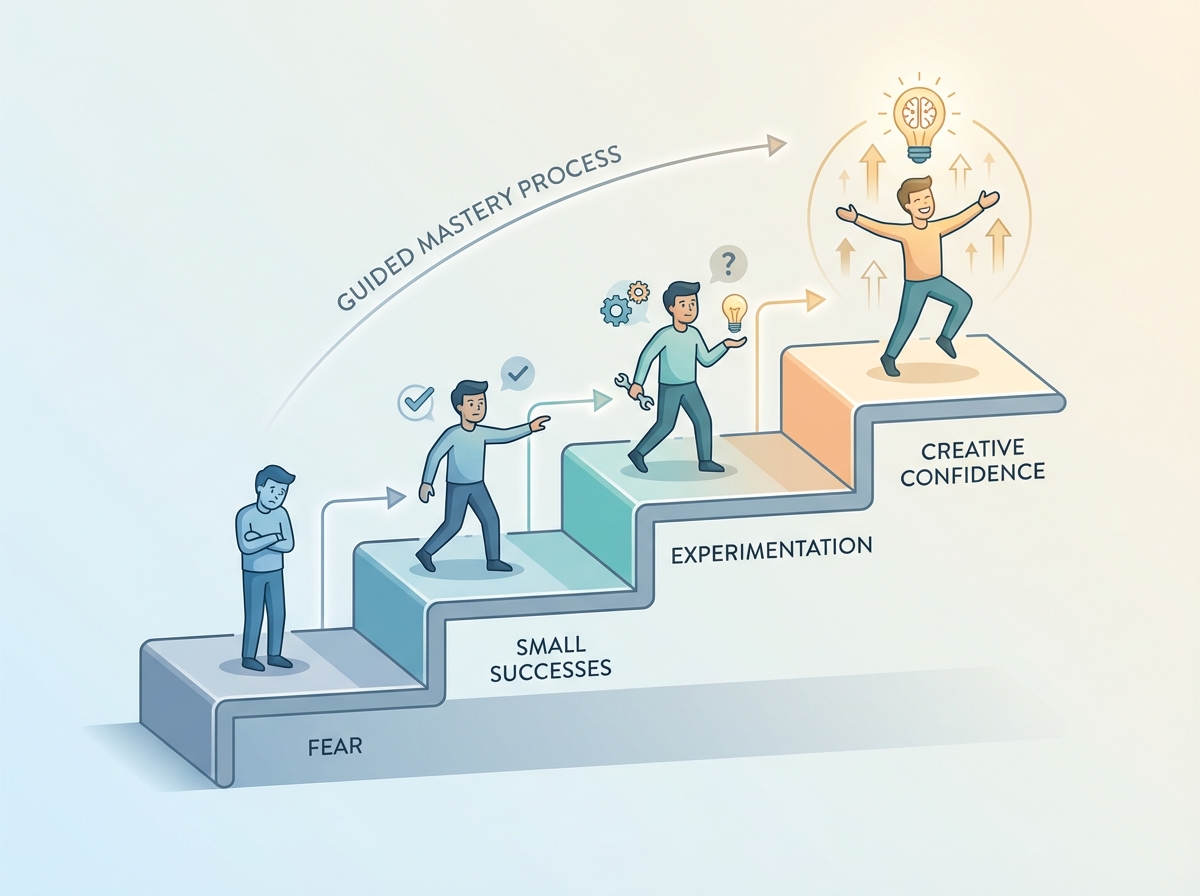
The antidote to these fears is not blind optimism. It is a psychological process known as Guided Mastery. This involves breaking a large, terrifying challenge into a series of small, manageable successes. By experiencing small wins, you slowly rewrite your internal narrative from "I can't do this" to "I am figuring this out."
> 💡 Break Through the Fear Barrier > > Fear of failure often stems from a lack of structured feedback. GPTnius AI Mentors, trained on proprietary research analyzing the methodologies of resilience experts and design thinkers, can help you deconstruct your fears into actionable micro-steps. > > Meet the AI mentors built from this research →
You cannot think your way into creative confidence; you have to act your way into it. Here are proven creative confidence exercises designed to lower the stakes and increase your tolerance for experimentation.
Creativity often starts with observation. Many people walk through life ignoring friction points. To build your creative muscles, start a "Bug List."
One of the biggest hurdles to overcoming fear of failure in creativity is the attachment to the "perfect" final product. Design thinking advocates for "thinking with your hands."
Borrowed from improvisational comedy, this technique is essential for team creativity. In many meetings, ideas are met with "Yes, but..." which effectively kills momentum. "But" indicates a roadblock.
Fostering creative confidence in the workplace requires a shift in leadership style. It is not enough for an individual to be confident; the environment must support it. Leaders must transition from being "gatekeepers" of ideas to "gardeners" who nurture them.
Google’s Project Aristotle found that psychological safety—the belief that you won’t be punished for making a mistake—was the number one predictor of high-performing teams. To build this:
The journey to unlocking creative confidence is effectively a journey of self-efficacy. It is about proving to yourself, through repeated action, that you are capable of navigating ambiguity. Whether you are an accountant, a teacher, or a CEO, the ability to approach problems with curiosity rather than fear is the ultimate competitive advantage.
When you stop dividing the world into "creatives" and "non-creatives," you realize that innovation is a capacity waiting to be unlocked in everyone. The only thing standing between you and your creative potential is the permission you give yourself to fail, learn, and try again.
Reading about creative confidence is inspiring, but applying it when you are staring at a blank screen or facing a skeptical boss is difficult. This is where GPTnius can bridge the gap between theory and practice.
GPTnius offers AI Mentors that have been trained on proprietary research analyzing the published works, philosophies, and proven methodologies of thought leaders in design thinking and behavioral psychology.
Here is how these AI Mentors can assist you:
By engaging in guided discussions with an AI Mentor, you can turn the abstract concept of creative confidence into a daily habit.
> 💡 Design Your Creative Future > > Don't let the fear of failure keep your best ideas locked away. Access AI Mentors trained on the world's best frameworks for innovation and start building your creative confidence today. > > Meet the AI mentors built from this research →
Creative confidence is the belief in your ability to create change in the world around you. It is the conviction that you can achieve what you set out to do, combined with the resilience to persist through failure.
Creative confidence is not about artistic skill; it is about problem-solving. You can build it through 'guided mastery'—taking small, manageable steps to solve problems, practicing rapid prototyping, and adopting a growth mindset.
The Bug List is a technique where you write down things that annoy you or don't work well in your daily life. It trains your brain to notice opportunities for improvement and innovation rather than just accepting the status quo.