Master the art of Blitzscaling. Learn how to prioritize speed over efficiency to achieve hypergrowth, based on the strategies of Reid Hoffman.
Blitzscaling is a high-risk, high-reward strategy designed to help companies grow at a lightning-fast pace to achieve a massive competitive advantage. By prioritizing speed over efficiency in uncertain environments, businesses can capture market share before competitors react. This guide explores the mechanics of Blitzscaling, the transition through growth stages (from Family to Nation), and the management innovations required to survive the journey.
---
In the modern digital economy, the adage "slow and steady wins the race" is often a recipe for irrelevance. When a market is up for grabs, the winner is usually the first to scale. This is the core premise of Blitzscaling, a concept popularized by LinkedIn co-founder Reid Hoffman and co-author Chris Yeh.
Blitzscaling is not just about growing fast; it is about growing at a pace that feels uncomfortable, unsustainable, and chaotic—and doing it deliberately. It is the science and art of building a company that serves millions of customers in record time.
Whether you are a startup founder looking to disrupt an industry or a corporate leader seeking to innovate from within, understanding the mechanics of hypergrowth is essential. This article provides a comprehensive look at the Blitzscaling strategy, how to implement it, and how to navigate the treacherous waters of rapid expansion.
At its core, Blitzscaling is a strategy that prioritizes speed over efficiency in an environment of uncertainty.
To understand this definition, we must contrast it with other forms of growth:
Why would anyone choose inefficiency? Because in a connected world, many markets are governed by "winner-take-most" or "winner-take-all" dynamics. If you are the first to reach critical mass, you establish a defensive moat—usually through network effects—that makes it nearly impossible for competitors to catch up. Think of Airbnb, Uber, or LinkedIn. Once they achieved scale, their value to the user increased exponentially, locking out competition.
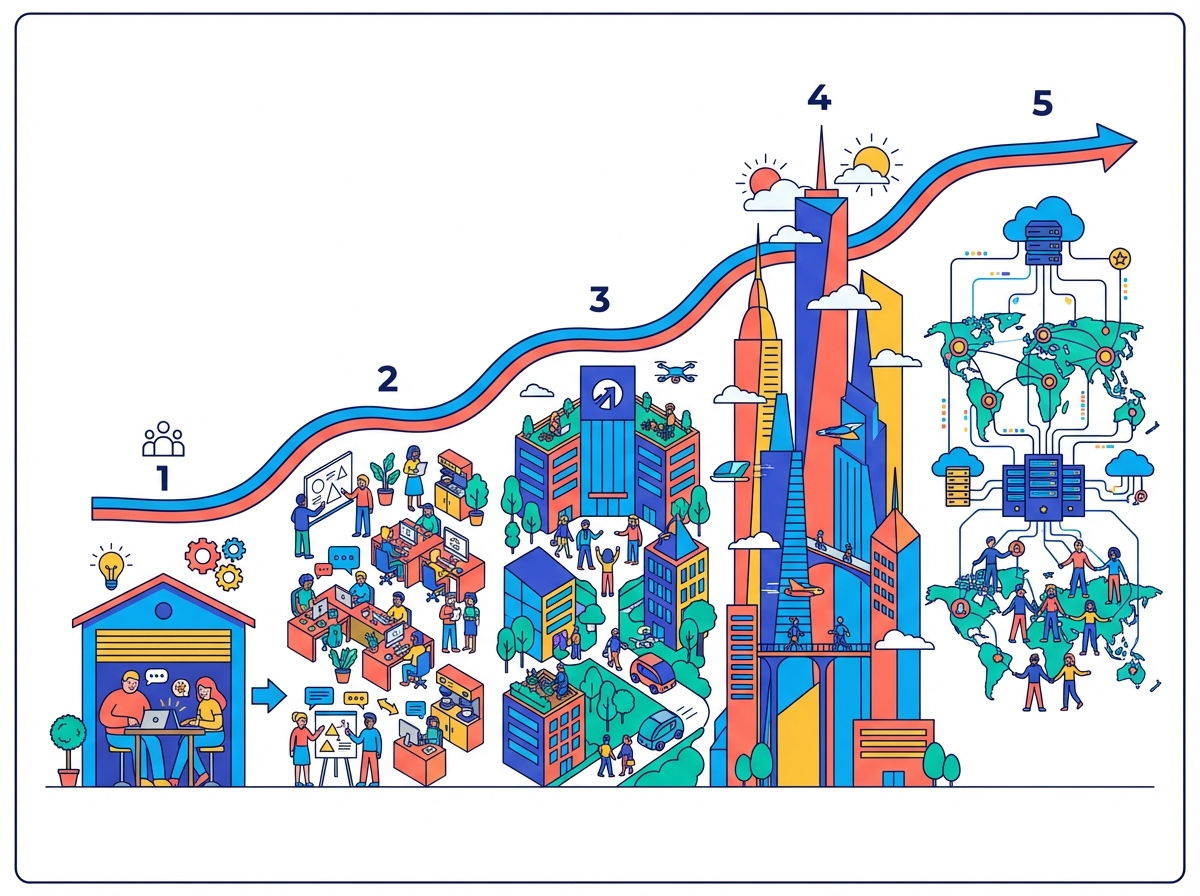
Reid Hoffman’s framework breaks down the lifecycle of a company into five distinct stages, based on the number of employees. As you move from one stage to the next, everything breaks—your management style, your communication channels, and your culture.
> 💡 Stuck Between a Tribe and a Village? > > Navigating the transition from a small team to a structured organization is one of the hardest challenges in business. GPTnius AI Mentors can help you simulate difficult management conversations and restructure your leadership approach using proven mental models. > > Meet the AI mentors built from this research →
To successfully Blitzscale, you cannot just hire more people and buy more ads. You need to innovate across three specific dimensions.
Technology is not enough. You need a business model that allows for exponential growth. A scalable business model typically possesses:
The strategy of Blitzscaling requires doing things that traditional MBAs would consider "wrong."
This is perhaps the most difficult aspect. As you scale from a Tribe to a Village to a City, you must constantly reinvent how you manage.
Not every company should Blitzscale. If you apply these techniques to a low-margin business without network effects (like a local restaurant), you will simply go bankrupt faster.
Checklist for Suitability:
Blitzscaling is dangerous. If you lose control of the vehicle while driving at 200mph, the crash is fatal. Here are the common traps:
Founders often hesitate to spend money inefficiently. They want to perfect the product before launching or optimize the supply chain before scaling. In a Blitzscaling scenario, this hesitation allows a competitor to seize the market.
When you hire hundreds of people a month, culture dilutes rapidly. If you don't codify your values early, you risk creating a toxic environment. Bad behavior can be overlooked in favor of results, leading to long-term reputational damage (a phenomenon Hoffman calls "Glauconian" risk).
It is acceptable to have negative unit economics initially, but eventually, the math must work. If you scale a business where you lose money on every transaction forever (with no path to profitability), you aren't Blitzscaling; you are just lighting money on fire.
Understanding the theory of Blitzscaling is one thing; making high-stakes decisions in the heat of the moment is another. This is where GPTnius provides a distinct advantage.
GPTnius offers AI Mentors trained on proprietary research analyzing the published works, philosophies, and proven methodologies of thought leaders, including thinkers like Reid Hoffman. Our mentors do not impersonate anyone. They synthesize researched frameworks, such as the five stages of growth and speed-over-efficiency decision making, into personalized coaching conversations built around your specific goals.
Here is how GPTnius can assist your growth strategy:
By engaging in guided discussions, you can apply these complex principles directly to your unique challenges, turning abstract theory into an actionable roadmap.
> 💡 Ready to Architect Your Hypergrowth Strategy? > > Don't navigate the chaos of scaling alone. Access AI Mentors trained on the world's best business frameworks to validate your strategy and keep your growth on track. > > Meet the AI mentors built from this research →
Blitzscaling is the specific strategy that separates the global giants from the average players. It requires a shift in mindset—accepting uncertainty, embracing inefficiency, and prioritizing speed above all else. However, it is not a strategy to be taken lightly. It requires a business model that supports it and a leadership team capable of evolving rapidly.
By understanding the stages of growth and utilizing tools to navigate the management challenges, you can harness the power of Blitzscaling to build an enduring, world-changing company.
The main difference lies in uncertainty. Fast scaling involves growing rapidly in an environment of certainty (you know the model works). Blitzscaling involves prioritizing speed over efficiency in an environment of uncertainty, taking calculated risks to capture market share before the business model is fully polished.
Reid Hoffman defines the 5 stages based on employee count: The Family (1-9), The Tribe (10-99), The Village (100-999), The City (1,000-9,999), and The Nation (10,000+). Each stage requires a different management approach.
No. Blitzscaling is best suited for businesses with high gross margins and strong network effects where a 'winner-take-all' dynamic exists. Low-margin businesses or service-based companies without scalability may fail if they attempt to blitzscale.