Unlock the power of Reid Hoffman's network effects. Explore the 5 types of network effects, real-world examples, and strategies to build a defensible business moat.
In the digital age, the difference between a successful small business and a billion-dollar unicorn often comes down to one specific structural advantage: Network Effects.
Reid Hoffman, co-founder of LinkedIn and partner at Greylock, has famously argued that in the networked age, you cannot build a massive company without them. They are the underlying force behind the rapid ascent of companies like Facebook, Uber, Airbnb, and, of course, LinkedIn. But network effects are frequently misunderstood or confused with simple virality. While virality is about growth (getting users), network effects are about value and defensibility (keeping users and locking out competitors).
If you are building a startup or refining a business strategy, understanding the nuances of the network effect business model is not optional—it is the prerequisite for scale. This guide explores the mechanics of network effects as analyzed by thought leaders like Hoffman, categorizing the different types and offering a roadmap for engineering them into your product.
At its core, a network effect exists when the utility or value of a product or service increases for every existing user as a new user joins.
It is a phenomenon of positive feedback loops. In a traditional business, adding a new customer adds revenue, but it doesn't necessarily make the product better for the previous customer. In a business driven by network effects, every new participant adds value to the ecosystem, creating a formidable barrier to entry for competitors—often referred to as a "moat."
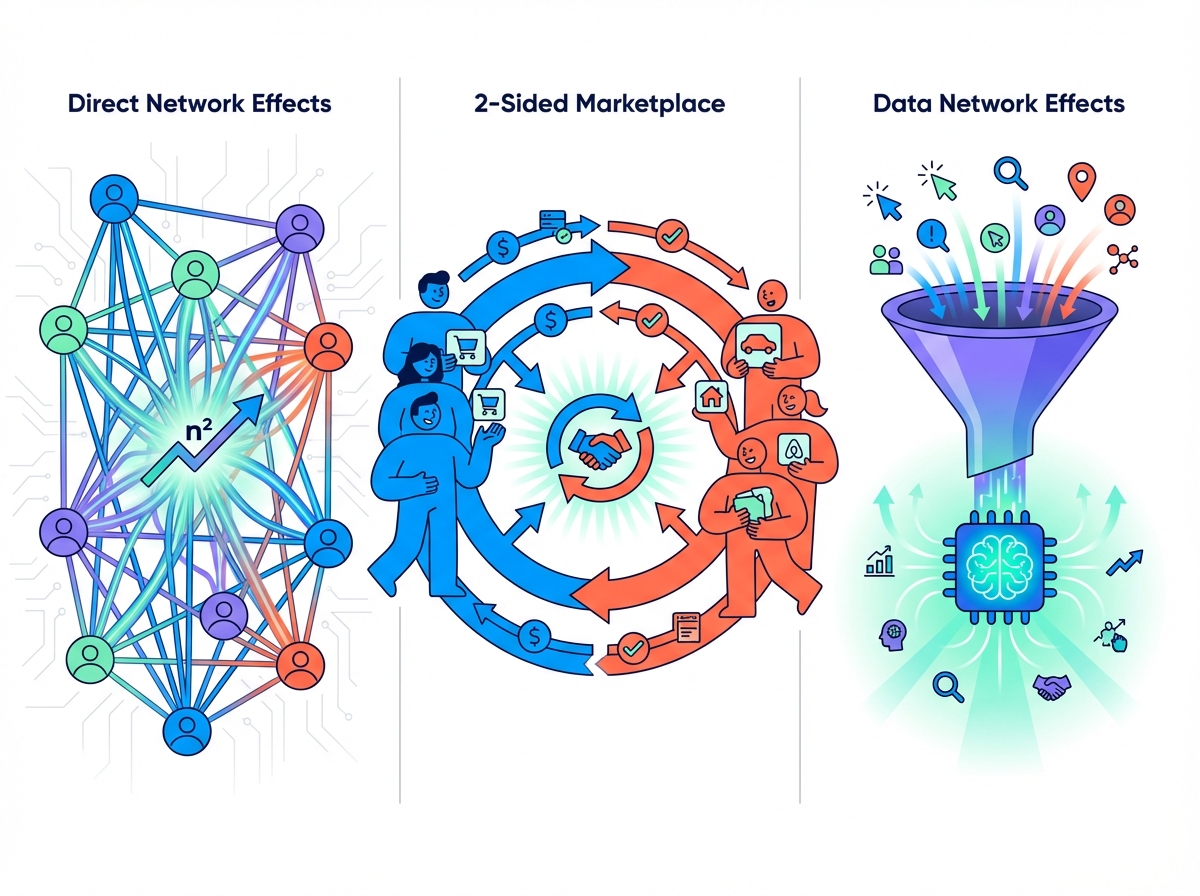
Reid Hoffman often cites the difference between the linear growth of traditional manufacturing and the exponential utility of networked software. This concept is mathematically rooted in Metcalfe’s Law, which states that the value of a telecommunications network is proportional to the square of the number of connected users ($n^2$).
> 💡 Identify Your Growth Engine > > Struggling to determine if your product has potential for network effects or just viral growth? Our AI Mentors can help you analyze your business model against proven frameworks. > > Meet the AI mentors built from this research →
While many theorists categorize network effects differently, research into Reid Hoffman’s philosophies and the investment theses of Greylock highlights several distinct categories. Understanding which one applies to your business is critical for your go-to-market strategy.
This is the simplest and strongest form. An increase in usage leads to a direct increase in value for all other users.
This occurs when two distinct user groups provide each other with network benefits. The classic example is buyers and sellers.
In the age of AI and Big Data, this is becoming the most sought-after moat. This effect happens when a product grows smarter and more valuable as it gathers more data from its users.
This occurs when the technology itself functions better or faster as the network grows. This is common in peer-to-peer (P2P) technologies.
Sometimes called "bandwagon effects," these are psychological but powerful. The value comes from the fact that "everyone else is doing it," creating a shared language or standard.
Investors love network effect examples because they are the only protective barrier that gets stronger as the company grows.
Most competitive advantages (proprietary tech, low prices, brand) degrade over time. Competitors can reverse-engineer code or undercut prices. However, copying a network is nearly impossible once it reaches "critical mass."
Consider Google Plus. Google had better technology, infinite capital, and massive distribution. Yet, they could not displace Facebook. Why? Because Facebook had the network effect. Users didn't stay on Facebook because the code was better; they stayed because their friends were there. To compete, Google didn't just need a better product; they needed to move everyone's friends over simultaneously.
Knowing the types of network effects is academic; applying them is strategic. Here is how to engineer these loops into your business, drawing on strategies often discussed in the context of Blitzscaling.
Every network starts with zero users. To get the flywheel spinning, you often have to do things that don't scale.
In 2-sided marketplaces, supply is usually harder to acquire than demand.
If your value proposition relies on mass adoption, any barrier to entry is a killer.
Reid Hoffman’s own masterpiece, LinkedIn, utilized a specific strategy: Professional Identity. By allowing users to host their resume online (Single-Player Mode), they attracted users. Once enough professionals were there, the value shifted to recruiting and networking (Network Effect). Today, LinkedIn has a monopoly on professional data.
MySpace had network effects, but they were weak. The network was based on anonymity and customization, not real-world identity. When Facebook offered a "real identity" graph, the network effect proved stronger. Users migrated because the quality of the connections on Facebook was higher, proving that not all networks are created equal.
Understanding the theory of network effects is one thing; applying it to your specific business model is another. This is where GPTnius bridges the gap.
GPTnius offers AI Mentors trained on proprietary research analyzing the published works, philosophies, and proven methodologies of thought leaders, including thinkers like Reid Hoffman. Our mentors do not impersonate anyone. They synthesize researched frameworks, such as the five types of network effects, into personalized coaching conversations built around your specific goals.
Through personalized coaching conversations, you can:
> 💡 Build Your Moat with Expert Guidance > > Don't leave your strategy to chance. Leverage AI Mentors trained on the methodologies of world-class business strategists to engineer your own network effects. > > Meet the AI mentors built from this research →
Network effects are the most powerful force in the technology industry. They account for the majority of value creation in the digital economy over the last two decades. By understanding the different types of network effects—Direct, 2-Sided, Data, Tech Performance, and Social—you can move beyond simple growth tactics and start building a business with true structural defensibility.
Whether you are solving the Cold Start problem or trying to transition from a SaaS tool to a marketplace, the principles championed by Reid Hoffman provide the blueprint. The goal is not just to acquire customers, but to build a system where every customer works for you, adding value simply by being there.
Viral effects are about the speed of customer acquisition (growth), where users bring in other users. Network effects are about value and defensibility (retention), where the product becomes more valuable as more people use it. A product can be viral without having network effects.
The Cold Start Problem refers to the difficulty of launching a networked product when there are no users. Since the value of the product depends on other users being there, early adopters have little incentive to join. Companies solve this by targeting micro-niches (Atomic Networks) or building single-player utility first.
Yes. Small businesses can leverage local network effects or 'Atomic Networks.' For example, a local community app becomes valuable to a small town once a critical mass of that specific town joins, even if the rest of the world doesn't use it.