Discover how to adopt an infinite mindset. This comprehensive Simon Sinek Infinite Game summary covers the 5 essential practices for sustainable leadership.
Business is not a game you can win; it is an infinite game where the goal is to keep playing. This guide explores Simon Sinek's framework for adopting an infinite mindset, detailing the five essential practices—from defining a Just Cause to embracing Existential Flexibility—that allow leaders to build resilient organizations capable of outlasting the competition.
---
In the modern corporate landscape, the language of leadership is often riddled with military metaphors and sports analogies. Executives speak of "winning" the quarter, "beating" the competition, and being "number one" in their market. While these objectives provide a rush of adrenaline, they are fundamentally flawed. They assume that business is a game with a fixed endpoint, clear rules, and a declared winner.
According to leadership expert Simon Sinek, this is a dangerous misconception. Business is not a finite endeavor; it is an Infinite Game.
Leaders who treat business as a finite game—prioritizing short-term profits over long-term viability—may achieve temporary spikes in performance, but they inevitably drain the will and resources of their organization. Conversely, leaders who embrace an infinite mindset build stronger, more innovative, and more inspiring organizations. They don't play to win; they play to keep playing.
This comprehensive guide explores the core principles of Sinek’s philosophy, offering a detailed Simon Sinek Infinite Game summary and actionable strategies to help you transition from a short-term operator to a visionary leader.
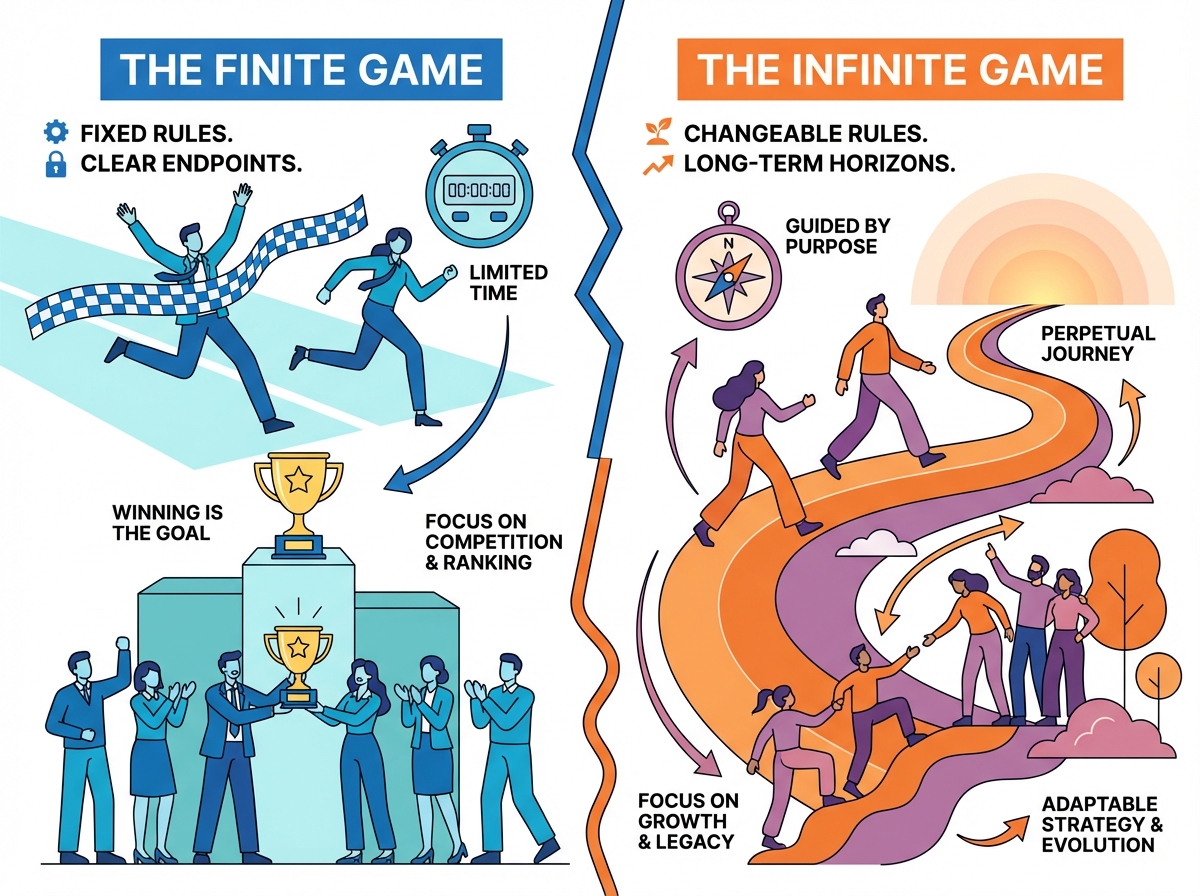
To understand how to lead effectively, one must first understand the game they are playing. Game theory, originally popularized by mathematician James P. Carse, distinguishes between two types of games:
Finite games have known players, fixed rules, and an agreed-upon objective. There is a clear beginning, middle, and end. Examples include baseball, chess, or a presidential election. The goal is simple: To win.
When the game ends, the players go home, and the trophy is awarded. In a business context, finite-minded leaders are obsessed with metrics that act as scoreboards: quarterly earnings, stock price, and market share. They view their counterparts as adversaries to be defeated.
Infinite games, in contrast, have both known and unknown players. The rules are changeable, and there is no defined finish line. The objective is not to win—because there is no winning—but to perpetuate the game.
Business, politics, and life itself are infinite games. Companies may come and go, but the game of commerce continues. There is no such thing as "winning business." You cannot be the winner of a game that never ends. You can only be ahead or behind.
The primary cause of struggle in many organizations is that they are playing a finite game within an infinite context. When a leader plays to win in a game that has no finish line, they make decisions that sabotage their own future. They cut R&D to meet quarterly projections, they sacrifice employee trust for efficiency, and they view quality as a cost rather than an investment.
> 💡 Shift Your Mindset from Winning to Lasting > > Struggling to differentiate between short-term wins and long-term viability in your current strategy? Our AI Mentors can help you analyze your decisions through the lens of infinite game theory. > > Meet the AI mentors built from this research →
Before diving into the solution, it is crucial to recognize the symptoms of a finite mindset. Companies led by finite players often suffer from a distinct decline in culture and innovation.
To avoid these pitfalls, leaders must adopt the five essential practices of the infinite mindset.
How to play the infinite game effectively requires a fundamental shift in behavior. Sinek identifies five specific practices that leaders must cultivate.
A Just Cause is a specific vision of a future state that does not yet exist but is so appealing that people are willing to make sacrifices to help advance it. It is different from a "Why" (which comes from the past/origin story); a Just Cause is about the future.
For a cause to be legitimate, it must be:
Example: The Declaration of Independence articulates a Just Cause regarding equality and liberty. We will never fully achieve it, but we strive toward it every day. In business, a Just Cause acts as a North Star, guiding decisions even when they are difficult.
Innovation cannot happen without risk, and risk cannot happen without trust. In an infinite game, leaders must prioritize Psychological Safety.
In finite cultures, performance is often valued over trust. Sinek famously uses the Navy SEALs matrix to explain this. The SEALs evaluate candidates on two axes: Performance (skills on the battlefield) and Trust (character off the battlefield). They would rather have a medium performer with high trust than a high performer with low trust. The high performer with low trust is a toxic leader who destroys the team.
Actionable Insight: Create an environment where employees can say, "I made a mistake," or "I don't know the answer," without fear of humiliation or retribution. When people feel safe, they share information, collaborate, and solve problems proactively.
In a finite game, you have competitors. You want to beat them. In an infinite game, you have Worthy Rivals.
A Worthy Rival is another player in the game who is worthy of comparison. They may do something better than you—perhaps their product is superior, or their culture is stronger. Instead of trying to destroy them, an infinite-minded leader studies them.
Worthy Rivals reveal your weaknesses. If a rival releases a better product, a finite leader gets angry or litigious. An infinite leader gets inspired and asks, "How can we improve?" This shift transforms the energy of competition into fuel for self-improvement.
Existential Flexibility is the capacity to initiate an extreme disruption to a business model or strategic course in order to more effectively advance a Just Cause.
This is the most dramatic practice. It occurs when a leader realizes that the path they are on, while perhaps profitable now, will not lead them to their vision in the future. They must be willing to "burn the boats" and pivot, even if it means short-term financial pain.
The Classic Example: In 1979, Steve Jobs saw the Graphical User Interface (GUI) at Xerox PARC. At the time, Apple was already successful. However, Jobs realized that the GUI was the key to his Just Cause: making technology accessible to individuals. He scrapped his current roadmap to build the Macintosh. It was a massive risk, but it aligned with the infinite vision. Xerox, a finite player, sat on the technology because they were worried it would cannibalize their copier business.
Adopting an infinite mindset is not easy. The pressure from Wall Street, investors, and the board to deliver short-term results is immense. It takes Courage to Lead to stand up to these pressures and make decisions that prioritize the long-term health of the organization over this quarter's earnings.
Courage is not an internal fortitude you conjure up alone; it is derived from the strength of your Just Cause and the support of your Trusting Team. Leaders must be willing to change the rules, ignore the arbitrary metrics of the finite game, and stay true to their vision.
Transitioning to an infinite mindset doesn't happen overnight. Here is a practical roadmap for applying these principles:
Look at what you measure. Do your KPIs encourage short-term hacking or long-term growth? If you only reward sales closings and ignore customer retention or employee satisfaction, you are playing a finite game. Introduce metrics that track the health of your culture and the loyalty of your customers.
Most corporate vision statements are generic ("To be the leading provider of..."). Rewrite yours to reflect a Just Cause. It should be a statement of the world you hope to build, not the company you hope to build.
Stop talking about "beating" the competition in meetings. Start asking, "Is this decision helping us advance our cause?" or "What did our Worthy Rival teach us this week?" changing the vernacular changes the mindset.
Understanding the theory of the Infinite Game is one thing; applying it to the daily pressures of running a business is another. This is where GPTnius can bridge the gap.
GPTnius offers AI Mentors that have been trained on proprietary research analyzing the published works, philosophies, and proven methodologies of thought leaders. Specifically, our "The Architect" mentor draws from research on strategic frameworks—including the principles of infinite mindedness found in modern leadership philosophy—combined with proven coaching models.
Through personalized coaching conversations, GPTnius AI Mentors can help you:
By engaging in guided discussions with an AI Mentor, you can synthesize these researched frameworks to provide personalized strategic advice tailored to your specific leadership challenges.
> 💡 Build a Business That Outlasts You > > Don't let short-term pressures derail your long-term vision. Partner with an AI Mentor trained on the world's best strategic frameworks to cultivate your infinite mindset. > > Meet the AI mentors built from this research →
The choice to play the infinite game is a choice to build an organization that is resilient, innovative, and inspiring. It requires the courage to reject the status quo of short-termism and the wisdom to prioritize people over profits.
As Simon Sinek argues, we cannot choose the game. The game of business is infinite. We can only choose how we play. Will you play with a finite mindset and eventually run out of will and resources? Or will you adopt an infinite mindset and build something that lasts? The future of your business depends on that choice.
A finite game has known players, fixed rules, and a clear endpoint (winning). An infinite game has known and unknown players, changeable rules, and no finish line; the goal is to keep playing.
The five practices are: 1. Advance a Just Cause, 2. Build Trusting Teams, 3. Study a Worthy Rival, 4. Prepare for Existential Flexibility, and 5. Demonstrate the Courage to Lead.
A Just Cause provides a resilient, future-focused vision that inspires employees to sacrifice for the greater good, keeping the organization focused during turbulent times.