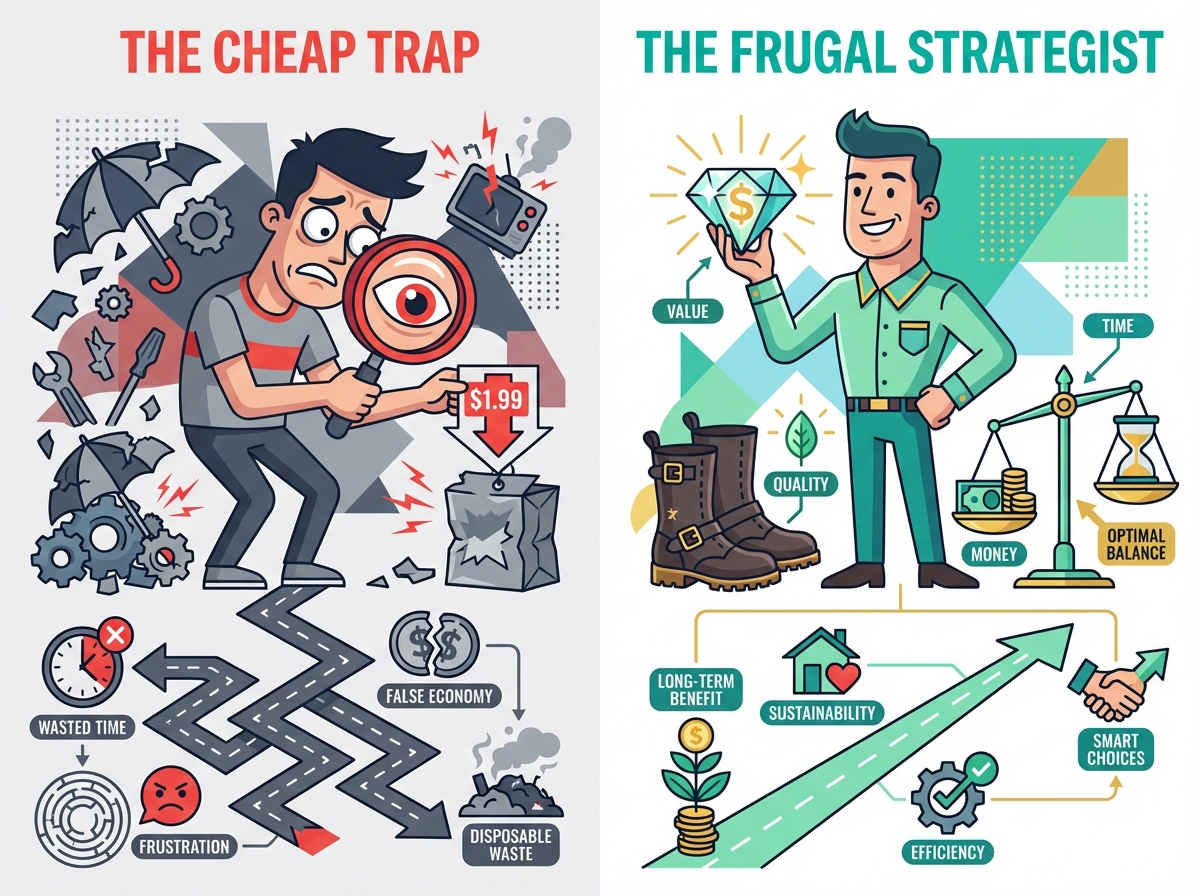
Discover the critical difference between frugal vs cheap. Learn Ramit Sethi's philosophy on conscious spending and how prioritizing value creates a Truly Rich Life.
In the world of personal finance, two words are often used interchangeably but represent diametrically opposite mindsets: frugal and cheap. While both involve saving money, the psychology driving them—and the results they produce—could not be more different.
Most traditional financial advice encourages a scarcity mindset: cut out lattes, reuse tea bags, and never pay full price. However, modern financial philosophies, particularly those popularized by thought leaders like Ramit Sethi (author of I Will Teach You to Be Rich), argue that this approach is a trap. It leads to a life that is smaller, not richer.
To build a "Rich Life"—one defined by your own values rather than societal expectations—you must understand the nuances of frugal vs. cheap. This article analyzes the research behind these financial behaviors and offers a roadmap for transitioning from a cost-obsessed mindset to a value-driven existence.
The fundamental difference between being cheap and being frugal comes down to one metric: what you are optimizing for.
Being cheap is about cost. A cheap person tries to get the lowest price on everything, regardless of the long-term consequences. This mindset is often driven by fear or a lack of understanding of value.
Example: A cheap person drives 20 minutes out of their way to save $0.05 per gallon on gas. They save $0.75 but waste 40 minutes of their time and wear down their vehicle. They value their money more than their time.
Being frugal is about value. A frugal person is highly selective. They prioritize their spending based on what brings them joy or utility and ruthlessly cut costs in areas that don't matter to them.
Example: A frugal person might buy generic brand paper towels (because they don't care about paper towels) but spend $300 on a high-quality pair of boots that will last ten years. They understand that quality often saves money in the long run.
> 💡 Stop Guessing, Start Strategizing > > Struggling to distinguish between expenses that add value and those that just drain your wallet? Our AI Mentors can help you analyze your spending habits against proven financial frameworks. > > Meet the AI mentors built from this research →
Ramit Sethi’s philosophy often highlights that being cheap is expensive. When you focus solely on the sticker price, you ignore the hidden costs of ownership, maintenance, and replacement.
Perhaps the most damaging aspect of cheapness is its social cost. Cheapness is often imposed on others.
Cheap people often value their time at $0/hour. They will spend hours searching for a coupon code to save $2 or DIY a complex plumbing repair to avoid paying a professional, only to cause more damage. A key component of a Rich Life is acknowledging that time is a finite resource, whereas money can be earned.
True frugality is not about deprivation; it is about allocation. This aligns with the concept of "Conscious Spending." This methodology suggests that you should not feel guilty about spending money. Instead, you should feel empowered by choosing exactly where that money goes.
"Spend extravagantly on the things you love, and cut costs mercilessly on the things you don't."
This simple sentence resolves the tension between saving and living. It gives you permission to buy the $5 latte or the business class flight, provided you have cut costs in areas you don't care about (like driving an older car or living in a smaller apartment).
To be successfully frugal, you must identify your "Money Dials." These are the areas where you naturally love to spend money. Common Money Dials include:
When you know your dial, you can turn it up. A cheap person tries to keep all dials at zero. A frugal person turns the "Travel" dial to 10 and turns the "Clothing" dial to 1.
Let’s look at specific scenarios to illustrate the difference between being cheap and being smart with money (frugal).
Moving from a cheap mindset to a frugal, abundance-based mindset requires a psychological shift. It involves unlearning the fear of spending.
Before making a purchase—or refusing to make one—ask yourself why. Are you buying the cheapest option because you genuinely don't care about the item? Or are you doing it because you are afraid to spend money?
Assign an hourly rate to your free time. If you value your leisure time at $50/hour, spending two hours to save $20 is a bad financial decision. You have essentially "paid" $100 to save $20.
Challenge yourself to spend slightly more in one category you love. If you love coffee, buy the best beans available for a week. Notice how it makes you feel. If it brings you joy, that is a valid place for your money. If not, cut it back.
Understanding the difference between being cheap and being frugal is intellectually easy, but applying it to your specific financial situation can be emotionally difficult. This is where GPTnius can assist.
GPTnius offers AI Mentors trained on proprietary research analyzing the published works, philosophies, and proven methodologies of thought leaders in personal finance and psychology. For example, our "The Architect" mentor draws from research on mental models and habit systems to help you restructure your approach to decision-making.
Here is how an AI Mentor can help you master Conscious Spending:
By engaging with an AI Mentor, you aren't just reading about financial theory; you are actively applying these principles to your bank account and your life.
> 💡 Design Your Rich Life Today > > Don't let a "cheap" mindset hold you back from the life you deserve. Use our AI Mentors to build a Conscious Spending Plan that prioritizes what you love. > > Meet the AI mentors built from this research →
Being cheap is a defensive crouch; it is an attempt to protect what little you have. Being frugal is an offensive strategy; it is a calculated effort to deploy your resources to get the maximum amount of happiness and utility from your life.
Ramit Sethi’s philosophy reminds us that we have the agency to define what being "rich" means. It doesn't necessarily mean having a yacht (unless that's your Money Dial). It means having the freedom to buy the appetizer, to upgrade the flight, or to invest in your health without guilt, because you have been smart enough to cut costs on the things that don't matter. Choose value over price, and you choose a richer life.
The main difference lies in the focus: cheap people focus on price, while frugal people focus on value. Cheapness prioritizes saving money at the expense of time, quality, or relationships, whereas frugality prioritizes spending on what matters most and cutting costs on what doesn't.
No. Frugality is not about hoarding money; it is about efficient allocation. Frugal individuals still spend money, but they direct it toward high-quality goods, services, and investments that align with their values, often supporting businesses that provide genuine value.
Start by identifying your 'Money Dials'—the things you love spending money on. Give yourself permission to spend in those areas while cutting back ruthlessly on things you don't care about. Also, begin calculating the value of your time to ensure you aren't wasting hours to save pennies.