Unlock the secrets of wealth creation. Learn how to apply Naval Ravikant's wealth principles, utilize leverage, and find your specific knowledge to get rich without luck.
Wealth creation is a reproducible skill, not a result of luck. To build sustainable wealth, you must stop renting out your time and start owning equity. The path involves identifying your "specific knowledge"—skills that feel like play to you but look like work to others—and applying leverage (capital, labor, code, or media) to scale your impact. By prioritizing judgment and accountability, you can play long-term games with long-term people.
---
If you believe that getting rich is primarily a function of luck, you have already lost the game. While luck plays a role in the timing or the specific magnitude of success, the process of creating wealth is a skill. It is a set of principles that, if followed, makes success deterministic rather than probabilistic.
This philosophy is most famously articulated by Naval Ravikant, the entrepreneur and philosopher-investor behind AngelList. His principles on wealth creation disassemble the traditional view of working hard for a salary and replace it with a framework of leverage, specific knowledge, and equity ownership.
In this guide, we will deconstruct how to get rich without getting lucky, analyzing the core components of modern wealth creation and how you can apply them to your career and life.
Before diving into the mechanics, we must define the terms. Most people chase money or status, thinking they are chasing wealth. They are distinct concepts.
The Goal: Ignore status games. They make you an angry, combative person. Focus entirely on wealth creation—a positive-sum game where everyone can win.
The most critical realization in wealth creation is the limitation of labor. If you are paid for your time (salary or hourly wage), your earning potential is capped by the number of hours in a day. You are linearly dependent on your input.
To get rich, you must own equity—a piece of a business. This provides the disconnect between your inputs (time/effort) and your outputs (financial reward). Equity allows you to benefit from the compounding growth of a company, market trends, and the efforts of others.
If you try to compete with everyone else, you will eventually be replaced by someone willing to do the work for less money. To escape competition, you must be authentic.
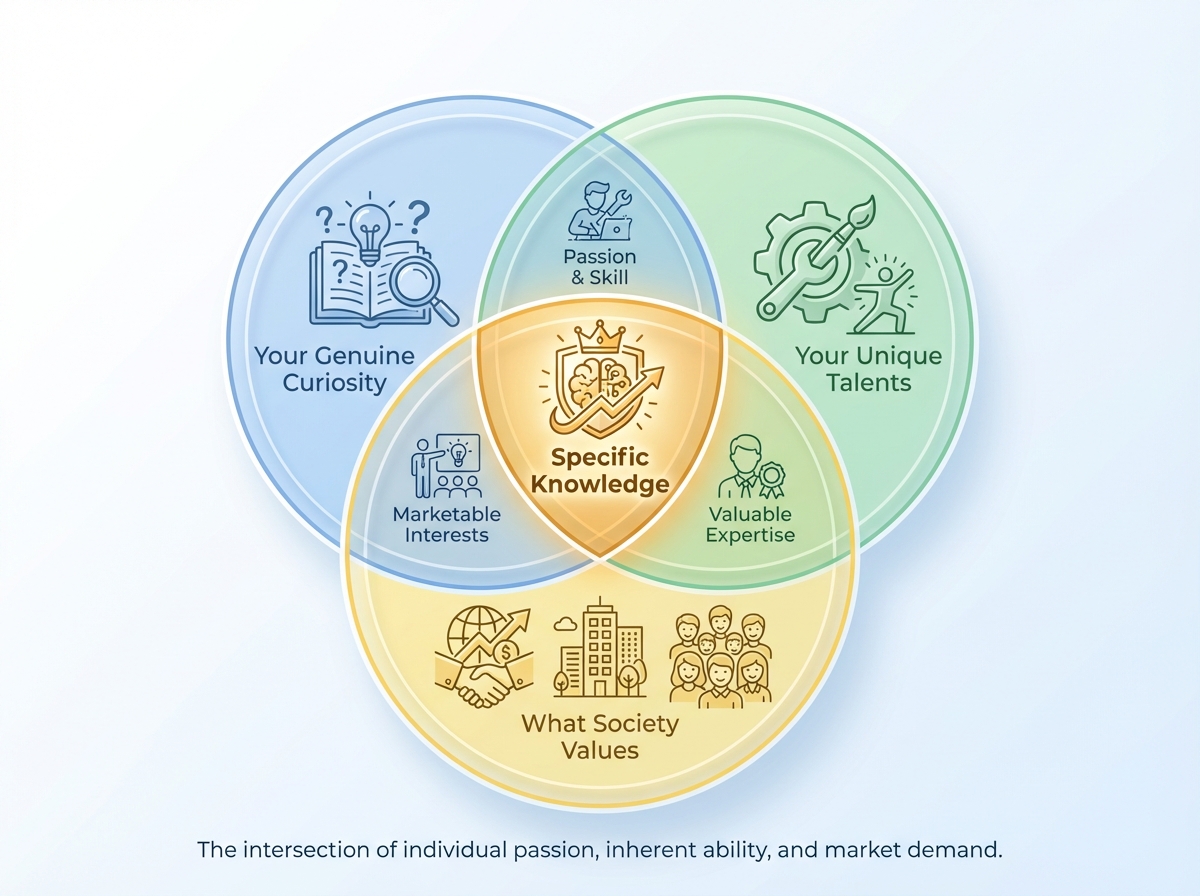
Naval argues that you should build wealth using Specific Knowledge. This is knowledge that cannot be trained. If society can train you, it can train someone else to replace you.
When you build a career on specific knowledge, you are not competing; you are simply being yourself. No one can compete with you on being you.
> 💡 Discover Your Specific Knowledge > > Struggling to identify what "feels like play" to you? GPTnius AI Mentors, trained on proprietary research regarding self-discovery frameworks, can help you audit your skills and uncover your unique value proposition. > > Meet the AI mentors built from this research →
Once you have identified your specific knowledge, you need leverage to apply it. Leverage is the force multiplier that turns your judgment and knowledge into massive output.
Archimedes said, "Give me a lever long enough and a fulcrum on which to place it, and I shall move the world." In the context of wealth, there are four types of leverage:
This is the oldest form of leverage: people working for you. If you have 10 people working for you, you have 10x the output.
This was the dominant form of leverage in the 20th century. It involves using money to make more money (factories, machinery, investing).
This is the leverage of the new rich. It includes software, algorithms, and automated systems. If you write code, it works for you 24/7 without complaining.
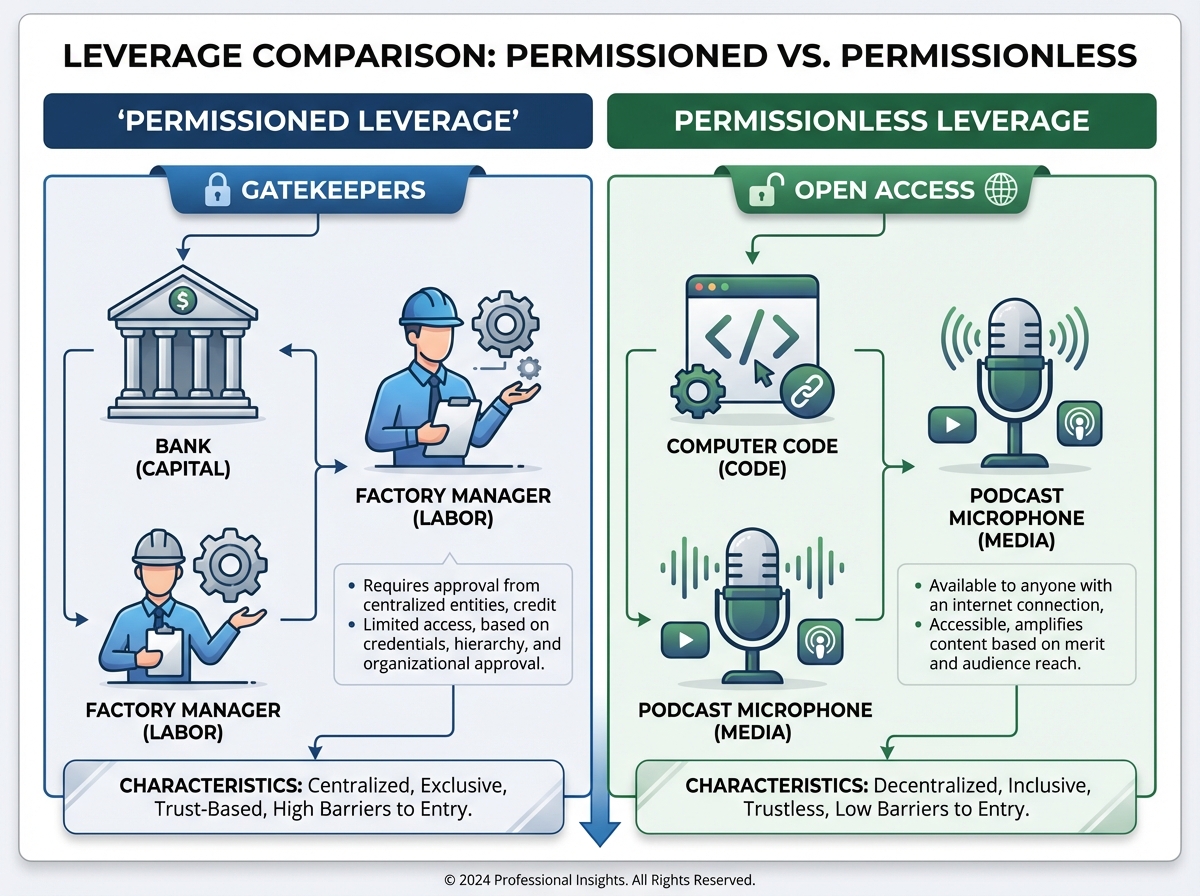
This includes content creation: blogs, videos, podcasts, and books. Like code, it is permissionless and has zero marginal cost of reproduction.
The most significant shift in the modern economy is the move toward Permissionless Leverage (Code and Media).
In the past, to get leverage, you had to ask a bank for a loan (Capital) or hire employees (Labor). Today, you can record a podcast or write a script that reaches millions of people without asking anyone for permission. This democratizes wealth creation for those willing to learn the skills.
If you have massive leverage (e.g., you are managing a billion dollars or running a platform with million users), your decisions have massive consequences. This brings us to Judgment.
In an age of infinite leverage, judgment is the most decisive skill. A single decision made by a CEO can create or destroy billions in value. Therefore, society pays highly for good judgment.
Through Accountability. You must take risks under your own name. When you attach your name to your work:
People who own their names and their risks get paid exponentially more than those who hide behind a corporation.
None of this happens overnight. Naval emphasizes that "All the returns in life, whether in wealth, relationships, or knowledge, come from compound interest."
Getting rich without getting lucky is a slow process of figuring out who you are, building specific knowledge, and applying leverage over a decade or more.
Understanding these principles is the first step; applying them to your unique situation is where the challenge lies. This is where GPTnius can accelerate your journey.
GPTnius offers AI Mentors trained on proprietary research analyzing the published works, philosophies, and proven methodologies of thought leaders, including thinkers like Naval Ravikant. Our mentors do not impersonate anyone. They synthesize researched frameworks, such as wealth-creation principles and the four forms of leverage, into personalized coaching conversations built around your specific goals.
Here is how you can use GPTnius to apply these concepts:
These AI Mentors synthesize researched frameworks to provide personalized coaching conversations, allowing you to turn abstract philosophy into a concrete action plan.
> 💡 Build Your Wealth Roadmap > > Don't leave your financial future to chance. Use GPTnius to apply proven wealth frameworks and build a strategy based on leverage and ownership. > > Meet the AI mentors built from this research →
Getting rich without luck is about positioning yourself where the probabilities are in your favor. It requires you to stop renting your time and start building equity. It demands that you find the intersection of what you are good at and what the market needs, and then apply massive leverage to scale it.
By cultivating specific knowledge, utilizing permissionless leverage like code and media, and taking accountability for your judgment, you make success inevitable over a long enough timeline.
Specific knowledge is a skill set that cannot be easily trained or taught in a classroom. It is often found at the intersection of your genuine curiosity and your unique talents. It feels like play to you but looks like work to others, making it your greatest competitive advantage.
The four types of leverage are Labor (people working for you), Capital (money working for you), Code (software working for you), and Media (content working for you). Code and Media are considered 'permissionless leverage' because they do not require gatekeepers.
Renting your time (working for a salary) limits your earning potential to the number of hours you can work. To build significant wealth, you need to disconnect your inputs from your outputs by owning equity or assets that compound and earn while you sleep.